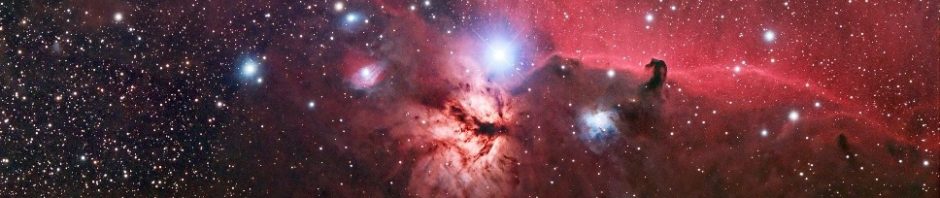
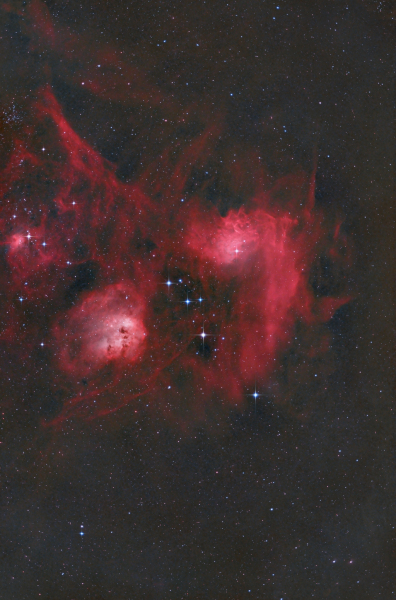
Archive for the “Hyperstar and SXVF-M25C” CategoryImages taken with the new Hyperstar lens and the SXVF-M25C camera. The Hyperstar III is so fast that all other amateur imaging systems are extremely slow and have very disappointing performance in comparison – and that includes the mini-WASP array as currently configured.
May
23
2013
Still learning how to use the Hyperstar IIIPosted by Greg Parker in Hyperstar and SXVF-M25CBit embarrassed to say that I am still learning how to use the Hyperstar III. Rather humbling when I thought I knew all there was to know about getting the best out of the Hyperstar. I had done a few camera swaps on the HSIII and I was having difficulty getting good stars across the whole of the M25C, something I had not had a problem with before. Now here is where I was going wrong. I thought that I could have the M25C adjusters set so that the face plate was perpendicular to the camera body (this means the chip would almost certainly not be flat to the optical axis) and that I could sort out all the chip flatness/collimation with the Hyperstar III adjusters alone. THIS IS WRONG!! I slowly caught on that I was not going to get good stars across the chip using the HSIII adjusters alone after spending around 3 hours playing about chasing my own tail – it was clear that the HSIII adjustments were not enough – YOU NEED THE CAMERA TO BE FLAT TO THE OPTICAL AXIS BEFORE IT GOES ONTO THE HYPERSTAR III. Oh well – live and learn. So I used Terry Platt’s method as given on his website to flatten the M25C APS-size chip to the optical axis, and I put the camera back on the Hyperstar III last night. I ran the FocusMax autofocuser on Sulafat (Lyra) and the first 20-second sub looked pretty good without touching the Hyperstar collimation adjusters. A CCDInspector look at the sub gave me the magic x = 0, y = 0 for the chip flatness (can’t do much better than that), and it gave me 2.7″ for the collimation. I have never seen a set of CCDInspector numbers this good before for the Hyperstar III/M25C combo. Hopefully I’ll be turning out some interesting Hyperstar images once again in the not too far distant
Mar
29
2013
The Coathanger ClusterPosted by Greg Parker in Hyperstar and SXVF-M25C, mini-WASP Array
Jan
27
2013
Globular cluster M56 lost in a Milky Way backgroundPosted by Greg Parker in Hyperstar and SXVF-M25C
Oct
21
2012
Hyperstar III and mini-WASP array images from the same night.Posted by Greg Parker in Hyperstar and SXVF-M25C, mini-WASP Array
The same night I got the California nebula data with the mini-WASP array, I also got some earlier Double Cluster data with the array, and, some M33 deep data with the Hyperstar III. The Hyperstar was using 20-minute subs for the M33 image – that’s deep!! That’s the equivalent of 1 hour and 40-minute subs with the Sky 90 or 3 hours and 20-minute subs with the TS 80s. Noel processed this deep M33 image just last night and will add it to our earlier efforts on this one. The Double Cluster image is the lower half of a 2-frame mosaic. The upper frame will make Stock 2 the subject and hopefully I will provide Noel with enough frame overlap to be able to bolt the two images together. As you can see – stars – lots of stars
Nice clear night (so far) tonight and I have both the mini-WASP array and the Hyperstar III grabbing data. Took one of two frames with the mini-WASP and then moved onto the California nebula for some half-hour subs (that’ll be interesting) - the Hyperstar is taking 20-minute subs of M33
Aug
28
2012
Hyperstar reunited with the M25CPosted by Greg Parker in Hyperstar and SXVF-M25C, mini-WASP Array, NewsI have returned the faithful old M25C to the Hyperstar and taken the new M26C into the mini-WASP observatory (North dome) awaiting the arrival of the TS 80mm triplet APO. Expect rain and cloud for at least the next 6 months. Spica Star name: Spica Other names: Alpha Virginis, Azimech, Alaraph, Dana Constellation: Virgo Other ID: 67 Virginis, HR5056, HD116658, SAO157923, HIP65474 Magnitude: +1.04 Absolute magnitude: -3.55 Luminosity, Sun = 1: 12,100 R.A. 2000: 13hr 25min 11.5793sec Dec 2000: -11deg 09min 40.759sec Spectral type: B1 III-IV/B2 V (Beta Cephei type variable, rotating ellipsoid) B – V colour index -0.24 Temperature: 22.400 K Mass, solar masses: 10.25 +/- 0.68 Radius, solar radii: 7.4 +/- 0.57 Distance in light-years: 260 +/- 20
Spica is the brightest very blue star in the night sky, the brightest star in Virgo, and the 15th brightest star in the whole (north and south) sky. Spica is a close binary with an orbital period of about 4 days. Spica is a Beta Cephei type variable which has a brightness variability over a 0.1738 day period, in addition, due to the presence of its companion star, Spica is also a rotating ellipsoidal variable leading to an apparent magnitude change of 0.03 over the binary orbital period. Note that this is not an eclipsing binary, but an effect of gravitational distortion due to the close companion star. As Spica is close to the ecliptic it can be occulted by the Moon and sometimes by the planets as well. From my 51 degree north location Spica can be seen close to my southern horizon during the spring. In 2012 as Spica crossed my southern horizon it was accompanied by Saturn which travelled almost directly above it creating a nice photo-opportunity for a wide field setup.
|


Entries (RSS)