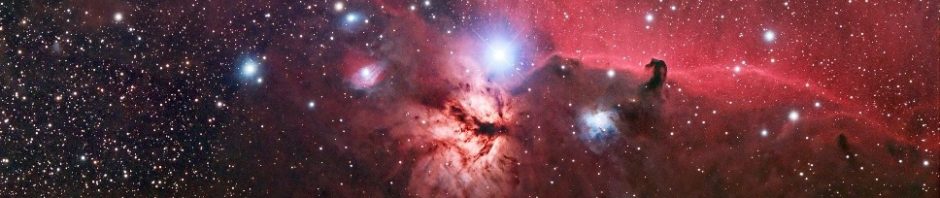
A most fantastic evening’s imaging last night – 5 and a half hours of data on two objects. The first was in Monoceros (next door to Orion) where I captured this fascinating, and very busy region around IC 2169. We have emission, dark and reflection nebulosity here all vying for attention. This was 16 subs at 10-minutes per sub with the Hyperstar III added (using Registar) to some earlier data taken in the same region. Last night the camera was in portrait mode whereas for the earlier data it was in landscape mode, hence the almost square result in this image (the overlap of the two).
No Comments »
Very nice globular cluster M3 in the constellation Canes Venatici. Taken with the Hyperstar III data from 22nd April 2009, 61 subs at 60-seconds per sub. I see that I left out a processing step in the cluster below so I’m now going to have to go back and redo that one before moving on
No Comments »
I like clusters (open or globular) with a Milky Way background – and here’s one in the constellation Lyra – Messier 56. O.K. so it’s not much of a globular to look at, but the Milky Way background certainly brightens things up. What’s also interesting is that there are a couple of background galaxies too! Don’t expect to see galaxies through the Milky Way – but they are there. Hyperstar III image from 3rd July 2010, 23 subs at 200 seconds per sub.
No Comments »
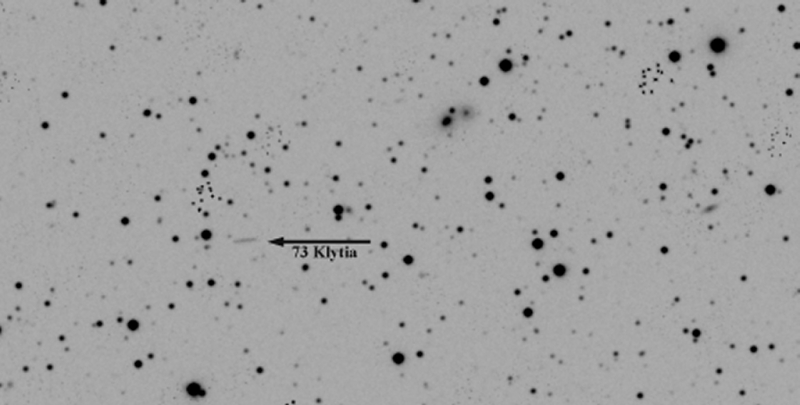
In order to see all the galaxies and the asteroids more easily – here’s the image below in negative B&W
Enjoy!
No Comments »
A slightly more careful processing of the earlier data. At least 4 asteroids in there and North is to the right
No Comments »
This is Hyperstar III data from 23rd May 2009 and consists of 64 subs at 80-seconds per sub.
No Comments »
Data from 21st September 2009 just processed. 57 subs at 2-minutes per sub.
No Comments »
This is a 4-framer mosaic from the Hyperstar III taken on 31st December 2008. Each frame was 1 hour exposure time using 40 x 90-second subs at f#2 on an 11″ Celestron SCT.
No Comments »
This is a Hyperstar III 4-framer of the Caph region in Cassiopeia. Each frame is a 1-hour exposure (40 x 90-seconds) at f#2. I had no idea there was so much dust in the region, this area is in the Milky Way, yet you can see vast areas where the stars seem to be missing due to the intervening dust clouds. Also in this image are vdB1 and HH161 at around the 7 O’clock position from Caph (thank you Anna for identifying these for me) and towards the middle/left is dwarf irregular galaxy IC10. Top right there is a piece of emission nebula that I have just caught – not sure what this one is yet either. Plenty going on in this 4.26 x 2.80 degree image
No Comments »