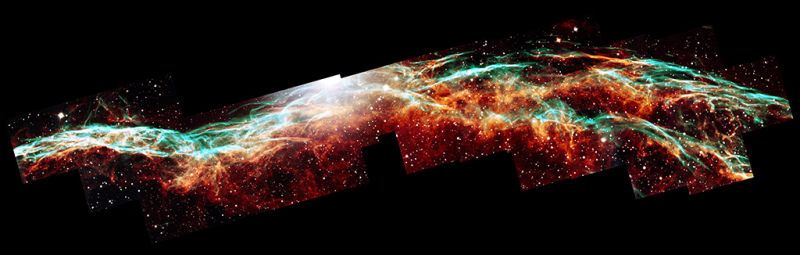
Back to astronomy this week with an image of the Witch’s Broom nebula in Cygnus. This is not my data but data given to me by a lecturer at Brockenhurst College. He got professional narrowband data – Ha Hb and O3 – from a Tenerife observatory and I assigned Ha to red, O3 to green and Hb to blue to get this image. Hb data is not usually taken professionally as it offers no more useful information than the Ha channel.
Pages
Categories
- Macrophotography
- Carbon Stars
- Picture of the Week
- High-Speed Photography
- Photomicroscopy
- Talks and Presentations
- Micro-Dragonfly Array
- Photographic courses
- Hyperstar III and SXVF-M26C
- Canon 200mm prime lens
- Astronomy Image of the Day
- Hyperstar III and Trius SX-814C
- Uncategorized
- Exhibitions
- CCD Images
- Published Work
- Site News
- Writing
- News
- Creating mosaics
- Star Vistas
- House and home
Visitors
Tags
Dr. Parker, would it be possible to hear how difficult it is to recreate your 6 month solar
Photo in the 12/2015 issue Discover magazine? Id love to do it in my back yard with a mountain backdrop. I will consult AI. Is it hard to get your fabulous?
I am a retired MD is slc ut and I congratulate you on your uninterrupted contributions.
Hi Gary – It is not at all difficult provided you can get some photographic paper. I use Ilford MGIV Multigrade IV RC DE LUXE paper 8″ x 10″ or 20.3 x 25.4 cm if you are going to use a beer can for the pinhole camera then you will need either smaller photographic paper or simply cut out from a larger piece. I do not like to use cans for the camera as the repeated heating and cooling gives you condensation inside the can which ultimately leads to a puddle of water in the bottom of the camera which will damage the photographic paper. I use a 4″ diameter plastic drain pipe for the camera, and the black waterproof end blanks that go with the drainpipe are perfect for making light-tight waterproof ends to the camera. As I was not sure the pipe itself was completely light tight, I wrapped and glued a couple of layers of Aluminium foil around the pipe. You now have to make the pinhole. To do this I drilled a 1″ diameter hole into the centre of the pipe. The pinhole itself was a pinhole made into a circular piece of aluminium cut out from a beer can slightly bigger than 1″ in diameter. I then Araldited the pinhole over the hole in the camera. The final thing to do is mount the camera. I built a wooden housing to take the camera that I could fix to the wall of the house. There are just two things you must ensure. Clearly the camera must not move AT ALL over 6 months no matter what the weather chucks at it. Secondly you need to tilt the camera upwards by about 30 degrees or so if you want to get the top of the Sun’s path (Summer Solstice) on the paper. If you have the camera fixed pointing out parallel to the ground, the top of the Solagraph will get chopped off. That’s about it. Good luck!