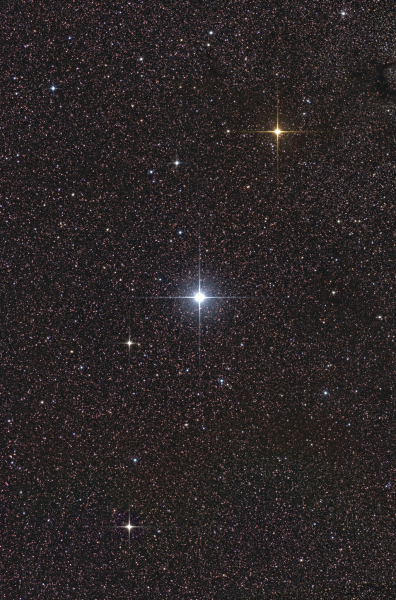
A bit late this year for the first outing of the season, but managed it in the end. This is the first image from the Canon 200mm prime lens array to use all 3 lenses at the same time. So I am now in the very happy position of getting down 3 hours worth of data for just one hour of imaging time. All 3 lenses are fitted with the superb ASI 2600MC Pro CMOS cameras, and last night I ran them at -5C. I chose Altair as it had just passed the Meridian when I started to set up at around 8:00 p.m. The central star is Altair, the top right bright orange star is Tarazed, with a tiny bit of Barnard’s “E” (dark nebula) off on the right, and the star bottom left is Alshain. As you can see, this part of Aquila lies in a star dense region of the Milky Way. This is a total of 18 10-minute subs, so 3 hours of data, but only one of of imaging time. Camera 3 (one of the 200mm lenses) is a bit out in alignment (Cameras 4 & 5 are fine) so I might need to spend a bit more time tuning that one in. I was amazed that all the hardware seemed to work OK considering I hadn’t touched anything since May – which is very naughty of me. Already planning the next object which I would like to be M31 with 15-minute subs and as many hours as I can get on it. I want this to be the definitive M31 from the New Forest Observatory and I would like 2026 to be the year it happens. Fingers crossed.
