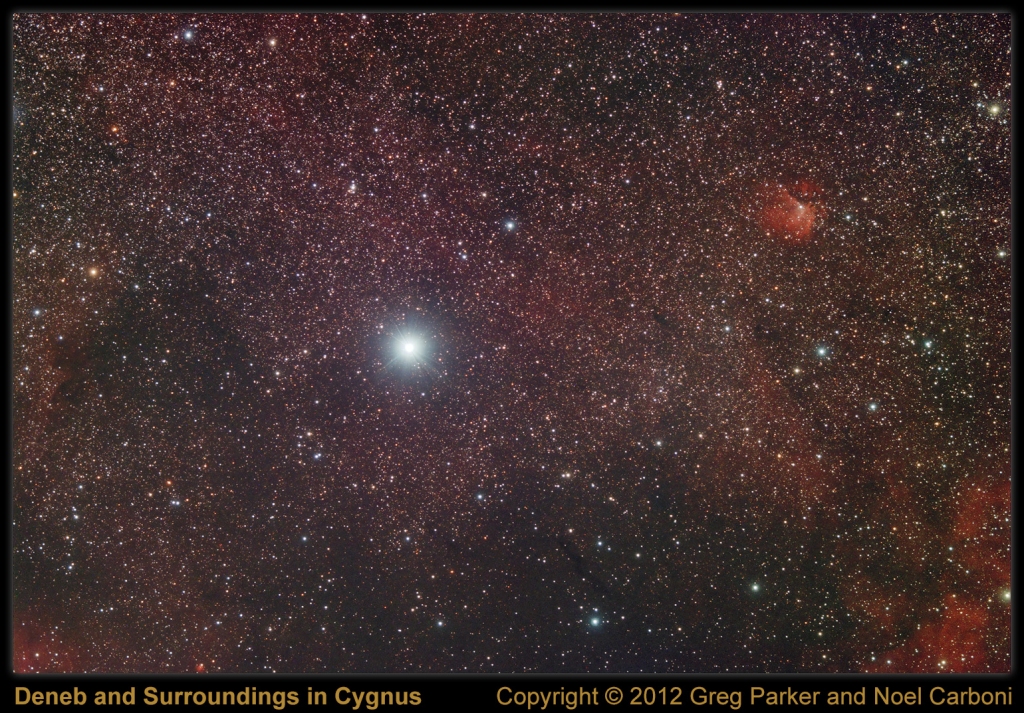
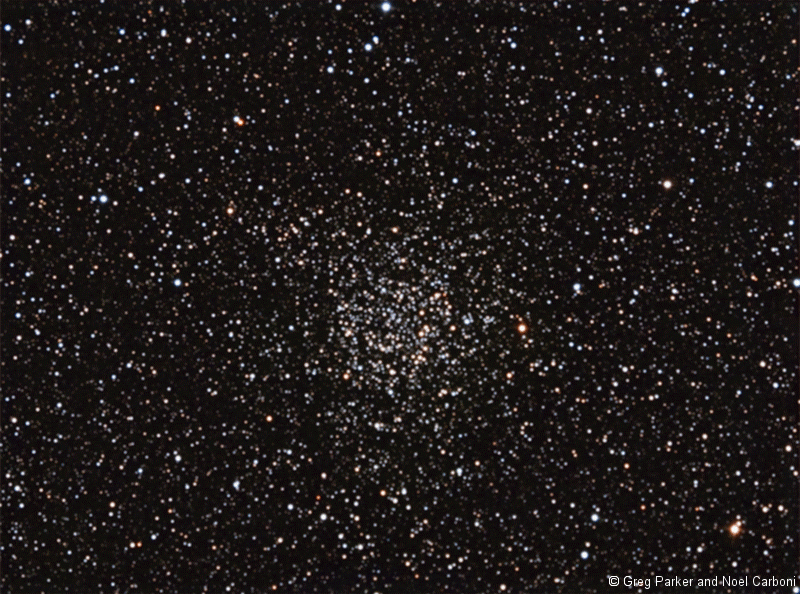
Deneb region – mini-WASP camera 2

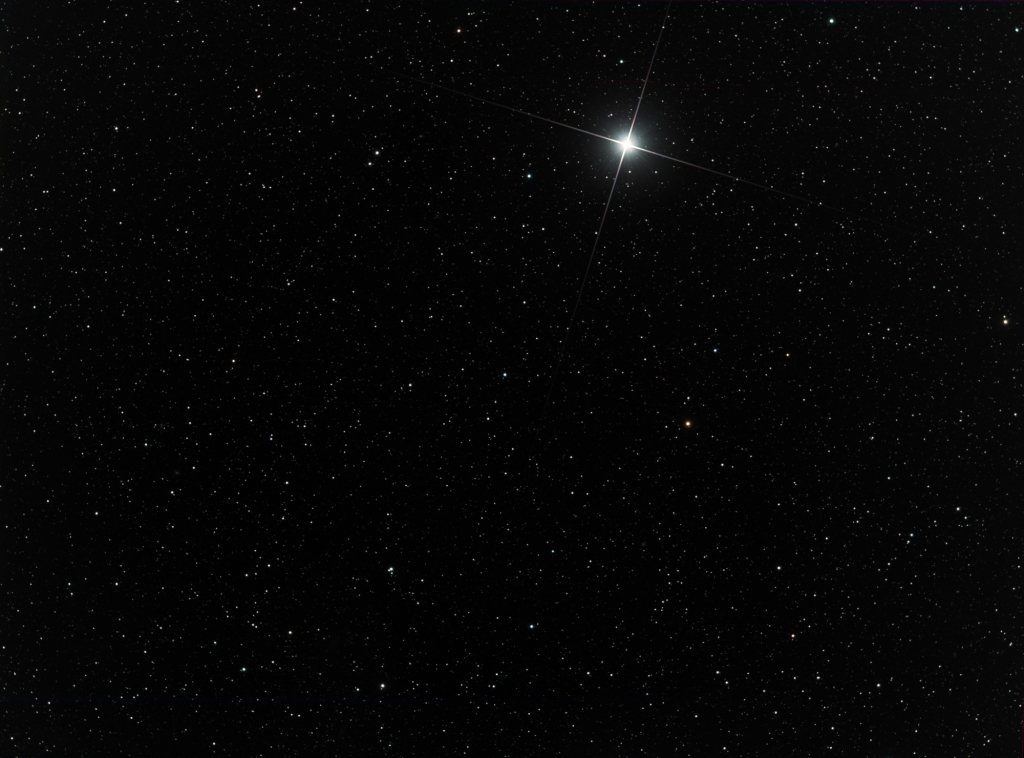
To see if the polar alignment was up to it I took 3 x half hour subs of the Deneb region with mini-WASP camera 2 – looks like the polar alignment is good enough (but I need to tweak it more I know).  As these were only test shots amounting to one and a half hours total exposure I wasn’t expecting much from the data.  But Noel Carboni pulled out all the stops on this one and produced what is a pretty decent image given the lack of data.  Now if only I taken 8-hours worth of data 🙂


Posted in Sky 90 and SXVF-M26C | Leave a comment

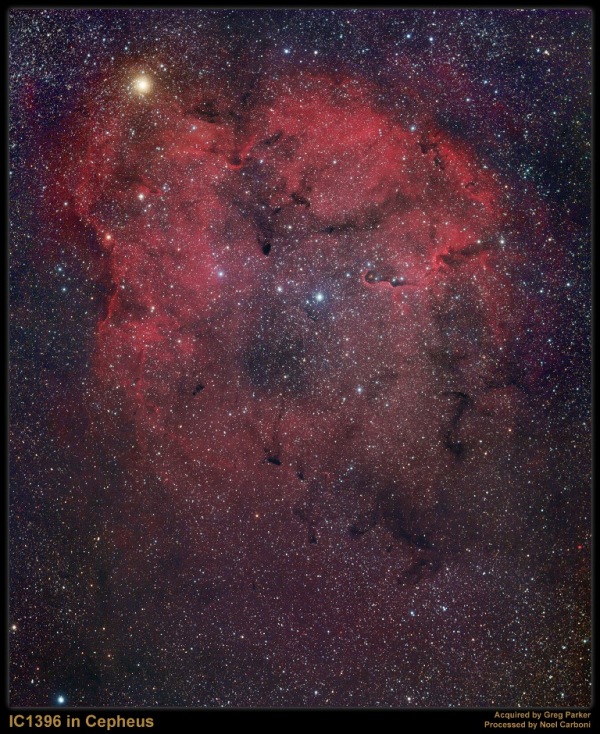
Image of the Month – June 2012 – IC1396 and the Garnet Star in Cepheus

Here is the first in the new series of Images for the Month 🙂  I will not be showing an Imaging Object for the Month but will replace that post with an amateur’s deep-sky image.  The first Image of the Month is this mammoth work from the Parker-Carboni stable and the second greatest amount of imaging time spent on any one object by me so far.  It is of course the massive emission nebula IC1396 in the constellation Cepheus, featuring the famous Elephant’s Trunk nebula and the equally famous Garnet star.

What makes this image such a massive undertaking?  Well for a start this nebula is BIG and it required a 2-frame mosaic even with the massive field of 3.33 x 2.22 degrees from the Sky 90/M25C combo.  Then – in addition to the need for two frames – there was a substantial RGB exposure time for each frame with the one-shot colour camera as IC1396 is a pretty weak emitter.  Finally – the emission was so weak that the RGB image alone was pretty unimpressive and I needed to grab some narrowband data as well.  So both frames also include substantial amounts of H-alpha narrowband data.  Sum total over 20 hours of exposure time on this one and a similar amout of image processing time putting the whole thing together from Noel Carboni.

At the time of finishing this one off I said “never again” – but I have found new strength with the arrival of the mini-WASP array at the New Forest Observatory (which can at least grab the two frames in one go) and of course it has a filter-wheel for each camera with two-inch H-alpha, H-beta, OIII and SII filters fitted.  So I can see a return to IC1396 in 2012 in order to grab a LOT more narrowband data to add to the existing RGB/narrowband template.  Should be fun 🙂


Posted in IOM | Leave a comment

A new CCD images category – Sky 90 and M26C images

Now that the mini-WASP array is beginning to turn out some images (even if it is only one scope/camera at a time) I have created a new section under CCD images – namely Sky 90 and M26C.  Hopefully, before too long, there will also be another category – Hyperstar III and M26C – once the amazing 10-Megapixel one-shot colour CCD is delivered by Starlight Xpress 🙂


Posted in Sky 90 and SXVF-M26C | Leave a comment

Vega – mini-WASP test shot

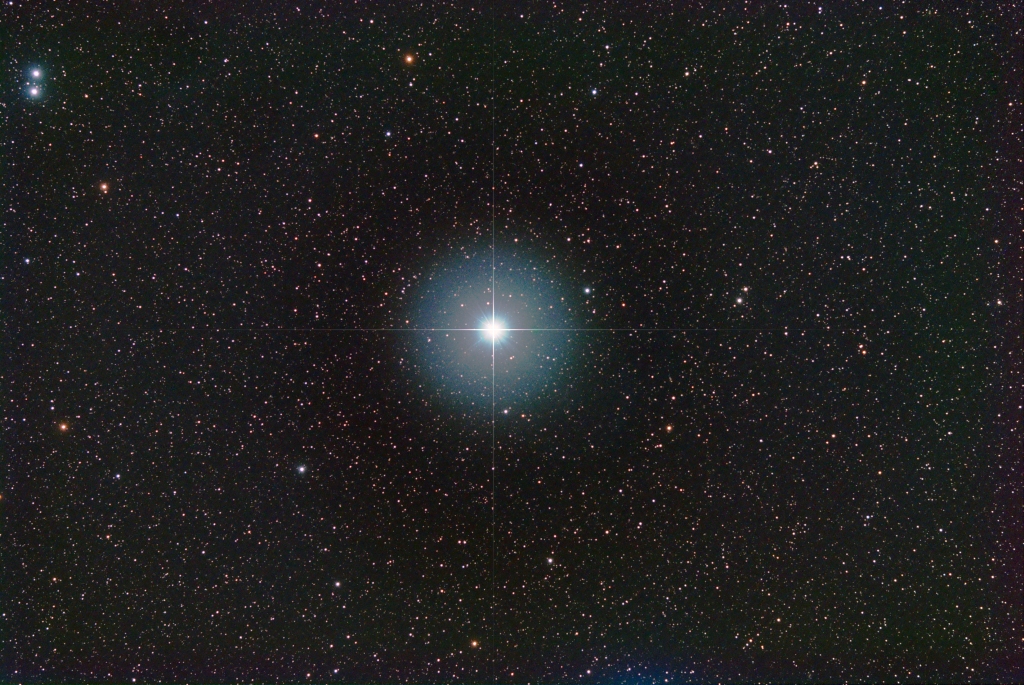
While I was collimating camera 1 to scope 1 I took some 3-minute subs of Vega using the well-tuned camera 2 and scope 2.  This is literally a 2-second process of the data just to see what I had taken whilst passing the time.  No dither, poor flattening, you name it, it’s there – but the stars ain’t bad from corner to corner 🙂

Posted in mini-WASP Array | Leave a comment

Re-collimation of second imaging Sky 90 successful :)

Much to my great relief my attempt to re-collimate the second Sky 90 (which had somehow lost its good collimation) was successful.  And on top of that we had clear skies last night for me to test the imaging results and to start the next laborious task of flattening the CCD chip to the scope optics.  During the chip flattening process for which I use the totally invaluable CCDInspector – I actually hit the magic 0.0″ collimation on the re-collimated scope.  Unbelievable!!  I have never before seen the magic 0.0″ collimation using CCDInspector on a Sky 90 before.  So for the moment at least, things seem to be moving in the right direction 🙂

The next major tuning jobs to undertake are to get both M26C cameras as flat and as well-collimated as possible – then it’s over to some serious deep-sky imaging with the mini-WASP array in mosaic mode – probably by then in the Cygnus region imaging all those H-alpha goodies.  4 x 3.33 degrees field of view at 3 arc seconds per pixel of yummy goodness 🙂 🙂


Posted in mini-WASP Array | Leave a comment

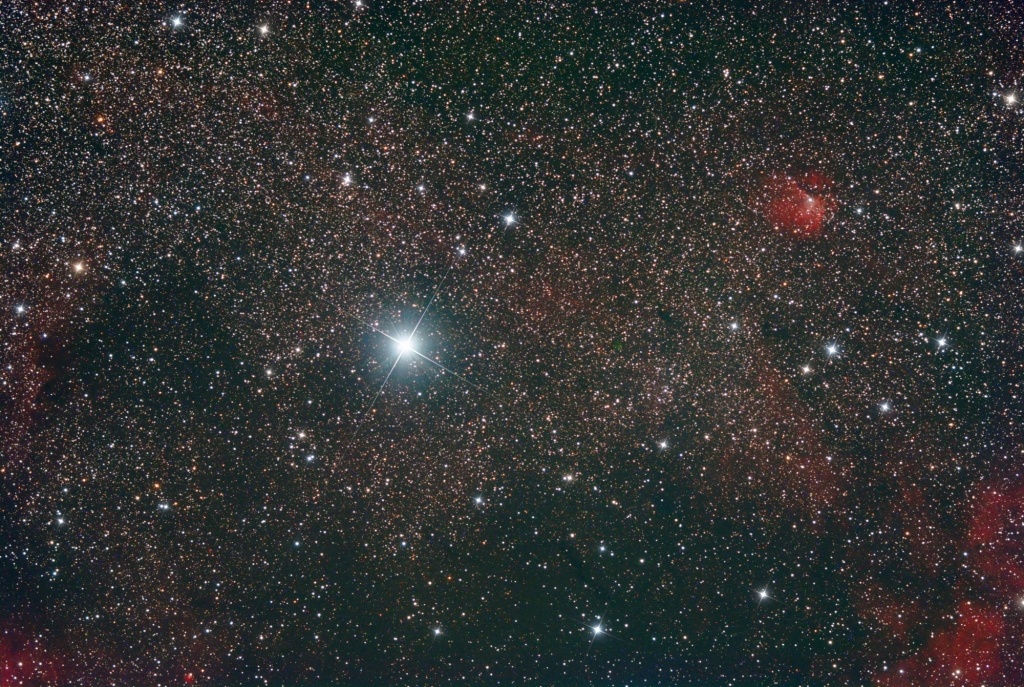
Deneb region using one scope and camera on the mini-WASP array

Only 3 half-hour subs but I am extremely pleased with the result!!  No dither so full of hot pixels, but good quality stars corner to corner on an APS sized chip – the Sky 90 CAN deliver the goods, but only IF you have almost spot-on collimation.  If the collimation is even a tad out then you will get coma in the corners of an APS size chip (e.g. M25C or M26C).


Posted in mini-WASP Array | Leave a comment

Statrep mini-WASP array

You will have seen the recent M57 image from one of the mini-WASP cameras and last night I took 3 x 30-minute subs of the Deneb region with the same camera just to check I could manage 30-minute subs with the polar alignment at the present level – answer, I could 🙂

But wasn’t the mini-WASP actually producing first-light images from both scopes and cameras something like 8-months ago?  Yes it was, but I soon put things back in one quick (and stupid) moment.  My original Sky 90 camera had always shown coma like stars in at least one corner, like an idiot I saw that one of the collimation screws was screwed “right in” so I loosened it off thinking this might be the problem – it was of course the start of all my problems – I chucked out what reasonable collimation I had with this scope.  Very annoying, but I still had the other Sky 90 that I had bought from an Irish astronomer and the collimation of this one was spot on, great stars corner to corner on an APS size chip and a field of view of 3.33 x 2.22 degrees – what more could I want.  So I did a fair bit of one camera imaging using the one good scope until I could find a way to collimate the other Sky 90.

Steve Richards was very helpful in suggesting an “artificial star” to help me do this, but my eyesight is so poor (even with glasses) that I couldn’t really make a go of it.  Then Nick Hudson of True-Technology told me of the Takahashi collimator a “beefed-up” Cheshire and I bought one thinking this was the answer to all my problems.  So I brought the scope indoors put the collimator on and started fiddling with the collimation screws.  Oh dear – I had brought in the “good” Sky 90 and now I’d thrown away the collimation on this “perfect” scope as well.  So at this point I had no imaging Sky 90s.  I also didn’t rate the Takahashi collimator too highly either as when it showed good collimation the collimation was still not good enough for quality imaging.  For the moment I was stuffed.

An earlier attempt at collimation involved focusing on a bright star and using a video camera with MetaGuide to get the star looking good on the camera (the software provides and intensity profile of the star so you can easily see if the collimation is any good or not).  Problem with this method is the limited time you have to get the collimation sorted and the fact of course that the star is always on the move making the process a bit inconvenient (yes I suppose I could use Polaris but then this sticks the mount in an awkward position) – and also the “seeing” which is always lousy when you want to collimate (let alone image).  Stuffed again.

Several weeks later, as I am very slow, it came to me how to collimate the Sky 90s.  Use the video camera and MetaGuide but instead of using a real star, use the artificial star.  Now I had a complete system under very well-controlled conditions!  Surprisingly this method works extremely well and I re-collimated my original Sky 90 to a state better than it was in previously, this is the scope I imaged M57 with as well as Deneb.  Very happy.

Unfortunately the Irish scope didn’t appear too well collimated when I imaged the same Deneb and M57 regions as the other scope.  Very odd.  So I brought that Sky 90 in today to have a look and “fortunately” (I use the word loosely) it had somehow lost collimation – I am really glad that it hadn’t maintained what I thought was good collimation and simply didn’t work or I’d have really been stumped.  So I have just re-collimated the Irish Sky 90 AGAIN (another 4-hours down the pan) and gave the lens cell a few taps with the knuckles just to make sure things didn’t move around before re-fitting the scope to the array framework.

So that’s why this has been such a long drawn out affair with results only ever from one camera.  There was another hiccup along the way of course, I had to put in a pier height extender so that meant a complete redo of the polar alignment as well (which Tom How had managed to get absolutely spot on for me last year).

Dare I say I am very slowly iterating to the point where I will be able to image with 2 scopes and 2 cameras in parallel?  I dunno, we’ll soon see next clear night when I can image and see if the Irish scope has kept collimation.  If it has, then we’re off on a pretty exciting journey of 4 x 3.33 degree field of view imaging at 3 arc seconds per pixel resolution, plus narrowband 🙂  It’s been a long, long wait!!
Posted in mini-WASP Array | Leave a comment

M92 in Hercules, Hyperstar III image 11 x 20-minute subs

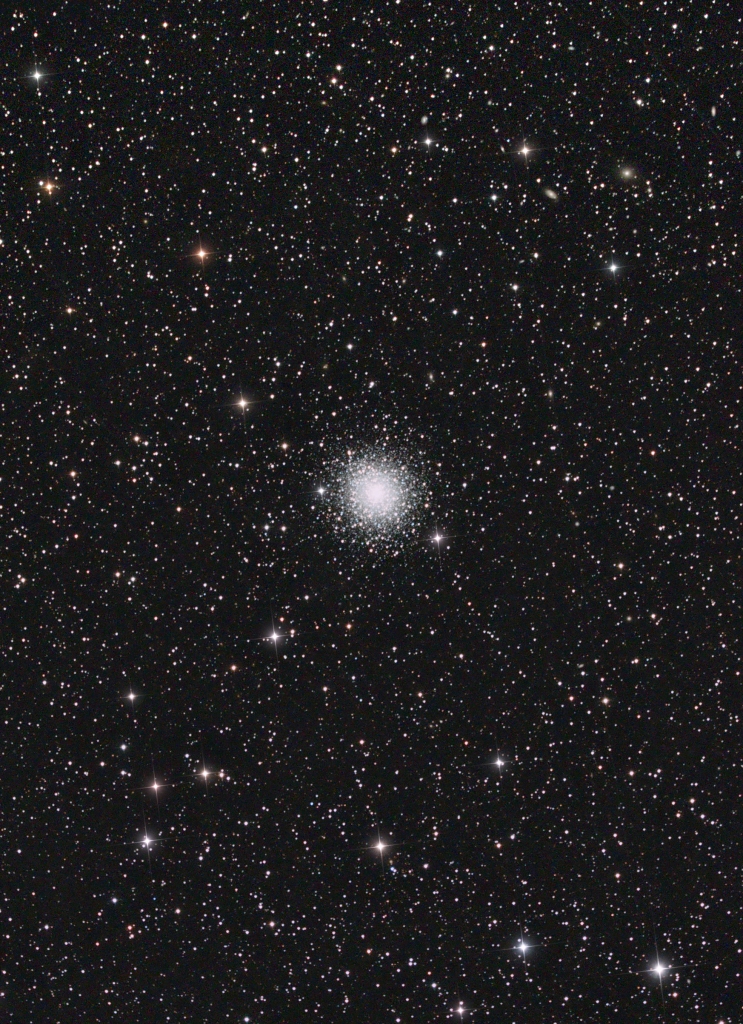
Taken in parallel with the M57 data, here is an image of the globular cluster M92 in Hercules, less well known than its M13 neighbour, but every bit as impressive.  11 sub-exposures at 10-minutes per sub in order to get some depth in this one.

Posted in Hyperstar and SXVF-M25C | Leave a comment

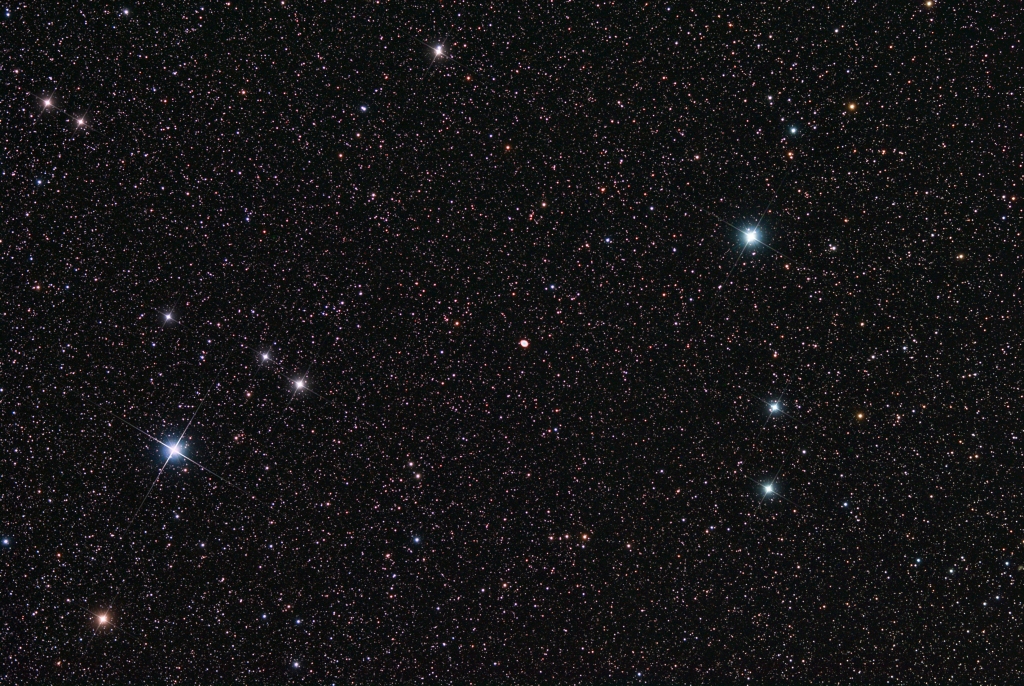
M57 region camera 2 mini-WASP array 26/05/2012

This is the result of 7 x 20-minute subs with camera 2 on the mini-WASP array, camera 1 needs some fine collimation/chip flatness tweaking, camera 2 on the other hand is almost spot on!!  Reason for 20-minute subs was to check the tracking which seems to be able to cope.  Need to tweak the polar alignment just a little as well.  Very slowly getting there 🙂


Posted in mini-WASP Array | Leave a comment

The New Forest Observatory control room

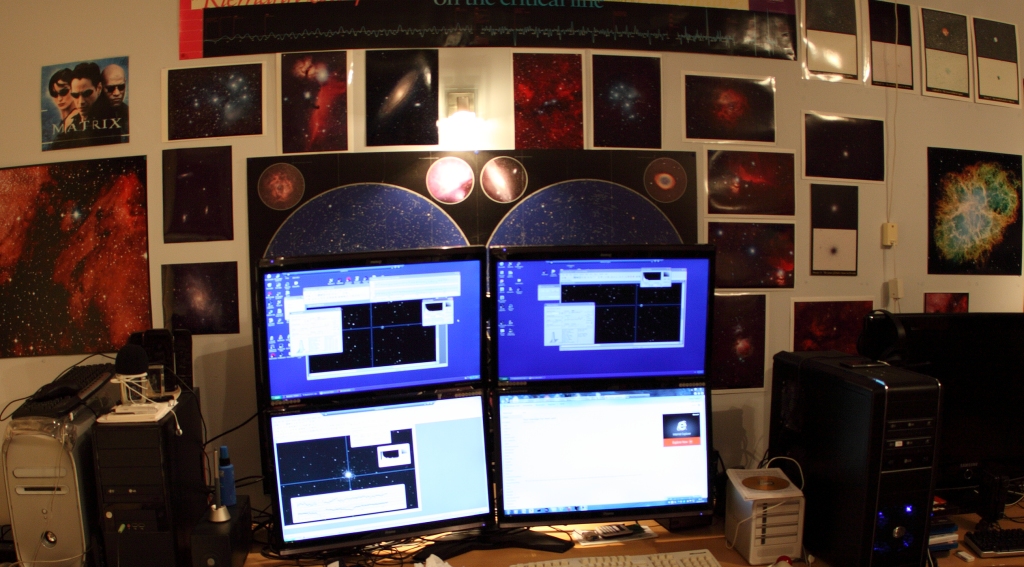
Last night was the most amazing beautiful clear night – and the Moon wasn’t too intrusive either (which is unusual on a clear night).  After a little extra “tuning” I set the two mini-WASP cameras off imaging a region around M57 in Lyra and I set the Hyperstar III off taking long subs on M92.  The data from all 3 cameras was shipped up to the monitors in the study so I could see what was going on outside whilst listening to CDs in the comfort of my chair indoors.  Top left screen is camera 1 on the mini-WASP, top right screen is canera 2 on the mini-WASP, bottom left screen is the Hyperstar III, and bottom right screen is the Internet.  It really doesn’t get any better than this 🙂 🙂 🙂


Posted in Hyperstar and SXVF-M25C, mini-WASP Array, Projects, Sky 90 and SXVF-M25C | Leave a comment