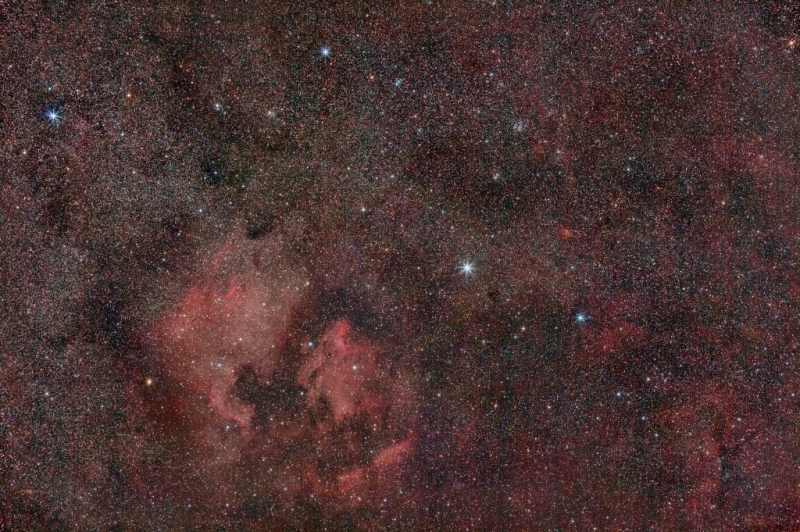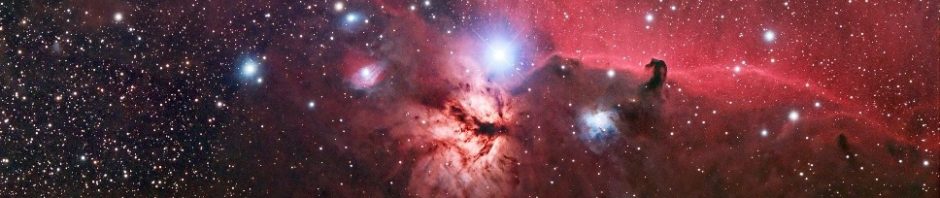
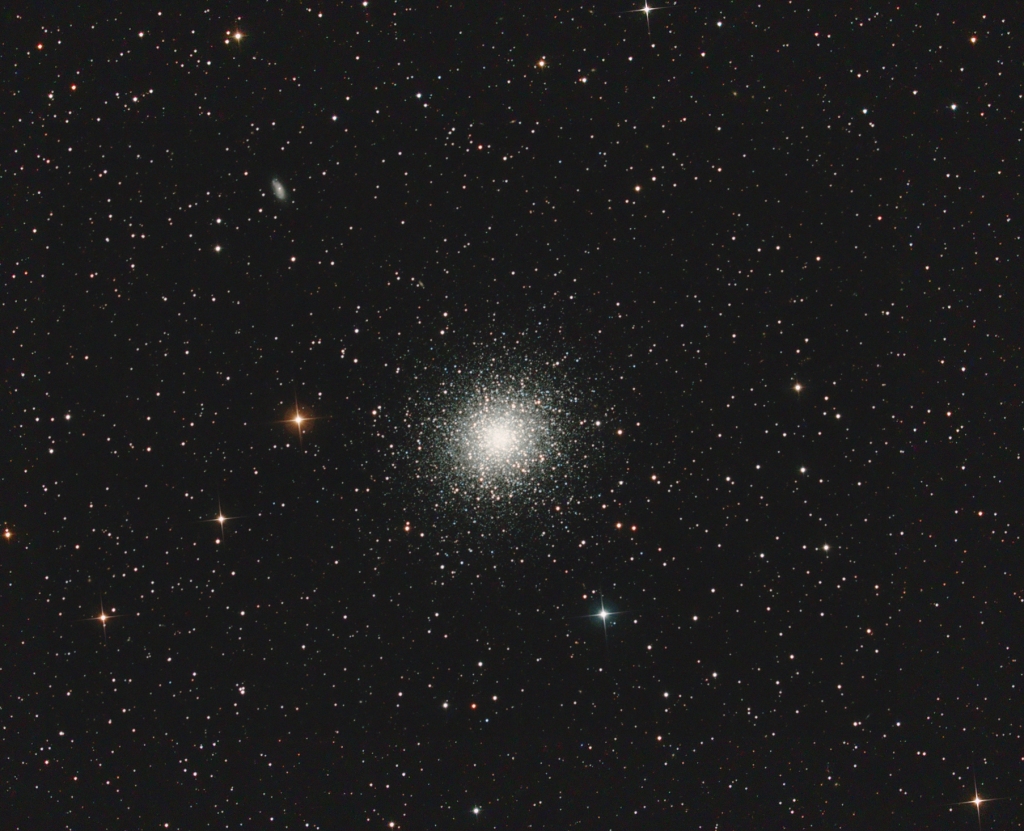
Added another 61 x 50-second subs acquired last night (12/05/2012) to the earlier Hyperstar III dataset.
Added another 61 x 50-second subs acquired last night (12/05/2012) to the earlier Hyperstar III dataset.
Along with some very nice SuperMoon images – my two “Little Planet” images made an appearance on Simon Parkin’s Meridian weather slot – Tuesday 8th May 6:20 p.m.
Video footage Copyright Meridian News & Weather.
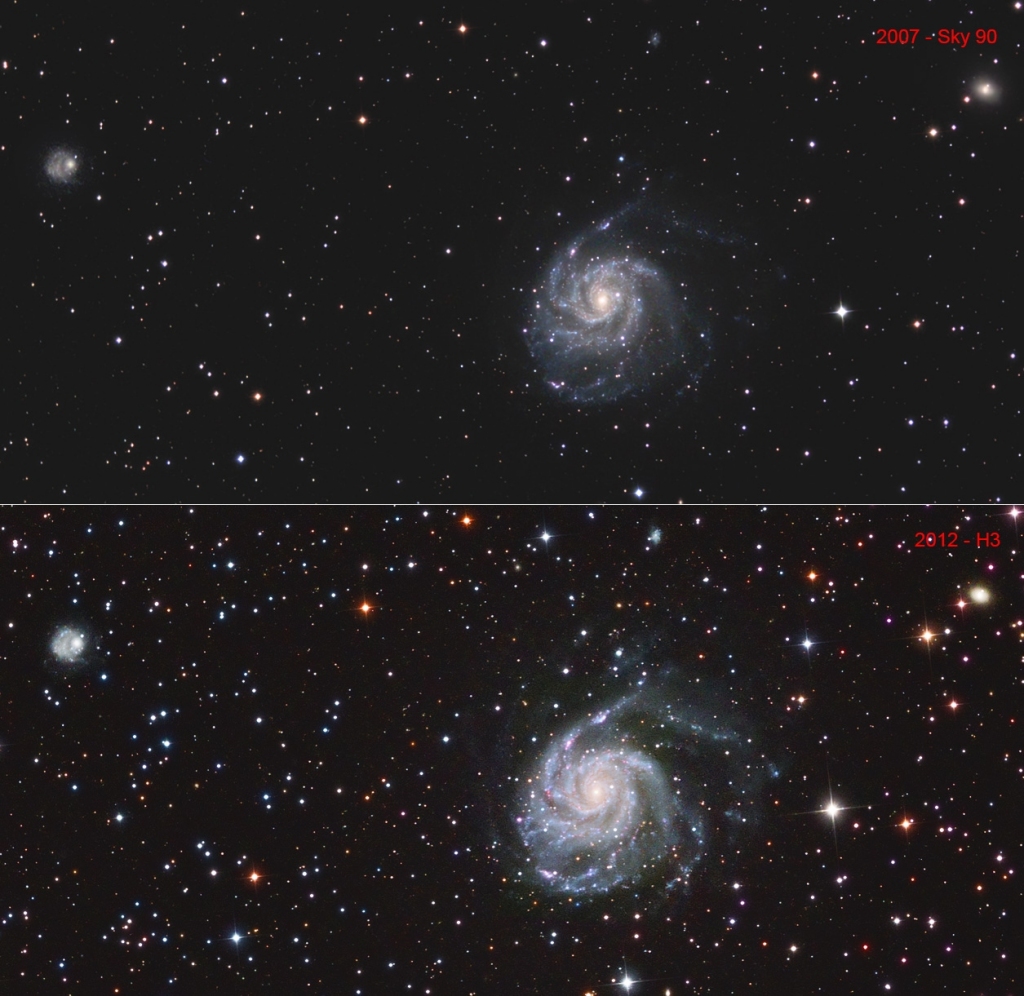
Noel Carboni compared two sets of M101 data taken using two different imaging systems (but the same imaging camera) at the New Forest Observatory.
The top image shows in excess of 5-hours (total) data, probably nearer 8-hours, taken using the Sky 90 and M26C 6-Megapixel one-shot colour CCD in 2007. The lower image shows the recent 2012 data taken using the Hyperstar III with the same imaging camera with exactly 5-hours of total exposure time but this system is at f#2. Now, theoretically (and practically it seems) an f#2 system is 5 times faster than an f#4.5 system, so 5-hours worth of Hyperstar III data should translate to 25-hours worth of Sky 90 data, which seems about right. Note the faint outer arms visible in the Hyperstar data that are totally missing from the Sky 90 data. Also note the far greater number of stars apparent in the Hyperstar data compared to the Sky 90 data.
What does all this have to say about the mini-WASP concept? Well the Sky 90/M25C (or M26C) combination gives twice the field of view of the HSIII/M25C combo. As the HSIII is 5x faster than the Sky 90 then I would need to take the equivalent of 5 frames of HSIII data using the Sky 90 in the same time which is 2 and a half Sky 90s, when I have two currently configured. So 2 Sky 90s doesn’t quite break-even compared to one Hyperstar III, if I get 3 Sky 90s imaging at the same time on the mini-WASP array then I am slightly winning over one Hyperstar III. The only other thing in favour of the mini-WASP array is that I can fit a filter-wheel to the Sky 90s (not possible with the Hyperstar) so I can grab narrowband data easily with the mini-WASP array as well. Lastly, the Sky 90s do seem to offer slightly better contrast than the C11/Hyperstar, it’s only a small improvement – but it is there. The Hyperstar III has higher sampling (better resolution).
So when you add it all up, is the mini-WASP array as I have configured it a very good idea? Probably not. A better approach would be to use 4 cheap large aperture refractors each with a full-frame mono camera and IDAS, H-alpha, OIII, SII filters (one for each scope) – as you are narrowband imaging you aren’t too worried about superb chromatic aberration compensation and the refractors don’t need to be top of the range. You would then image THE SAME object with all 4 scopes and get all your data for processing down in one go.
Except of course when the Full Moon is a Super-Moon or Mega-Moon as it was this morning – then you get wall to wall cloud for 24-hours.
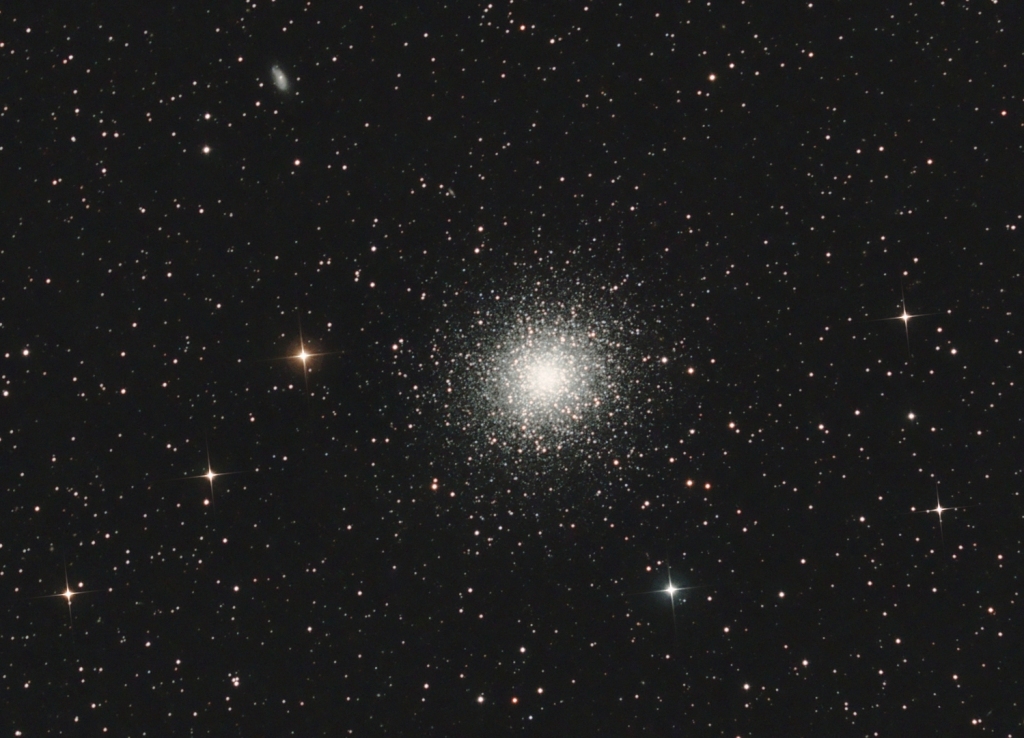
This is literally a 10-minute process of some Hyperstar III data taken last night in parallel with me working on the mini-WASP array. 68 1-minute dithered subs with very poor collimation as I spent no time tuning up before imaging – central crop of a much bigger image.
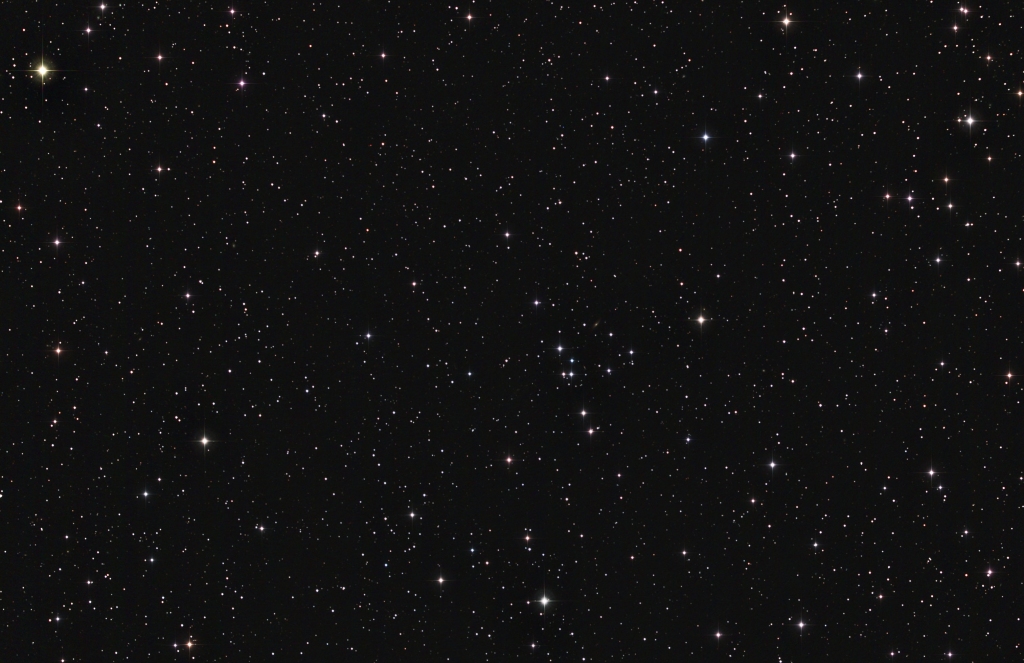
You don’t often see images of this month’s “Image of the Month” and I’m really not quite sure why this is. The mini-coathanger cluster is a small asterism lying in the constellation Ursa Minor, so it can be imaged all year round, not just in May 🙂 However, as Ursa Major is very well placed this month and Ursa Minor is just next door – I chose May to image the mini-coathanger. As its name suggests, this is a small version of the much more famous Coathanger cluster in the constellation Vulpecula (which was a New Forest Observatory APOD a while back). A very pretty little asterism, and if you look very closely you will see that one of the “stars” that makes up the mini-coathanger is in fact a galaxy, which just makes the object even more interesting IMO. As this is a star image we don’t need to go for particularly long subs and 5-minutes at f#4.5 with a 90mm refractor is plenty. If you can get 4-hours or more total imaging time on this object then you should end up with a very nice image of an asterism that doesn’t seem to get very much attention. Plenty of stars nearby that are bright enough for the autoguider if you don’t actually use one of the mini-coathanger stars.
Well, the nights are getting considerably shorter and we are about to enter my “dead season” as far as deep-sky imaging is concerned, so make the most of these May nights as it is the last time in quite a while before we can return to some decent imaging conditions.
Until next month – happy imaging!!
I have ordered another Starlight Xpress M26C one-shot colour CCD – this time for the Hyperstar III. Up until now I have been using the M25C on the Hyperstar III – a 6-Megapixel OSC giving me a 2.4 x 1.6 degree field of view at 2.85 arc seconds per pixel sampling. As I have managed to get the collimation pretty much sorted on the Hyperstar III it has been clear for quite a while now that I could push the system a bit further on the camera side. The M26C OSC will give me the same field of view but the resolution goes up to 10-Megapixels (how nice is that!) and the sampling goes up too to 2.1 arc seconds per pixel. I think this scope/CCD combination is pretty much spot on for the work I want to carry out at the New Forest Observatory 🙂
With the two M26C cameras on the mini-WASP system, the NFO now has three M26C cameras to work with (and an M25C).
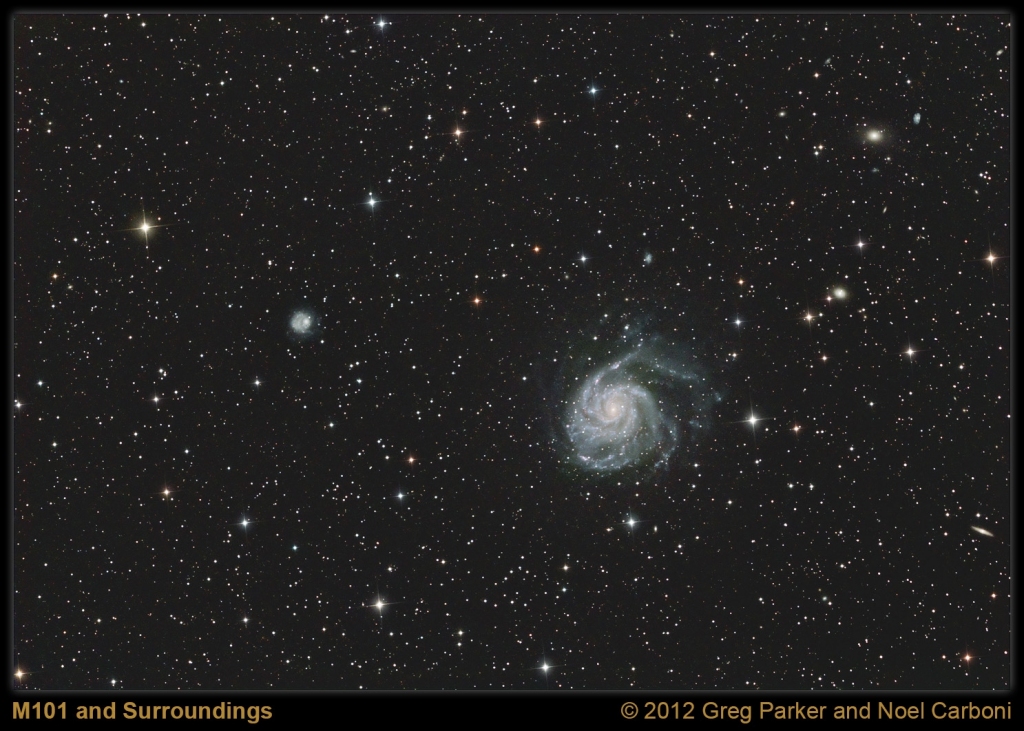
This is the 5-hours of Hyperstar III data taken in February 2012 and processed by Noel Carboni. As you can see, Noel has managed to bring out some of the very faint fine detail in the outer arms of M101 and has created a nice flat image 🙂
It has been brought to my attention by people wishing to use my images in their advertising/promotion that there is no indication of the prices involved for image acquisition. On the Image Agency page I have now added a pricing range to give any potential customers an idea of the prices for both deep-sky and DSLR images. Could I also bring to your attention the change made in the Copyright section where you will see that it is no longer possible to acquire any images free of charge, and that this now applies to both non-profit making organisations and also to educational organisations.

Eric Kennedy of NTE Poole Ltd. brought over the all-Aluminium pier extender for the mini-WASP on Sunday.
Today (Tuesday) I have just spent all day completely disassembling the mini-WASP to fit the pier extender and then rebuilding the whole thing again – what a pain!
Several jobs to be done now: 1) Need to redo the polar alignment.
2) Need to carefully collimate both Sky 90s (this could take a LONG time!)
3) Finally, get on with some imaging.
I am really glad I kept the Hyperstar rig going so at least I can continue to do imaging whilst I’m getting this mini-WASP rig sorted.