Deep-Sky Image of the Week – Astrophotographer Steve Cannistra

Steve Cannistra needs no introduction as one of the very best amateur deep-sky imagers on the planet – and he holds down a responsible day job too 🙂  When I first started imaging it was Steve’s name and web site that I first chanced upon, I discovered Rob Gendler quite a while later.  Steve’s work has always highly impressed me (especially as he did a lot of great stuff with the little Sky 90 refractor) – but this fantastic image of the supernova remnant CTB1 in Cassiopeia really does it for me – especially as this is my Nemesis object.  My light pollution makes this faint one right at the limits of what I can capture with the IDAS filter and RGB one-shot colour camera, and I have a bunch of very unimpressive faint red smoke rings to prove it.  However – I have far from given up on this object and I will return to it with the mini-WASP array and some narrowband H-alpha filtering – that’ll get the little blighter!

However, as you can see, Steve managed to get a great image of the little blighter quite a while back, and it is one of the best images of this object that I have seen.  It’s an interesting story how I came across CTB1 in the first place.  There was an article in the “Practical Astronomer” magazine called “Six little clusters all in a row” which described a bunch of open clusters in Cassiopeia lying close together that could be seen in the field of view of a low-powered scope.  But what was much more interesting than the clusters that were being discussed was the “half a smoke ring” right at the top of the black and white image that was CTB1.  It just struck a chord – I thought this was one of the best deep-space objects I’d ever seen – and I wanted to get a great image of it.  That’s probably why it has fought back at me so long and hard 🙂

Well Steve beat it, and here are the details to go with his image:
Date:  Ha- September 19, 2008;  RGB- September 23, 2008
Scope:  Takahashi FSQ106 at f5 on the Takahashi NJP Mount
Autoguider:  SBIG ST-402 with 60mm guidescope, focal length 227mm
Camera:  STL11K -20C
Filters:  Baader RGB filter set; Baader 7nm Ha filter, all 50.8mm unmounted
Exposures:  Ha 360′; R 60′; G 60′; B 90′.  Total exposure 9.5 hours
Post-processing:  Calibrated, aligned, and Sigma Clip combined in Maxim, followed by DDP in ImagesPlus (IP).  Further processing in Photoshop CS (16 bit)

You can see a higher resolution image on Steve’s site here.

Thank you for sharing a great deep-sky image with us Steve!
Posted in Uncategorized | 1 Comment

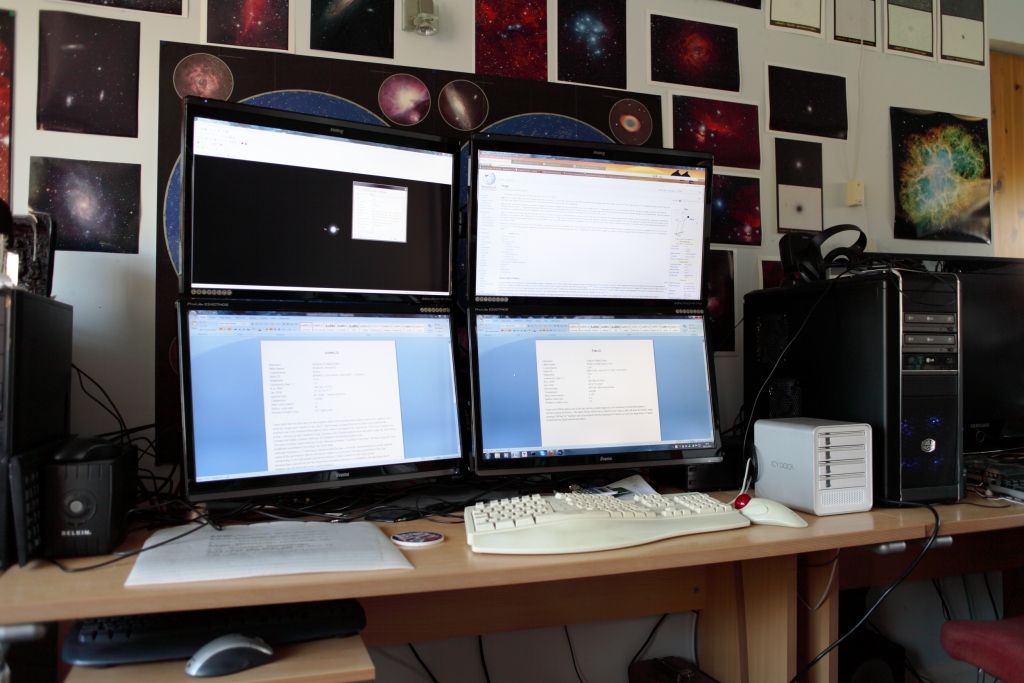
All four screens used for real for the first time today :)

I have started the long and arduous process of putting together another astronomy book today.  For the first time since setting the system up I actually needed to use all four screens to get this particular job done.  Up until this moment I thought the only time all four screens would be used in anger was when I was running the mini-WASP array from indoors, but I actually needed to fire all four up to make my life easier in putting a new data entry into the book.  One screen had the page I was working on, another screen had a previously completed page for use as a template, on screen 3 I had “The Sky 6” open for object data and on screen 4 I had the Internet open on a Wikipedia page for data on the same object.  I don’t think I really need 6 screens to do my book-writing work unlike Terry Pratchett whose famous reply to the question “Why do you have 6 screens on your desk?” was the unforgettable “Because 8 screens won’t fit” 🙂 🙂

Posted in News | Leave a comment

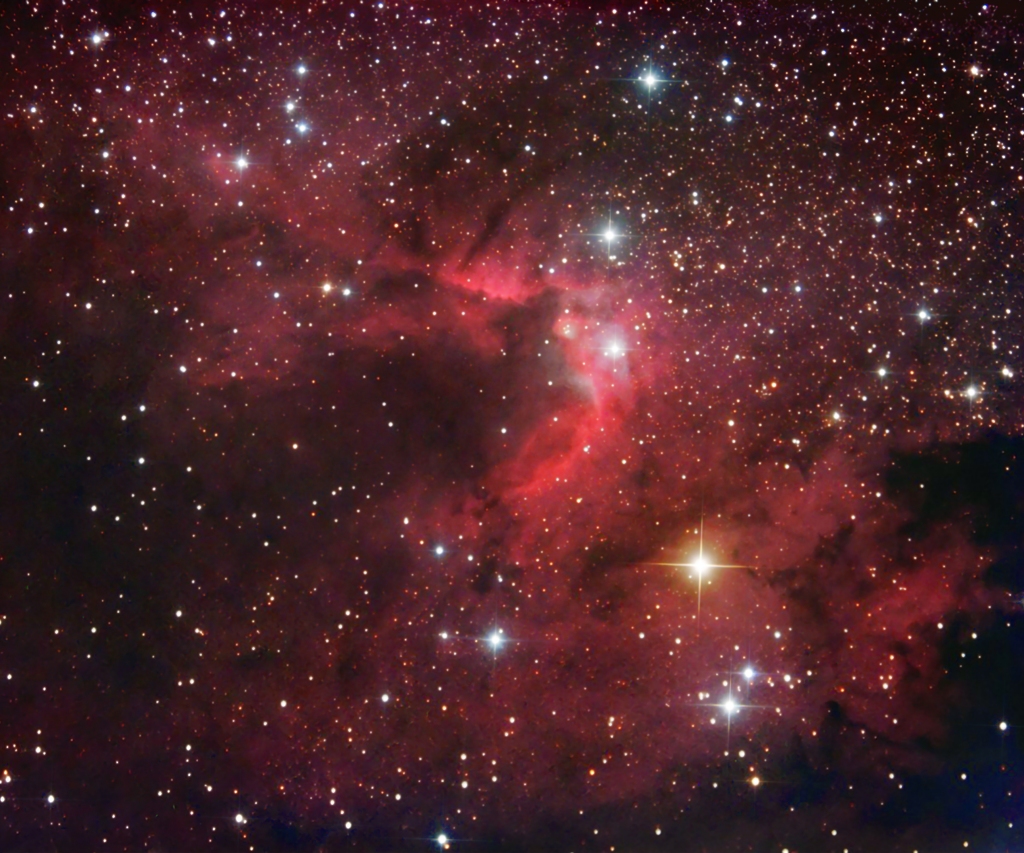
The Cave nebula in Cepheus – blast from the past

Another deep-sky image from the NFO archives, and another original Hyperstar/H9C composition.  This time the Cave nebula in Cepheus.  I recall the tracking was so good on this one that I actually got some vertical banding where the tracking error was well within 1-pixel for the whole imaging session.  Not sure why it was quite so good that time, something to do with where I was imaging in the sky as well as several other things all working together with me for a change, but I never managed to repeat the precision tracking with this system afterwards 🙁

Posted in Hyperstar and SXV-H9C | Leave a comment

IOM November 2011 – Phecda and galaxy M109 in Ursa Major

This month’s composition is a little different from the form I normally follow.  I wanted to get a nice bright single star image, but I also wanted something else of interest in the field of view apart from other stars.  So I took a good look at the star map to see if there was a main star with something nice and interesting lying close by.  I came up with Phecda in Ursa Major for the bright star, and lying close by are the spiral galaxies M109, NGC3953, and a bunch of other galaxies too.  This image was taken with the Sky 90/M25C combo piggy-backed on the C11 in the south dome.  For this image I used 10-minute subs as I wanted a decent exposure for the little galaxy (and to stand a chance of seeing all the other faint fuzzies in the region).  My notes tell me that I managed to get 27 sub-exposures in all and managed to use the lot giving me a 4 and a half hour total exposure time.  It came out well enough, but of course it would have benefitted from even more time – I usually try for 8 hours if possible using the Sky 90/M25C and 10-minute subs meaning somewhere around 50 subs in total.  This is pretty much the “sweet-spot” for imaging from my moderately light-polluted location with the Sky 90/M25C.  More subs will give a smoother image but beyond 50 and you are definitely entering the realm of diminishing returns where it takes a LOT more extra subs to make any noticeable difference.

The clocks have gone back, and if only the Gods would give us some clear decent skies we could be out imaging by 6:00 p.m.  Weather hasn’t been kind to us for a couple of weeks and as we are now getting into winter constellation time I am wishing for a change for the better in our weather.  The mini-WASP is built and ready to go so it isn’t as if I’ve just bought a load of new kit for the weather to mis-behave in this way.  Here’s hoping we have some improvement during this November so that I have something interesting to report next month.

So until December – clear dark skies, and start grabbing those winter gems 🙂

Posted in IOM | Leave a comment

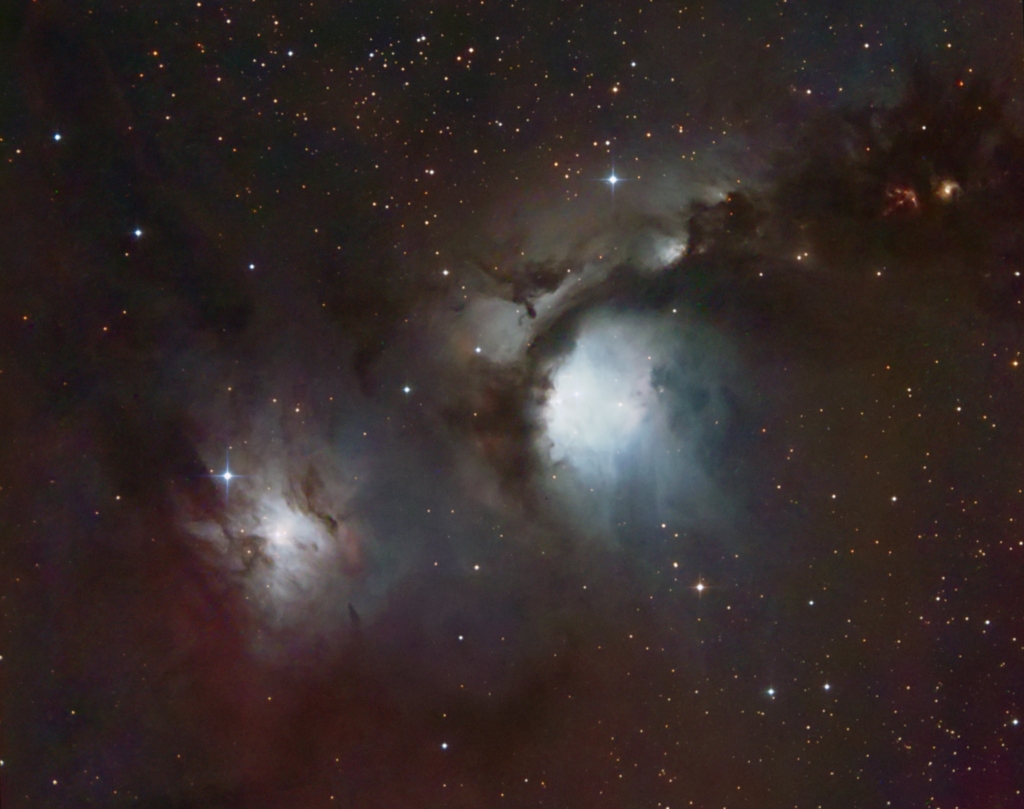
M78 blast from the past

Another old image from the New Forest Observatory taken with the original Hyperstar and a little SXV H9C one-shot colour camera (1.4 megapixels only!).  The camera was highly sensitive and I regret selling it when I bought the APS-sized chip M25C.  This image of M78 was taken using just two hours of total imaging time showing the enormous speed (f#1.85) of the original Hyperstar.

Posted in Hyperstar and SXV-H9C | Leave a comment

Deep-Sky Image of the Week by astrophotographer Alan Chen

This jaw-droppingly beautiful image of the M42 and “Running Man” region in Orion has been sent in from sunny Florida U.S.A. courtesy of Alan Chen.  I have known Alan for many years and have always admired his work, much of which has been acquired at the well-known “Chieflands” site in Florida.  The specs for this fantastic image are as follows:

10″ Homebuilt Newtonian.  Starlight Express SXV-H36 monochrome and SXV-M25 one-shot ccd camera.  Ha: 39×10 minutes (390 total) at f/4.6 Paracorr.  RGB: 34×4 minutes + 11×1 minutes (core) (135 total) at f/3 Keller Corrector.  Stacked and flattened in Maxim and processed/combined in PS.  Guided with SX OAG and SX guide head.  3.8.08 and 11.18.09.  Chiefland and Orlando, FL.  Alan as you can see from the above specs is also a Starlight Xpress man 🙂

A high resolution version of this image can be seen here.

M42, M43 and the Running Man all lie just below the Belt of Orion at a distance of 1,500 light-years.  M42 can be seen as a glowing patch of light with the naked eye and it blazes away at a massive magnitude 3.7 (which is pretty enormous for a nebula!).  This is an annual imaging target for most imagers each winter simply because it is so bright.  However rather than get a monotonous string of M42 images all looking alike, this object is pretty much unique in that I don’t think I’ve seen two images (taken by different people at different times) that look indistinguishable.  It is in the processing that the real beauty of M42 is revealed and as you can see Alan has done a remarkable job on his data, and it is in the processing that the uniqueness of each and every M42 image is created.  So, don’t worry about not getting your M42 published because “we’ve already had that one shown before” – so long as it is a breathtaking image – like this one – you stand a very good chance of it appearing on the “Deep-Sky Image of the Week”.

And – PLEASE – don’t think if it’s not colour I’m not interested.  I actually prefer negative black and white images with that beautiful “battleship grey” background for many faint objects that simply don’t do well in colour.  Not only do they look more “scientific” I think they simpler look better to the eye.

Until next weeks ground-breaking Deep-Sky Image – keep imaging!!

Posted in Uncategorized | 2 Comments

Steve Jobs by Walter Isaacson II

Well – I am very pleased to say that I have finally finished the Steve Jobs biography so now I can resume my work.  I am also very sad to have finished the book as it is one of the best pieces of writing I have come across.  I don’t know if Steve Jobs was a genius, but he was enough of a genius to know who the best person on the planet was to write his biography.  RIP Steve Jobs – your unique way of viewing and interacting with the World will be sorely missed 🙁

Posted in News | Leave a comment

Steve Jobs by Walter Isaacson

Now exactly half way through this book which I started two days ago.  Can’t put it down – it is completely disrupting my work.  Will give a fuller report when I finish it, but I can say that it is very educational and if you are thinking about starting your own company you really should read it along with Alan Sugar’s Autobiography “What you see is what you get”.

Posted in News | Leave a comment

Icy Dock 8Tb storage solution for the mini-WASP data

The white Aluminium box with 4 x HDD bays is my new “Icy Dock” attached storage unit for the mini-WASP data.  Each evening’s imaging (if we ever see a clear sky again) will generate a lot of data from the 2 x M26C one-shot colour cameras, and I will store all this data on the Icy Dock.  Behind the 8Tb Icy Dock unit there are 2 x 2-bay Icy Box units holding a total of 4Tb (4 x 1Tb HDDs), and just to the right of the computer is a USB3 caddy with a 500Gb HDD attached.  With 2 x 500Gb in the actual computer itself this means something like 13.5Tb of storage on the Windows 7 64-bit machine – should do me for a while before I need to start burning data to Blu-Ray 🙂

Posted in mini-WASP Array, Projects | Leave a comment

Deep-Sky Image of the Week – Harry Page

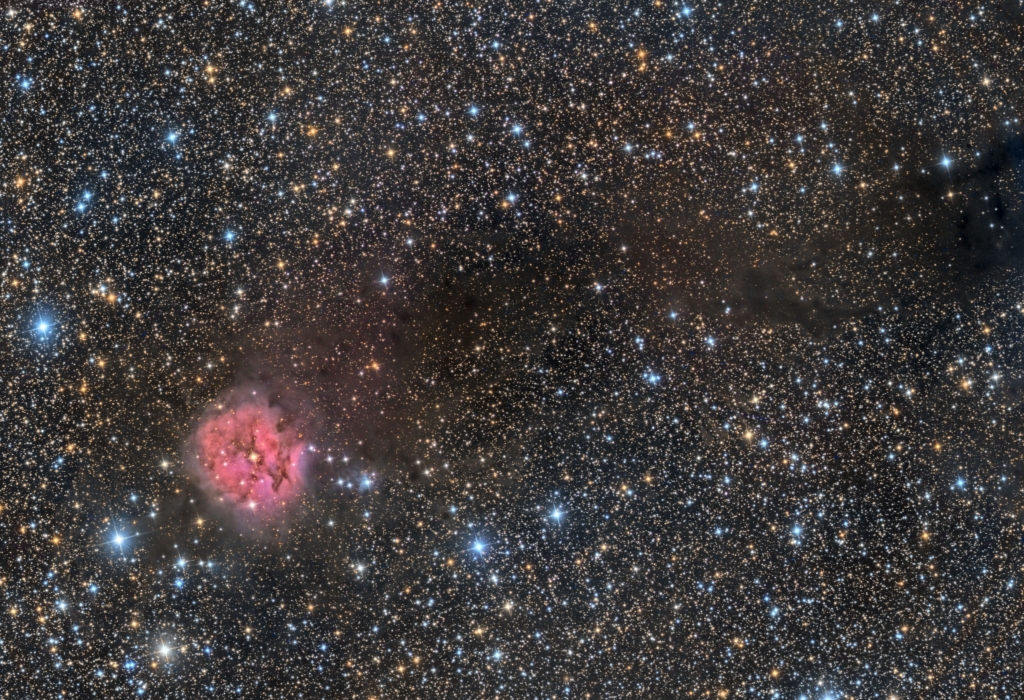
This week’s image is a superb ultra-deep offering of the Cocoon nebula from fellow PAIG member Harry Page – VERY nice Cocoon Harry!

The Cocoon nebula (IC5146, Caldwell 19) is a small emission nebula in the constellation Cygnus.  Why I particularly like this region is the Milky Way background and the long dark trailing nebulosity of Barnard 168.  Lying at a distance of 3,300 light years this small nebula only covers 10 x 10 arc minutes, so Harry is working at a longish focal length to get this frame.  Details from Harry are:


1) Lum 10 hrs SXVR H35

2) RGB 5Hrs SXVR H35

3) 14″ newt with orion optics corrector

4) Processed in Pixinsight

Thank you for a superb Image of the Week Harry 🙂

Posted in Uncategorized | 1 Comment