M109 and Phecda in Ursa Major

A double dataset was processed for this one.  From 7th March 2011 27 subs at 10-minutes per sub, and from 13th March 36 subs at 5-minutes per sub.  The odd shaped resulting image shows the overlap wasn’t too good between the two frames.  In fact the overlap wasn’t bad – it was the frame rotation (due to poor polar alignment) between the two dates that caused all the problems.

Posted in Sky 90 and SXVF-M25C | Leave a comment

Michael Hattey of Starlight Xpress brings the tested M26C down to the NFO – with Maglev fans for both cameras

Well – here’s that Starlight Xpress super customer service for you!  Michael Hattey of Starlight Xpress drove my tested M26C camera down to the New Forest Observatory today – thank you Michael.  Both M26C cameras are now back on the mini-WASP framework – together with Maglev cooling fans – and we’re all ready to go (well after the polar alignment anyway).  Thank you Terry Platt, Michael Hattey and all at Starlight Xpress for such a speedy turnaround!!

Posted in mini-WASP Array, Observatory, Projects | Leave a comment

The usual superbly efficient customer service from Starlight Xpress

Camera already at SX headquarters and Terry is giving it a good soak-testing.  Can’t find any fault with it, but I know it does run (a lot) hotter than the other M26C – so Terry will be returning it with one of his bolt-on fans to get some airflow moving over the cooling fins.  This could be “one of those things” where my last few remaining neurons got all confused at 2:00 in the morning and there really was nothing wrong with the camera at all – who knows?  I’ll bolt it back on when it gets back and try again.  Alternatively it could have been a computer hiccup – I have just replaced the PCI 4-port USB hub with a new one as I got a “blue screen of death” pop up with the old USB hub mentioned as the culprit in the error log.  It’s probably going to be one of those things we never get to the bottom of – and it could be several little problems all linked – but thank you Terry for the very fast checkup of the camera 🙂

Posted in mini-WASP Array, Projects | Leave a comment

First Light – Sadr region

I hadn’t realised that the First Light image I took with the mini-WASP was also this month’s IOM and was also my first APOD.  Let’s hope this lot is a good omen for the future of the mini-WASP array 🙂

Posted in News | Leave a comment

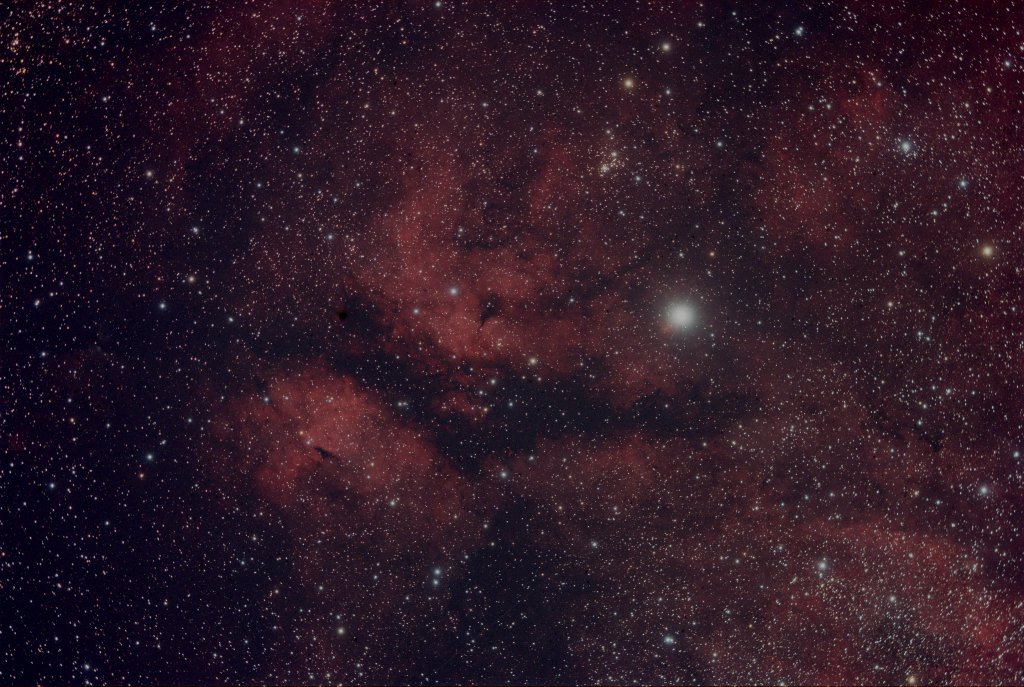
First Light for the mini-WASP project – the Gamma Cygni region

Just a single 2,000 second sub from one M26C camera – no processing other than brightening up so here’s the hot pixels, the polar rotation – the lot – in all its glory.  But it’s my First Light 🙂

Posted in mini-WASP Array, Observatory, Projects | 2 Comments

First Light for the mini-WASP array Saturday night and Sunday morning:

We unexpectedly got a clear patch of sky last night – and no Moon – but of course such luck has to be tempered 🙂

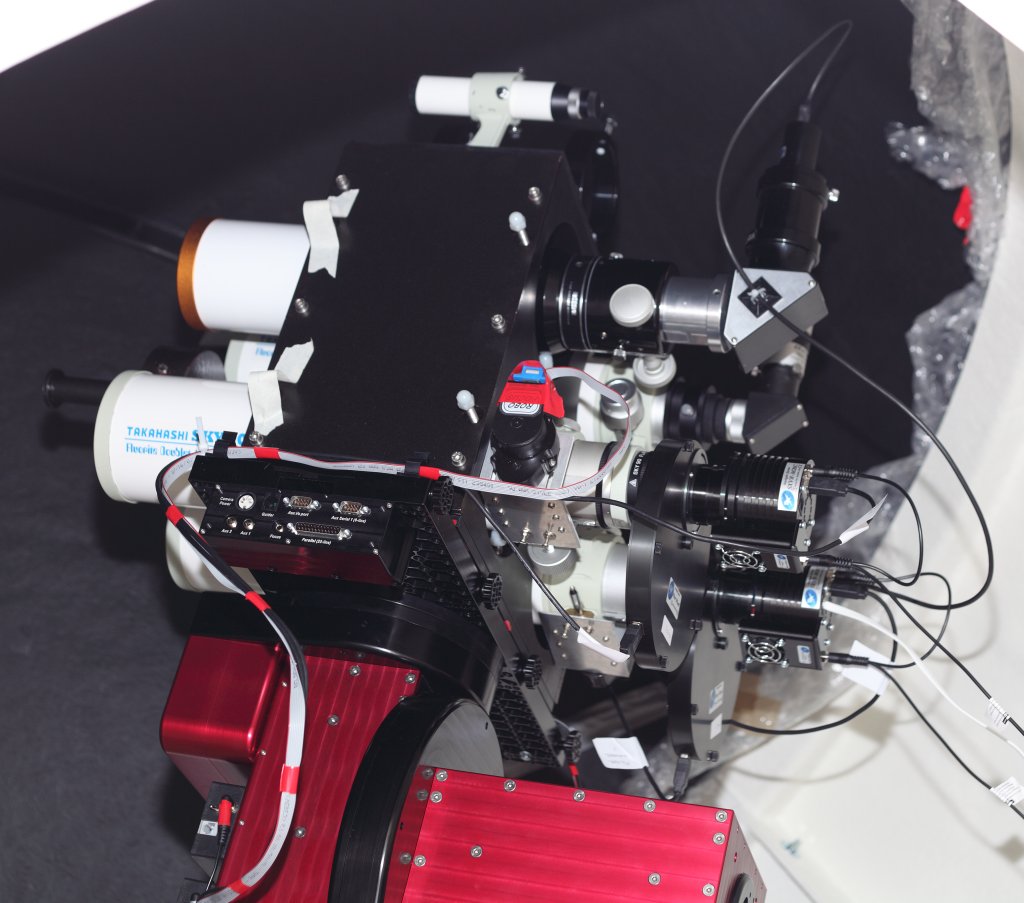
Started up the mini-WASP array around 10:30 p.m. and decided to start with some Polar Alignment by the drift method.  Surprisingly the alignment wasn’t too far out, so rather than lose good imaging time in drift aligning I fired up the cameras and filter-wheels ready for some imaging at last 🙂  Unfortunately it looks like one of the M26C imaging cameras has a fault with the cooling circuit and will be returned to Terry tomorrow – but the other M26C and the SXV guide camera performed well.  Of course the Paramount played a part in only 0.5 pixel deviation in guiding all through the night – something I’ve never seen before – but the guiding was absolutely superb.  I was imaging in the Sadr region to get some nebulosity along with the stars and took a whole range of sub-exposures from just 60-seconds to 2,000 seconds.  Got the expected Polar Rotation all around the edges at 2,000 seconds – but the image quality was excellent and gives me a lot to look forward to when the whole array is tuned and up and running in earnest.  Finished playing at 3:30 a.m. and managed to get my head on the pillow by 4:00 a.m.

One thing you should keep in mind if you are about to embark on a new, big, ambitious project like this one – is to remember your history.  Your current (hopefully) fine-tuned rig didn’t just happen overnight.  It is the result of an enormous amount of effort, blood sweat and tears, and learning – to get to the end result of a good imaging rig.  Well the bad news is that when you put a new rig together it is just like starting from scratch again because all that learning history is tied up in the old rig and the new rig needs new approaches and new solutions.  Just thought I’d share that with you so that you do better with the blood pressure than I’m managing at the moment 🙂

By the way – I manually pushed the dome around last night (sorry Tom) as I had enough on my plate with two imaging cameras, a guide camera, and two filter wheels.

Posted in mini-WASP Array, Observatory, Projects | 2 Comments

Tom How’s Patented dome rotation system :)

Today Tom How fitted and ran a fully automated dome rotation system to the Pulsar Observatories mini-WASP dome.  You can see a video of the system in operation HERE.

You will see the telescope array deliberately slewed using the joystick and the dome automatically rotating to keep in line with the telescopes.  Tom’s touch of genius in making this system work (despite any motor stalls or slippage between drive wheel and dome) is the use of a solid-state magnetic compass for absolute position reference – no rotary encoders needed.  Brilliant piece of work there Tom and I really appreciate the time and effort you have put into this project.  At least you have given me something a bit special (and a bit sexy) to show the sponsors on our “First Light” day 🙂

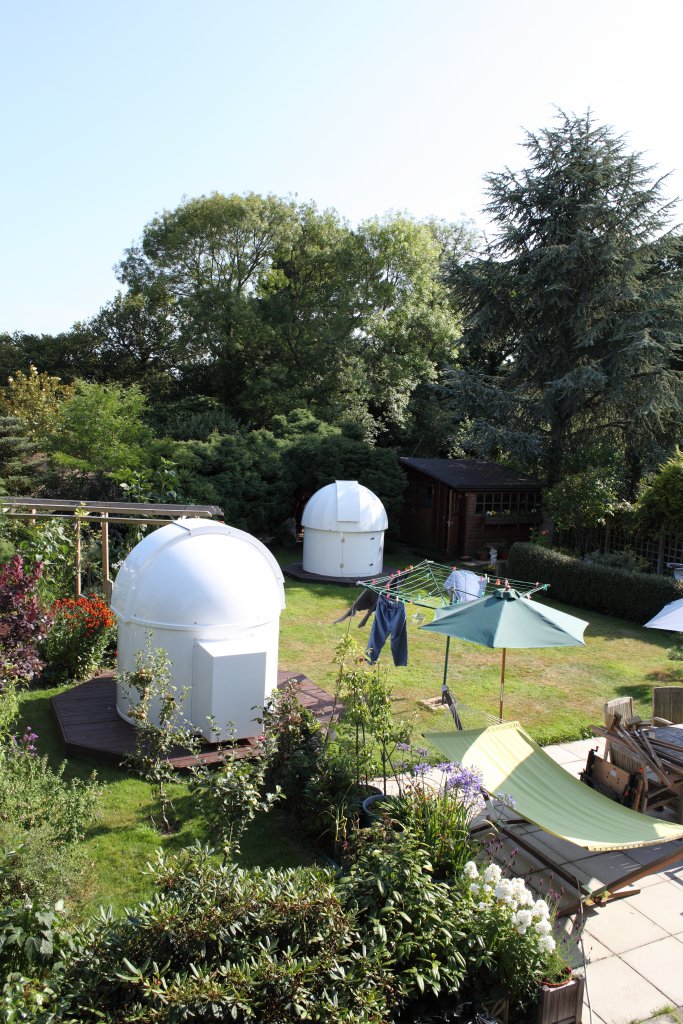
Keck I (the South dome) can be seen through the doorway of Keck II (the North dome).

Posted in mini-WASP Array, Observatory, Projects | 7 Comments

Blistering hot day here at the NFOs

This is the view from my study on this blistering hot Wednesday – it’s now coming up to 5:00 p.m. and it’s still too hot to do anything sensible indoors or outdoors.  Managed to fit a solid-state magnetic compass in the mini-WASP dome today (the reason for this little beauty will become apparent in the coming weeks) – and I measured up, and ordered the metal for a new strengthening rig to go on the Celestron, so-called, “Heavy Duty Wedge”.  The design of the wedge isn’t too bad (I have seen worse) but there is an open ended box section that deforms when a heavy scope like the C11 is cantilevered all over the place.  Up until now I have securely bolted a 2.2mm Aluminium plate over the box-end which has done a fairly good job of stiffening up the wedge – but I could do a lot better.  I intend to securely bolt a 6mm plate over the end, and will report back if this has improved things at all – I will be very unhappy if it makes no difference at all.

O.K. so the view from my study includes the washing line, which I feel brings the whole image a bit more down to earth, and then of course there’s the hammock with the Sun umbrella strategically placed nearby for yours truly to enjoy his early retirement in the sunshine 🙂

Posted in mini-WASP Array, News, Observatory | Leave a comment

IOM August 2011 – the Sadr region in Cygnus

We are just about to enter the longer evenings where we can once again return to getting some decent quality deep-sky images.  To be frank, it never really gets dark enough to do good work for all of June, and most of July.

So this month, as we are still effectively in summer, with the summer triangle overhead, our object is (as usual for August) something in Cygnus.  That something is the bright star Sadr, the central star in the constellation – and as you can see from the accompanying image – it is completely surrounded by emission nebulosity – so this is a nebula image for a change.

Again – considering the deep-sky image as a whole – just a mass of red (emission nebulosity) can look very boring.  It is much better if you can break up the monotonous red region with something interesting – like a reflection nebula [NGC6914] which lies a little north of the current region.  In the present case I have broken up the red monotony by placing the bright star Sadr in the centre of the frame.  This must have also impressed the APOD guys as this image made APOD for January 4th 2007.

Sadr is the supergiant star Gamma Cygni and the two “winged” regions to the left of Sadr form the Butterfly Nebula IC1318.  Above and left of Gamma Cygni are the stars forming the group NGC6910.

Gamma Cygni lies at a distance of only 750 light years, while estimates for IC1318 and NGC6910 vary from 2,000 to 5,000 light years.

So there’s plenty more than just a uniform region of red in this image 🙂

We’re coming up to my favourite imaging month now -for the first time since May we get decent dark skies that will yield us the best quality images.

So until September – clear, dark skies 🙂
Posted in IOM | Leave a comment

Stock2 open star cluster in Perseus

I just processed this data from September 2nd 2010 to keep my hand in 🙂  This colourful cluster (which is rarely imaged) is Stock2 and it lies in the constellation Perseus – right next door to the Double Cluster – which is why it rarely gets a look-in.  This pretty cluster covers a lot of ground as this image was taken with the Sky 90/M25C combo which gives a massive 3.3 x 2.2 degree field of view.  In this image North is to the right as the camera was used in “portrait mode” on the Sky 90.

Posted in CCD Images, Sky 90 and SXVF-M25C | Leave a comment