The unreasonable effectiveness of Mathematics

I am just starting to read Cliff Pickover’s “The Loom of God” and it jogged my rapidly fading memory of my Professorial Inaugural lecture.  Below I reproduce the last few minutes of the 2005 Inaugural lecture I presented at the University of Southampton.


“It really is very strange that mathematics should describe our physical world so well.  There is after all no good reason why certain mathematical functions should so precisely describe what goes on in our physical world, unless there is of course some hidden link between these two sciences.  In fact some people find this link is so peculiar that they have written papers on the subject, as Eugene Wigner first did with  “The unreasonable effectiveness of mathematics in the physical sciences”.

Einstein is said to have remarked, “The most incomprehensible thing about the Universe is that it is comprehensible.” And I think this guy knew what he was talking about.

To quote Eugene Wigner:

“The miracle of the appropriateness of the language of mathematics for the formulation of the laws of physics is a wonderful gift which we neither understand nor deserve. We should be grateful for it and hope that it will remain valid in future research and that it will extend, for better or for worse, to our pleasure, even though perhaps also to our bafflement, to wide branches of learning.”

Is this one of those cases where one introduces complexity when it isn’t really there, or is there something deep and meaningful here?  Why should mathematics be able to describe physical events so well?  As any Mathematician will tell you, the maths is already “out there” it has an existence of its own independent of us, all we do is occasionally turn over a new stone and find a new piece of maths that had always “been in existence” independent of us.  Likewise with our physical measurements and experiments, the results of these experiments has always “been out there” we just came along at this particular point in time to uncover some of them.

If you were to apply Occam’s Razor to this problem, where Occam’s Razor states that the simplest most logical answer is usually the right one – you might be led to conclude – as some people firmly believe, that the reason mathematics so “unreasonably” describes the “real” world we live in is because we really are “living” inside a computer simulation – the Matrix had it right all along!

Thank you for listening, have a good evening, and let’s hope the program doesn’t decide to crash tonight!”

Posted in Articles, Writing | Leave a comment

Life, the Universe, and the EPR “Paradox”

Einstein was pretty unhappy with the way Quantum Mechanics was developing – which was a bit odd seeing as he came up with the concept of the photon and an explanation of the photoelectric effect – but I digress.

In trying to show those poor wayward Quantum Scientists where they were going wrong, Einstein came up with a number of “thought experiments” which tested and probed Quantum Mechanics to its limits.  One such thought experiment involved the simultaneous emission of two oppositely polarised photons from a source (something which can be achieved, and which has actually been practically carried out in ground-breaking experimental work by Aspect et al) and then measuring the polarisation state of each photon when separated by a distance greater than that which would allow “communication” between the two photons during the polarisation measurement.  In other words the polarisation state of each photon was measured in a time shorter than that which would allow a photon to travel between the two polarised photons being measured.

For many years I didn’t think this was much of an experiment.  For conservation reasons the two photons will be emitted in opposite polarisation states from the source, so that if at some large separation distance I measure the polarisation state of photon A and then I measure the polarisation state of photon B it is hardly surprising that I find the polarisation states are separated by 90 degrees.  This is in fact true and correct and shows that both common-sense and Quantum Mechanics agree for this special case.  Now what I cannot simply explain is that if the polarisation measurements are made for angles other than 90 degrees (and in fact 45 degrees where again common-sense and Quantum Mechanics agree) we find a discrepancy between the common-sense expected result of the polarisation measurement and the Quantum Mechanical result.  How very odd!!  As mentioned above, this experiment has been carried out practically by Alain Aspect and his team, and the experimental results agreed with …………………………Quantum Mechanics.  How extremely odd!!!!!

Now this is not the first time that a Quantum Mechanical result has gone against “common-sense”  but the repercussions of this are a little more far-reaching than in some of the other cases.  Einstein, together with Podolsky and Rosen (hence EPR) came up with this thought experiment to show an inconsistency in the Quantum Mechanical theory that required the theory to be “non-local” that is it allowed photon A to know what polarisation state photon B was in at any separation distance, even if that distance was greater than a photon could travel during the measurement time.  Einstein having created the Special Theory of Relativity would have been extremely unhappy with this possibility existing within another theory (Quantum Mechanics) – and this was the whole idea behind the EPR thought experiment – to show that the current ideas of Quantum Theory were “incomplete” as they required QM to be a non-local theory.

If you go into great detail regarding this experiment and where it “goes wrong” as far as common-sense is concerned, there are just three basic principles, one (or more) of which must be violated.  These principles are:

1)  The Reality principle.

2)  The Induction principle.

3)  The Locality principle.

Reality – regularity of phenomena is due to an underlying physical reality.

Induction – it is possible to reach conclusions valid for all systems of a given type from a consistent set of observations on a large sample of systems of that type.

Locality – if two systems have for a time been in dynamical isolation from each other, then a measurement on the first system can produce no real change in the second.

Now it is the Locality principle that was being “probed” by Einstein’s thought experiment – so it seems extremely perverse to me that out of the three possible principles that could be at fault – this is the one chosen by the Quantum Mechanical theorists to be the “joker”.

Surely in this post-Matrix age where the possibility exists that we are all part of a computer simulation, it is the Reality principle that needs to be called into question – and that the EPR Paradox is actually an extremely testing experiment into the very reality of our Universe – not simply a statement about the light-like separation of particles that had once interacted.

Posted in Articles | Leave a comment

Star Vistas – another (possible) Exhibition, Bristol area October 2010

There is an on-going discussion at present that may result in another Star Vistas Exhibition of deep-sky images – plus a talk on deep-sky imaging – but this time in the Bristol area.  If you are unable to make it to the ArtSway Exhibition this September, then there could be a 2-week October Exhibition in Bristol.  Keep visiting the New Forest Observatory web site to be kept up to date on the latest developments.

Posted in Exhibitions, News | Leave a comment

Star Vistas – an Exhibition to be held at the ArtSway gallery 3-5 September 2010

There will be an Exhibition of Greg Parker’s latest and best deep-sky images at ArtSway, running from Friday 3 September 2010 until Sunday 5 September 2010.  A Private Viewing for invited guests begins at 6:00 p.m. on Friday 3 September and a short PowerPoint presentation on “The Magic of Photography” will start at 7:00 p.m.  The ArtSway gallery can be found in Station Road, Sway near Brockenhurst and seen on-line at ArtSway gallery.

If you are unable to attend the Exhibition, you can still see a collection of Greg’s earlier work in the recent publication “Star Vistas”, Springer 2009, with Forewords by Sir Arthur C Clarke, Sir Patrick Moore, and Dr. Brian May.

Friends and acquaintances will soon be receiving invitations to the Private Viewing.  If you do not receive an invitation and would like to attend the Private Viewing please e-mail me at:  greg@newforestobservatory.com


Posted in Exhibitions, News | Leave a comment

The Cocoon nebula in widefield

Recent clear night a few days back so I grabbed some more Hyperstar III data on the Cocoon and its associated dark nebulosity and added it to some data taken last year.  I will try and get another frame off to the right of this one just to see if there’s anything there – if not it should still give us some nice Milky Way stars 🙂


Posted in Hyperstar and SXVF-M25C | Leave a comment

Galaxies in the Milky Way

In a pathetic attempt at trying to keep imaging with nights that are like a sunrise, here is a globular cluster in the Milky Way – M56 in the constellation Lyra.  I really like globulars with a Milky Way background – and fortunately there are a few of these.  What I didn’t know was that you could see galaxies through the Milky Way – there are 2 small ones top-left, there’s also a planetary nebula in there (towards the middle) as well.

Posted in Hyperstar and SXVF-M25C | Leave a comment

Want a brand new copy of Star Vistas for around £8?

Try Best Bargain Books (States) on Amazon.  Look under “new” and you will find Star Vistas for around £6 with just over a couple of quid for postage from the States – amazing value for money.  Looks like they limit you to only 5 books though as I put in an order for 10 and they automatically cut it back to 5.  Never mind – just get all your friends and family to buy 5 as well for you 🙂

Posted in Star Vistas | Leave a comment

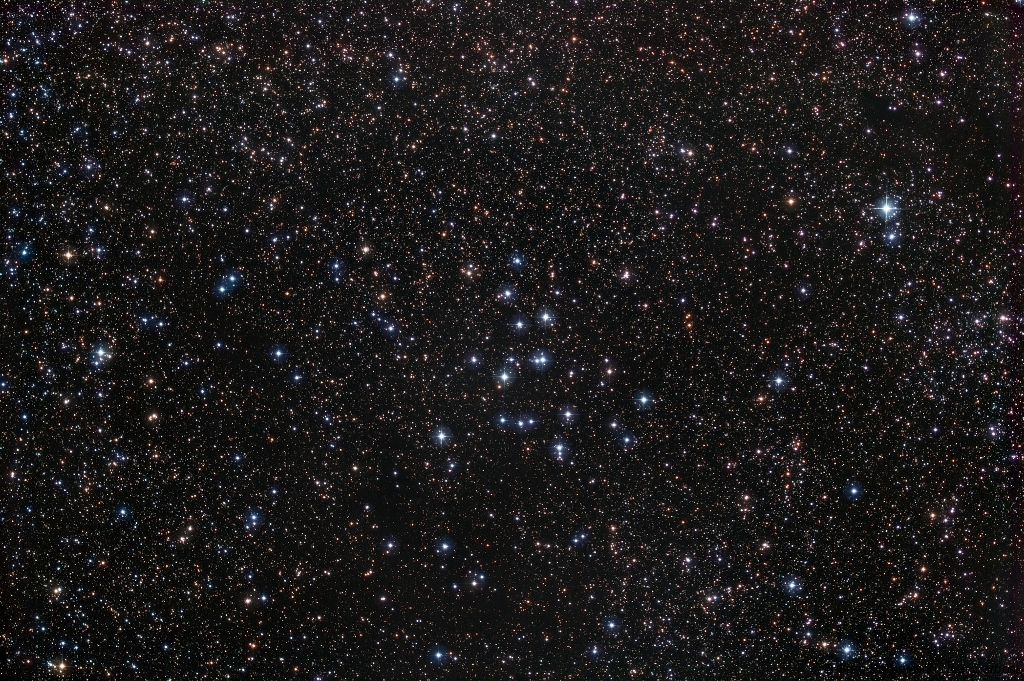
IOM July 2010 – Messier object 39 in Cygnus

With virtually no imaging for the last 6-8 weeks we enter July where at least the skies start to get a little darker in the late evening.  It is still not great conditions for imaging though and you will note a slight degradation of image quality during July compared to the pitch-black skies we get over the winter.  Never mind!!  Dust of the telescope, fire up the mount and let’s get some imaging underway.

This month’s object is open cluster M39 in Cygnus.  Not too surprising we are looking at a Cygnus object in July, but M39 is pretty much overlooked by imagers – perhaps because it is noted as being a “very large, very poor cluster, very little compressed, of 7th – to 10th- magnitude stars” – not exactly a great advert for M39 is it?  But then you put some imaging time on this one and get a little depth and you realise that although large and sparse it is a very colourful cluster.  Being large [30′ diameter] you need a decent field of view, and the Hyperstar III with the SXVF-M25C camera with its 2.4 x 1.6 degree field of view is almost ideal for imaging this object.  Clusters as we know need less sub-exposure time, and we have the bonus that we can also work on them when the Moon is about.  For the Hyperstar III at f#2 I typically use 3-minute subs on clusters, and for the Sky 90 at f#4.5 I often used 4-5 minute subs.  However, as with any object things simply improve with total exposure time and I always like to get an absolute minimum of 4-hours on an object – even a cluster.

Give M39 a try – open clusters in general are often overlooked by imagers, yet they have so much to offer.

Until August – Clear Skies, and happy imaging!

Posted in IOM | Leave a comment

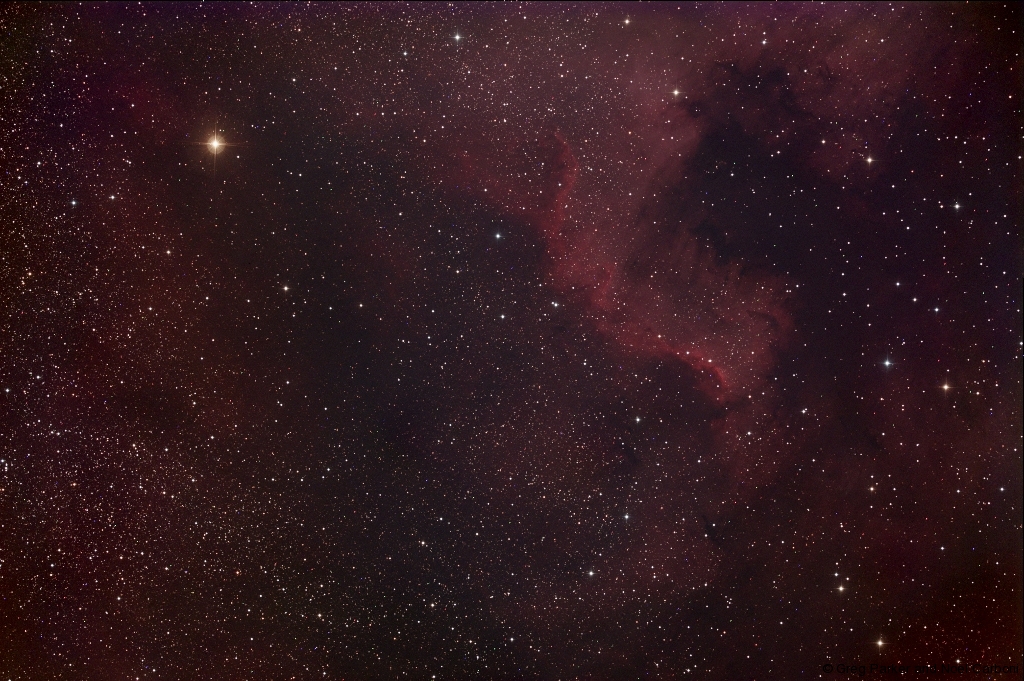
First light for the modified Hyperstar III – the “Wall” region of NGC7000

Last night I successfully collimated the modified Hyperstar III lens assembly and took a “first light” image with the new setup.  Full Moon (or close to) low down on the southern horizon, and a sky that doesn’t really get dark.  Imaged from midnight until 1:00 a.m. once I had collimated the system using CCDInspector (this is a great program!).  To remind you – the Hyperstar III modification was to take the whole lens assembly apart, then blacken all the lens edges using a matt black paint, and then to flock the internal lens spacer tube.  First time I re-assembled the Hyperstar I managed to put the lenses back the wrong way round (what a twit!) – but thankfully Dean of Starizona came to the rescue YET AGAIN and second time around I got it right.  So – lenses back in correctly, wires all fixed to the connector rods at 90 degrees to one another – final job, get the collimation sorted.  Took me just over an hour to sort this out using CCDInspector – and the result? – errors of -0.0 in x and -0.1 in y – the best I’ve EVER seen to date using the Hyperstar III, so I now have a highly-collimated system to play with 🙂  Having completed the collimation I set up on the “Wall” region of NGC7000 for a quick practical test of the optics.  Noel dropped everything and kindly processed this one in ultra double-quick time.  WOW!!  Those stars are nice and round across the whole FOV and the result is about the best I’ve seen in using the Hyperstar III for over a year – great!  You can now expect a large quality-jump in the images coming out from the New Forest Observatory from today onwards.

Posted in Hyperstar and SXVF-M25C | 4 Comments

A better image taken from outside the house using a beer can pinhole camera

I also mounted two pinhole cameras outside the house on a south facing wall.  These cameras were based on beer cans as the Ilford photographic paper fits very nicely inside a standard size aluminium beer can.  Like the indoor cameras the exposure time was also 6-months, but it looks like the Sun’s path has come out a lot better on the outside cameras.  No vertical exposure streak either 🙂  The white fibreglass dome of the New Forest Observatory can be seen in the centre of the image.  The checkerboard pattern across the centre of the image is the patio, and sitting in the centre of the patio you can just make out the teak table and chairs.  Only thing wrong with this image is that I didn’t have the camera angled upwards enough to capture the Sun at the peak of its travel.  However – I have just reloaded the beer can cameras and put them back on the south facing wall, but they are now angled upwards by about 30 or so degrees so I should definitely get the Sun at its highest point tomorrow – the summer solstice 🙂

Posted in Projects | 2 Comments