The pinhole camera project

Just under one month to go before I open up the 4 pinhole cameras that have been looking towards the south for the past 5 months.  Time seems to pass at an ever accelerating rate – as Peter Landsberg said, I think I live in logarithmic time 🙂

Posted in Projects | Leave a comment

Markarian central – the central frame of a Coma/Virgo mega-mosaic

This is the central frame of a large mosaic being constructed of the galaxy-rich region at the Virgo/Coma border – hot off the press from Noel Carboni.  We see Markarian Chain central and at the bottom M87 in this Hyperstar III image.  This is just one of seven (yes 7!) Hyperstar III frames taken in this general area during April – I am surprised we had so many clear nights in the one month.  The mega-mosaic will also incorporate 3 frames taken 2 years ago with the Sky 90/M25C system with its 3.33 x 2.22 degree field of view per frame.  I will cover the region up to (Northwards) M100 and its surroundings, and Southwards to well below M87 where plenty more small galaxies are to be found.  I’m not sure what the final size of the mosaic will be, but I estimate it somewhere in the region of 6 degrees by 4 degrees – high-resolution and good depth 🙂  Another Parker-Carboni mega-imaging-project in the same league as the Veil nebula, the Andromeda galaxy, and of course the Belt and Horsehead region of Orion.

Posted in Hyperstar and SXVF-M25C, Projects, Sky 90 and SXVF-M25C | Leave a comment

An interstellar alien beacon?

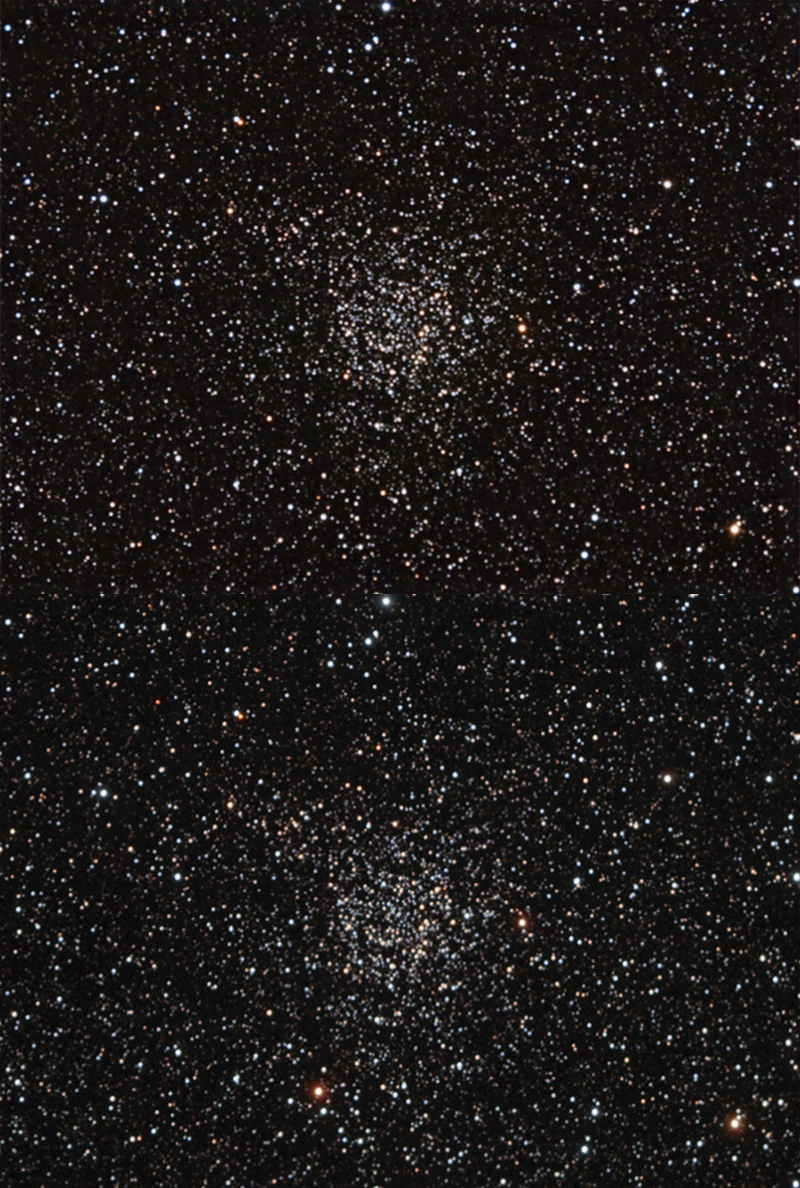
The photo below is an animation of two images of open cluster NGC7789 (in the constellation Cassiopeia), taken around 18 months apart, from the New Forest Observatory, Hampshire, U.K. The star sitting just below the open cluster has changed in magnitude during this period from about magnitude 7 (brightest) to approximately magnitude 14 (dimmest). This impressive variable star (WY Cas) sure appears like it’s trying to get our attention.  According to Roger Pickard of the British Astronomical Society, W Y Cass does indeed vary by something like 7 magnitudes over a period of about 18 months! So, no aliens this time, but instead rather an incredibly interesting object all the same. Processing as usual by Noel Carboni, Florida U.S.A.

Please click on the image to see the animation in a new window:

Posted in Articles | Leave a comment

Get voting today!

Just went out and voted for one of the parties that does not wish to bring back hunting with dogs.  Brian May has created an effective campaign to make people more aware which parties have the strongest links to the stone-age.  And yes I do live in the country and have done for most of my life – I also happen to like the wild creatures that live there too, and greatly admire their ability to survive despite man’s best attempts to make sure they don’t.

Posted in News | Leave a comment

Got today’s EPOD :)

Managed to bag today’s EPOD with an image of the White Lady Falls, Lydford Gorge, Dartmoor National Park – the highest falls in Devon.  Thanks once again to Jim for publishing my work (even the non-deep-sky stuff 🙂 )

Posted in EPOD | Leave a comment

IOM May 2010 – M97 and M108 in Ursa Major

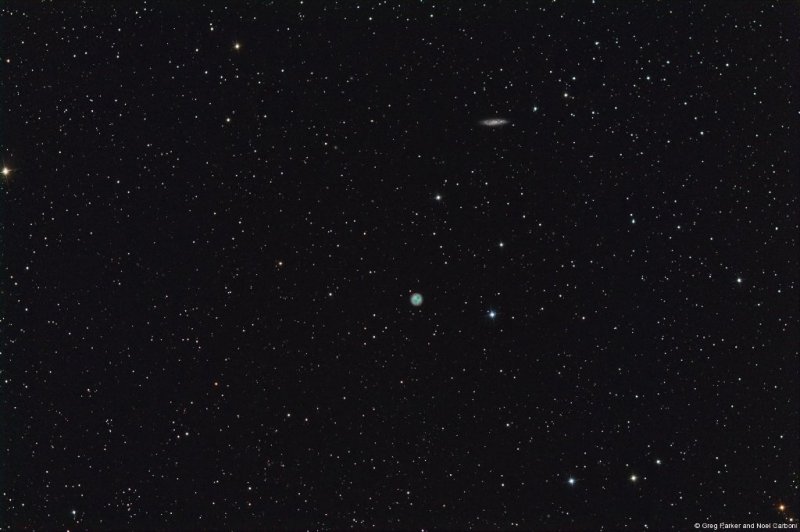
The imaging object for this month is actually a pair of objects lying in the constellation Ursa Major.  M97 also known as the Owl nebula is a lovely little planetary nebula, so named as it has a pair of dark round spots in its green interior which look like a pair of Owl’s eyes.  It is very small at only 170″ in diameter and it is also quite faint at magnitude 9.9.  Close by there is another Messier object, a small spiral galaxy M108 which measures 8.7′ x 2.2′ and is similarly faint at magnitude 10.  Normally a long focal length is used so that there is a reasonable image scale for the Owl nebula, but if both objects are to be captured we need to work at shorter focal lengths.  In the accompanying image the focal length is much too short really to bring out the two objects well, but it still seems to work by showing them in their largely barren environment.  Surprisingly a couple of other “smallish” objects also do well in large field images including the Crab Nebula and M13 the Great Globular Cluster in Hercules.

At this time of the year we find Ursa Major near the zenith so we benefit from the best dark skies from our site and also minimum atmospheric interference.  M97 and M108 still need plenty of exposure time however, like any object, and a minimum of 4 hours using 5-minute subs is recommended for either the f#4.5 Sky 90 system, or even the f#2 Hyperstar III scope.

We are now being forced to start imaging at indecently late hours as summer approaches and if like me you have a day job you are approaching the end of your imaging season until later in the year 🙁

Posted in IOM | Leave a comment

Water-filled balloon HSF image goes viral

I mentioned a while back that the HSF image of the shot egg went viral with something like 1700 hits on my Flick site – I clearly don’t know the definition of viral.  The HSF image of the shot water-filled balloon I posted on NFO yesterday had over 8,000 hits yesterday and over 13,000 hits so far today according to my Flickr stats!!  WOW!!

Just a reminder – these incredible ultra high-speed Xenon flash units are commercially available from:

http://www.highspeedflash.com/

Posted in News, Projects | Leave a comment

Print of the Month – April 2010

After 3 weeks of brisk sales of the “Belt of Orion” things have settled down again so it’s time to introduce the second “Print of the Month” offer from the New Forest Observatory.

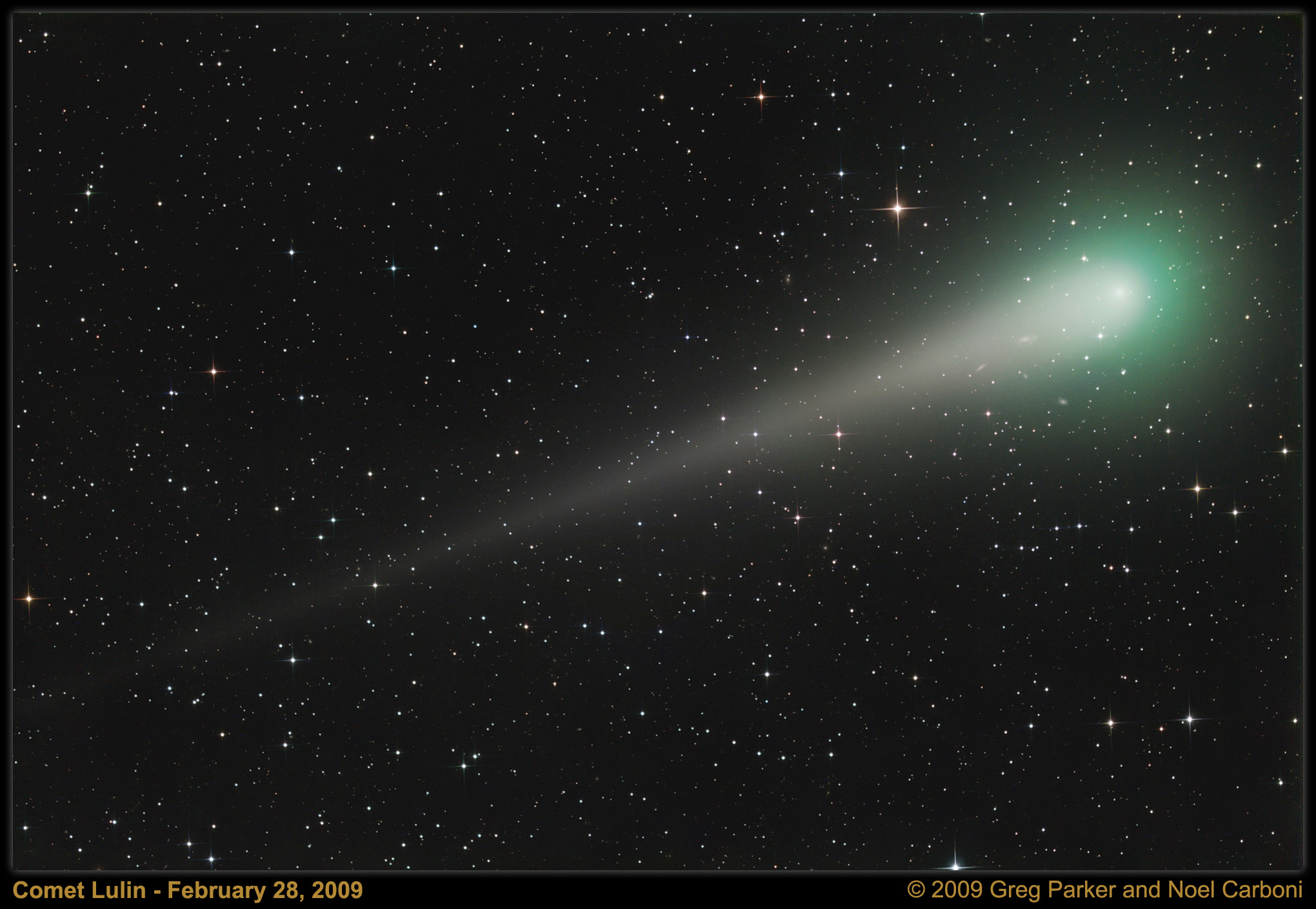
This Month’s full colour A3 print using HP Glossy 250g/m2 Advanced Photo Paper and the 6-colour HP Designjet 130 printer is Comet Lulin in the constellation Leo taken on February 28th 2009.  The print will be signed and dated and will come in a protective polypropylene punched pouch.  Your print will then be packed in a robust cardboard poster packaging tube for shipping.  The Special Offer price for the Comet Lulin print is still only £25 which includes postage and packing!  This offer is only open to U.K. residents.

If you would like to order your April 2010 “Print of the Month” of Comet Lulin – please e-mail sales@newforestobservatory.com to arrange your delivery.

Posted in House and home, Sky 90 and SXVF-M25C | Leave a comment

Photographic courses at the New Forest Observatory

I have recently given a series of talks in the Hampshire area titled “The Magic of Photography”.  Based on the deep-sky images taken from the New Forest Observatory, I also discuss macrophotography and macromosaics, microphotography and micromosaics, creating panoramas using mosaics, Nature & wildlife photography, and of course ultra high-speed flash photography.

What has been brought to my attention during these talks is that most people have access to a good quality digital SLR camera, but most people do not have an observatory or telescope to fit their camera to, and most are unlikely to invest in one either preferring to leave the deep-sky image taking to the experts.  So although the deep-sky images generate a nice number of “oohs” and “ahhs” when the PowerPoint slides go up – it is actually the macro, micro, Nature, and high-speed flash photographic work that creates the most public interest.

At the end of the talks I am asked many questions, and a recurring request was for beginner’s courses for the above aspects of general photography – there was not a single request for a deep-sky photography course (which the NFO currently offers)!!  To this end, the New Forest Observatory will now be offering a number of new photographic courses for budding photographers with digital SLR cameras including:

1)  Photography in the New Forest.  A hands-on field trip course, bring your camera and all your lenses.

2)  An introduction to macrophotography and macromosaics.

3)  How to set up a photographic system for microphotography.

4)  The basics of Ultra High-Speed flash photography.

You will find more details in the Courses section of this site.
Posted in News, Photographic courses | 2 Comments

Another HSF image takes off!

Having just made a quick check of my Flickr site I see that another high-speed flash image is suddenly attracting a large number of hits.  I have tracked down the link to the image which is pulling in the punters and it is that well-known American author of countless fascinating scientific (and mathematical) books – Cliff Pickover!!  Thank you Cliff for putting me on the map, glad you like the HSF images 🙂

Posted in News, Projects | Leave a comment