Last one for today – a 9-microsecond ultra high speed flash shot of an air rifle pellet interacting with an apple. Used the beautiful little 50mm Canon lens on this – pin sharp and costs around £85, excellent value for money!

Last one for today – a 9-microsecond ultra high speed flash shot of an air rifle pellet interacting with an apple. Used the beautiful little 50mm Canon lens on this – pin sharp and costs around £85, excellent value for money!
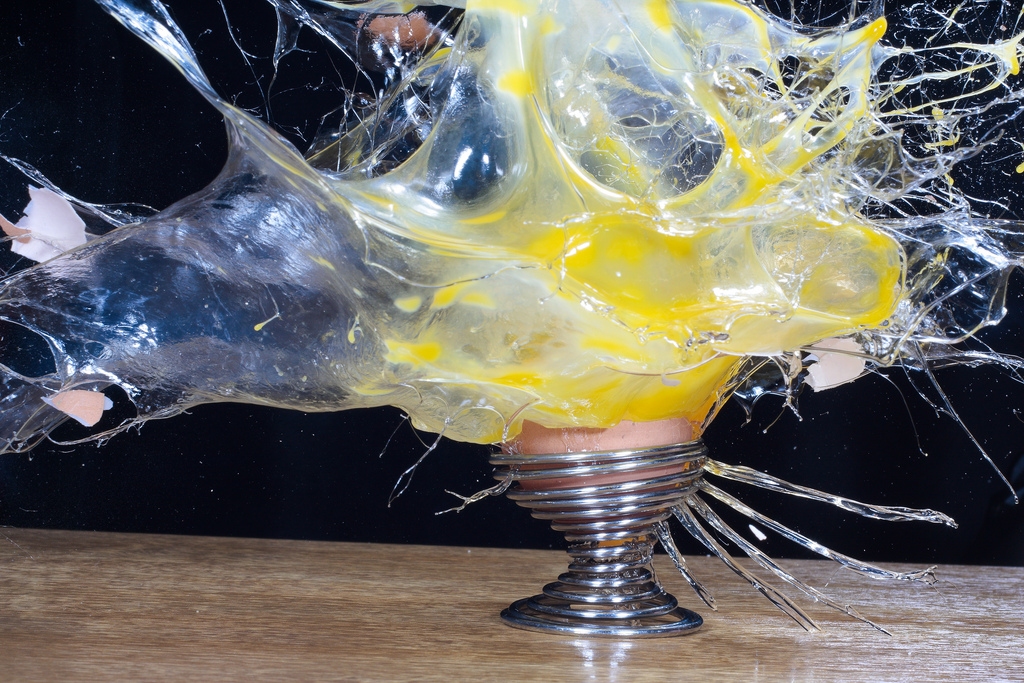
As the weather is not going to play ball for deep-sky imaging I had planned on taking the definitive shot of an egg meeting an air rifle pellet. However – I had forgotten just how messy this business is, so after 3 eggs I have packed up this subject. Here is the best image of the three – just a bit too close to the action for nice framing, but that’s it for the foreseeable from me.
Today the CEO of NTE Poole Ltd. Eric Kennedy – brought me the all Aluminium pier for the mini-WASP! The usual beautiful craftsmanship and Aluminium-welding which are the hallmarks of NTE Poole Ltd. The wall thickness of that vertical tube is 1″ 🙂 I am expecting great stability from the new mini-WASP array as the concrete block that this pier will sit on will go 6 feet into the ground, with 1 foot above ground, and as you can see from the pier base – the block will be 2 foot by 2 foot in cross-section. Now if that lot is not rock-solid with the array sitting on top, I don’t know what more I could have done. There will also be strengthening rods bashed into the ground that the concrete will be poured around for extra strength and stability. So what does the Paramount look like on top of this piece of art?

🙂 🙂 🙂
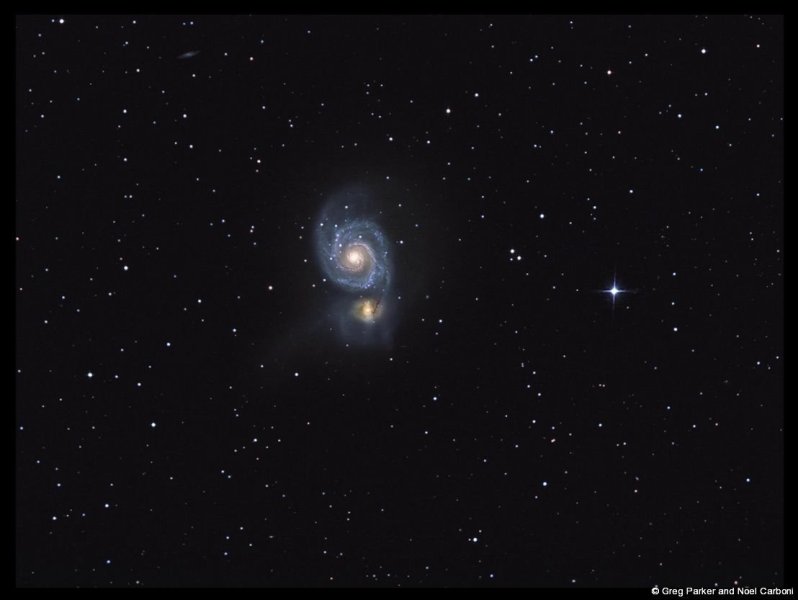
April brings the Ursa Major/Canes Venatici objects into a good imaging position. Our Imaging Object of the Month this month is the interacting galaxy pair M51 known as the whirlpool galaxy. M51 lies 15 million light years away in the direction of the constellation Canes Venatici. Although M51 is pretty bright, there is a great deal of fine structure and also some close-by faint fuzzies that will only be pulled out by using long subs, and many of them. What’s particularly nice about M51 is that nearby there is a very handy 8th magnitude star which is perfect for autoguiding on 🙂
A smaller field of view (than I can manage) is better for this object, and this is true for most galaxies come to that – so this is not a particularly good subject for either the Sky 90/M25C or the HyperstarIII/M25C – however I still can’t resist imaging it whenever I get the chance (along with M101, and M81/82). The accompanying image was taken with the original Hyperstar and the SXV-H9C one-shot colour camera, giving an FOV of roughly 1 x 0.75 degrees – still too big really! I found that the C11 with the f#6.3 reducer and the H9C camera gave just about the perfect FOV for M51 which filled the field of view very nicely if placed along the camera’s diagonal.
Until May, clear skies to you all!
I touched on the answer to this one earlier when I commented on the public’s misunderstanding of the use of Photoshop in image processing. To recap very briefly on the use of Photoshop in digital image processing deep-sky images, nothing is “added” to the original data with the possible exception of star spikes – the skill of the digital processor is to bring out the faint detail that is present in the raw data without “blowing out” stars or other bright regions of the image, and also in removing (note removing data rather than adding!) any light pollution, plane/satellite trails that might have been captured. The deep-sky imager’s use of Photoshop is in stark contrast to the public’s understanding of its use in creating promotional images, where many liberties are often taken with the original data from the camera.
The question of colour is considered slightly more controversial simply because (I believe) we are often not comparing like with like. The short answer to the question of are the colours “real” is YES, the NFO images show objects in the colour representative of that wavelength being emitted/reflected by the deep-sky object. So the RED Hydrogen-alpha regions really are emitting red light at that specific wavelength and similarly for other emission lines (SII, OIII, H-beta etc.) the lines all have very well defined wavelengths, and therefore colours.
The controversy about “true colour” in deep-sky objects comes about due to a basic misunderstanding regarding the physiology of the eye, and the operation of the CCD. Now we are all very well aware that the human eye is not good at discerning colour under low-light conditions. This is why when we go out at night everything goes into greyscale mode, apart from bright objects (plenty of incoming photons) which can then retain their “true” colour identity – so Sodium street lights (Sodium line emission) appear to be that “Sodium-yellow” colour to the human eye, lots of incoming photons to work with. The CCD is like a very sensitive eye in that it doesn’t suffer from the loss of colour reception at low-light levels – so one shot colour CCD cameras accurately represent what the eye could see IF only it were sensitive to low-level photon fluxes (which it isn’t). The fact that the eye is not sensitive to low photon fluxes and therefore cannot see the “true” colour of deep-sky objects, even though very large telescopes (which can send many more photons to the retina than the naked eye can collect) is neither here nor there. Would you consider a monochrome image of the Rosette nebula to be a more accurate representation of the object as “that is what the eye sees” or do you find the rich red hydrogen alpha emission to be a more realistic representation of the object?
I actually fail to understand how this “controversy” arises – as there is no actual controversy – the problem lies I think at a fundamental level where the Physics – (or rather the spectroscopy) – involved is simply not understood or appreciated. Where I do have a real problem is with the “false colour” images from telescopes like Hubble which have neither the “true” colour representation of the object as defined by its emission wavelength, nor does the image look anything like the eye would see if it were sensitive to low-light intensities.
I have seen a big jump in UK sales of Star Vistas over the last couple of days – absolutely no idea why. Maybe there’s been a review somewhere that I haven’t seen. Whatever the reason – enjoy!!
Simon Parkin presented the Meridian TV weather on March 10th around 6:30 p.m. and showed the beehive cluster image (Messier 44) taken just the night before from the New Forest Observatory 🙂 Noel Carboni processed the data as usual to create the deep-sky work of art.
Video footage Copyright Meridian TV.
Noel Carboni has brought out a new PhotoShop plug-in that allows you to put “star spikes” on bright daytime objects as well as on stars in your deep-space images. Add an extra “zing” to you photographs of jewellery, or those shiny chrome regions on your bike or car. Applications limited only by your imagination 🙂
Today the New Forest Observatory website clocked up its 130,000th visitor. Next announcement when we hit 150,000 🙂
On a fairly regular basis (but probably NOT monthly) I shall be offering a “Print of the Month” at a significantly reduced price. This will be an A3 full colour, full-resolution print using HP Glossy 250g/m2 Advanced Photo Paper and the 6-colour HP designjet 130. Each print will be signed and dated and will come in a protective polypropylene punched pouch. Prints will then be packed in a robust cardboard poster packaging tube for shipping. The Special Offer price is just £25 which includes postage and packing!! This offer is only open to U.K. residents.
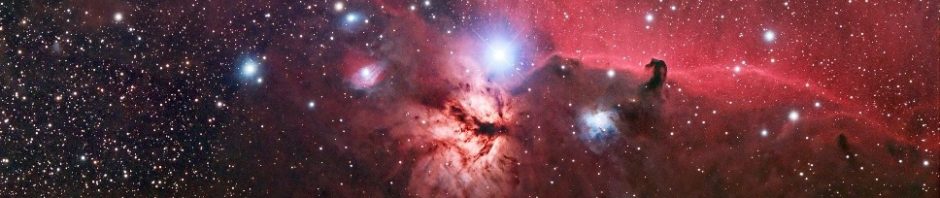
This Month’s “Print of the Month” is the 2-frame Sky 90/SXVF-M25C image of the Horsehead nebula and Belt of Orion region.
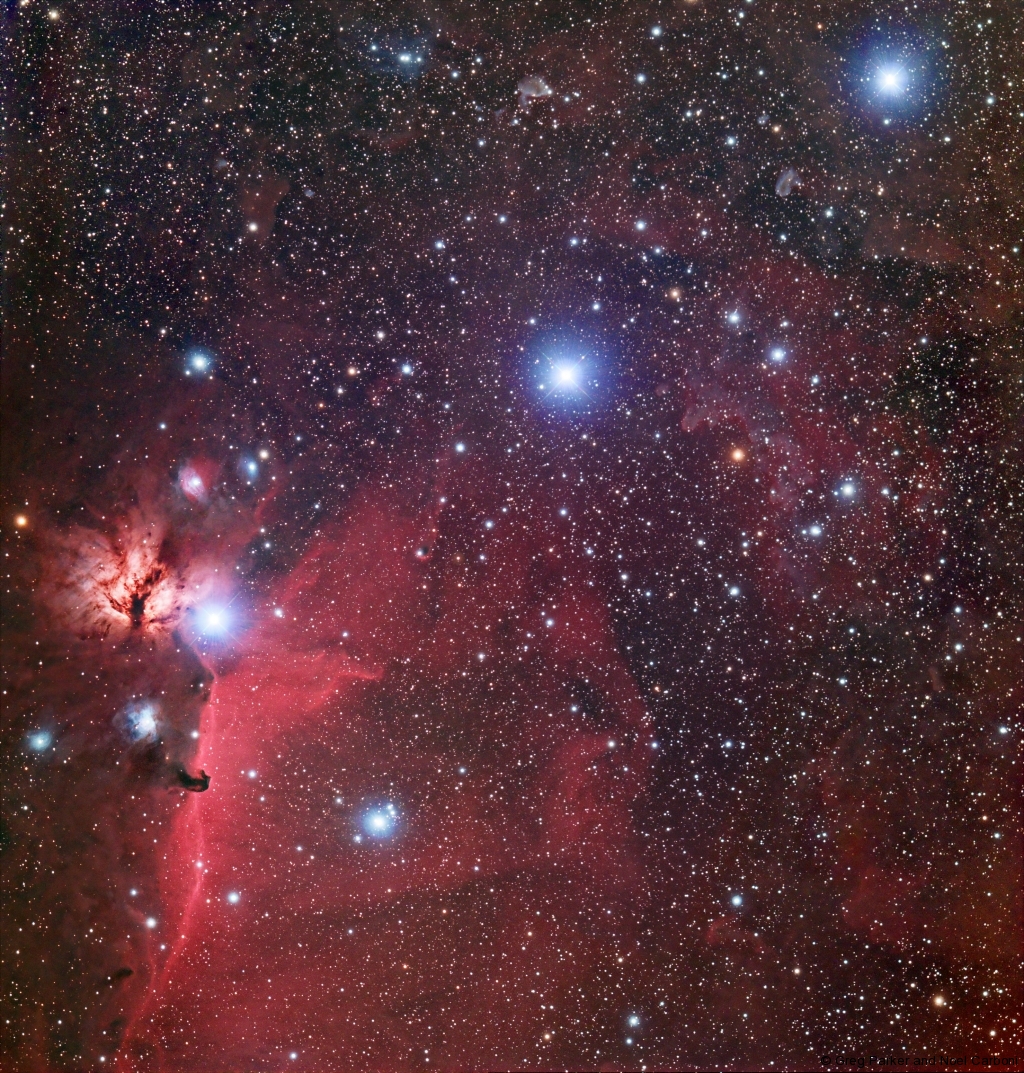
Please note that as this image is almost “square” there will be a largish white border on the long side of the paper, i.e. the image will take the maximum width of the A3 sheet, and this will also be the “length” of the image as well.
If you would like to order your March 2010 “Print of the Month” of the Horsehead nebula and Belt of Orion region – please e-mail sales@newforestobservatory.com to arrange your delivery.