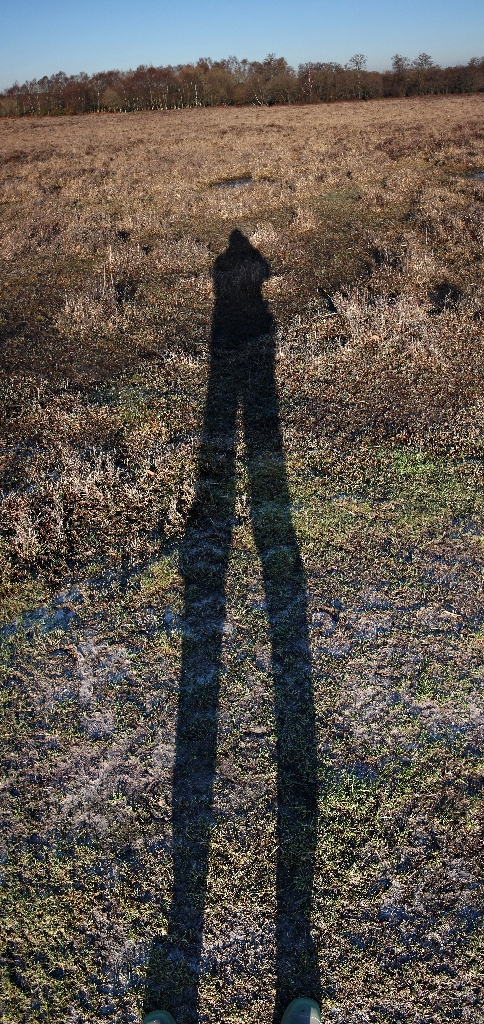
Got today’s EPOD with a shadow self-portrait taken at mid-day near the winter solstice over the New Forest. Thank you Jim for continuing to show my work 🙂
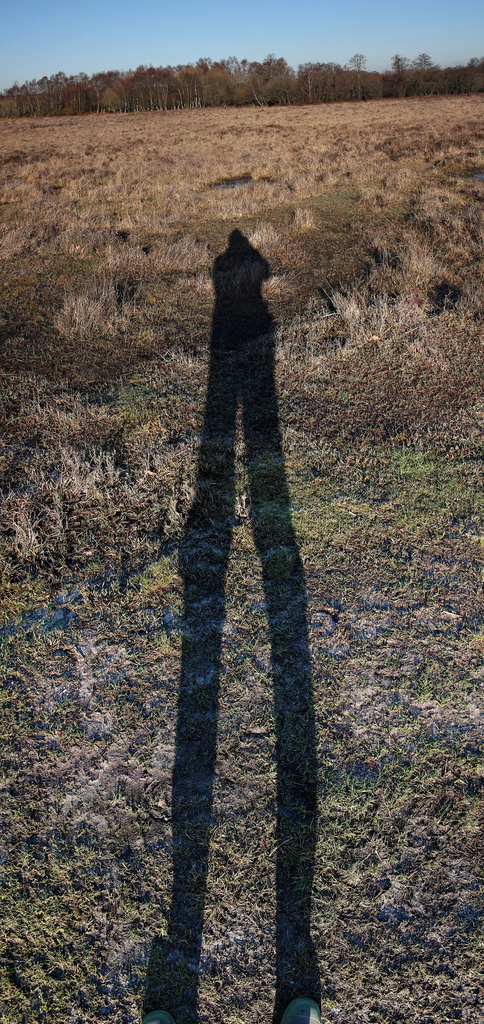
Got today’s EPOD with a shadow self-portrait taken at mid-day near the winter solstice over the New Forest. Thank you Jim for continuing to show my work 🙂
Mr. Ray Girvan has kindly replicated my Golden Solid angle work from 2007 for others to see (with diagrams!) on his site. Ray states that he can see why the Mathematical Gazette might have been unimpressed by the Golden Solid angle paper I wrote back then, as basically it is no different from splitting up the surface area of a sphere into any other ratio, such as 3:1 for example. Unfortunately this is quite incorrect! Go down one dimension to the Golden (planar) angle of roughly 137.5 degrees and you will find this angle appearing time and time again in the subject area of Phyllotaxis – the ordering and spacing of leaves on plants and trees. It is also the underlying rotation angle in the spiral patterns of the sunflower seed head, the pinecone and the pineapple (and possibly DNA if there are 10.5 base-pairs per turn!).
An unexpected by-product of applying the most irrational, irrational number (phi) to the packing of sunflower seeds is that it leads to a geometric structure with an infinite rotational symmetry which has important applications in modern optics and was Patented by me back in 2002 🙂 So the planar Golden Angle appears extensively in the Natural World and this is a direct result of applying the Golden Ratio to dividing up the circumference of a circle into the Golden section, not a ratio of 1:3 or any other ratio – the Golden Ratio.
It is for this reason that I am expecting to see the Golden Solid angle making an appearance in the 3-D packing of objects (seeds, cells, ?) in the natural world, but to-date I don’t have any unambiguous examples of Golden Solid angle packing in Nature.
So the initial question still remains unanswered – can anybody give me an example of 3-D packing of objects in the Natural World according to the Golden Solid Angle? If anyone can answer this question it will bring something new to the discussion.
I see that Ray believes that my more detailed piece on the Golden Solid angle (below) was just for his benefit. It was in fact written for people on astronomy forums (where I also posted my question) who didn’t know about solid angles. I have written a correcting comment to Ray but he has not posted it on his site yet.
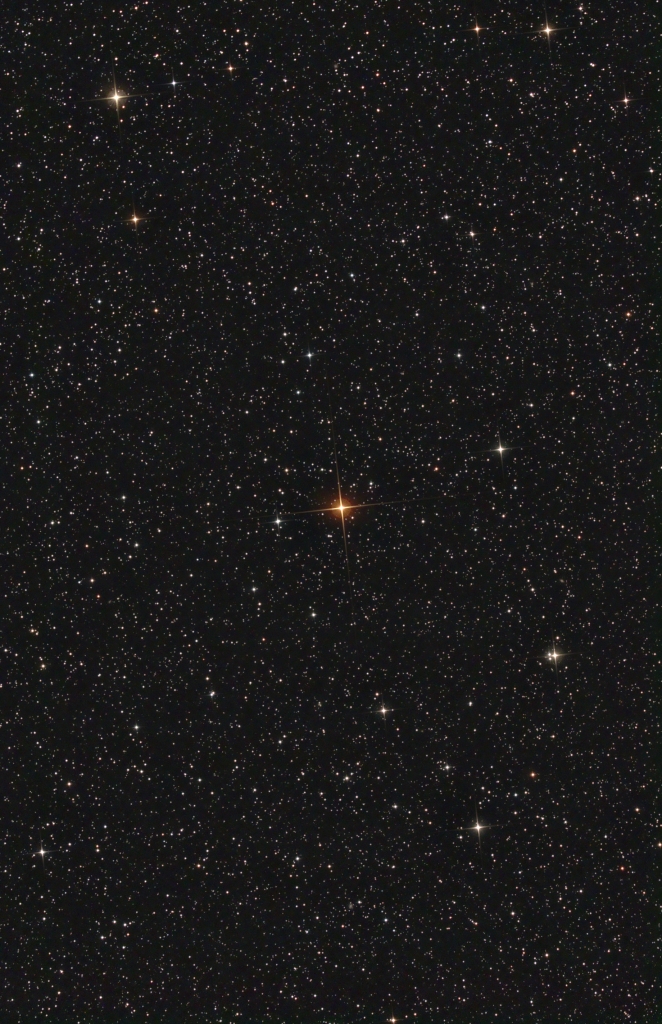
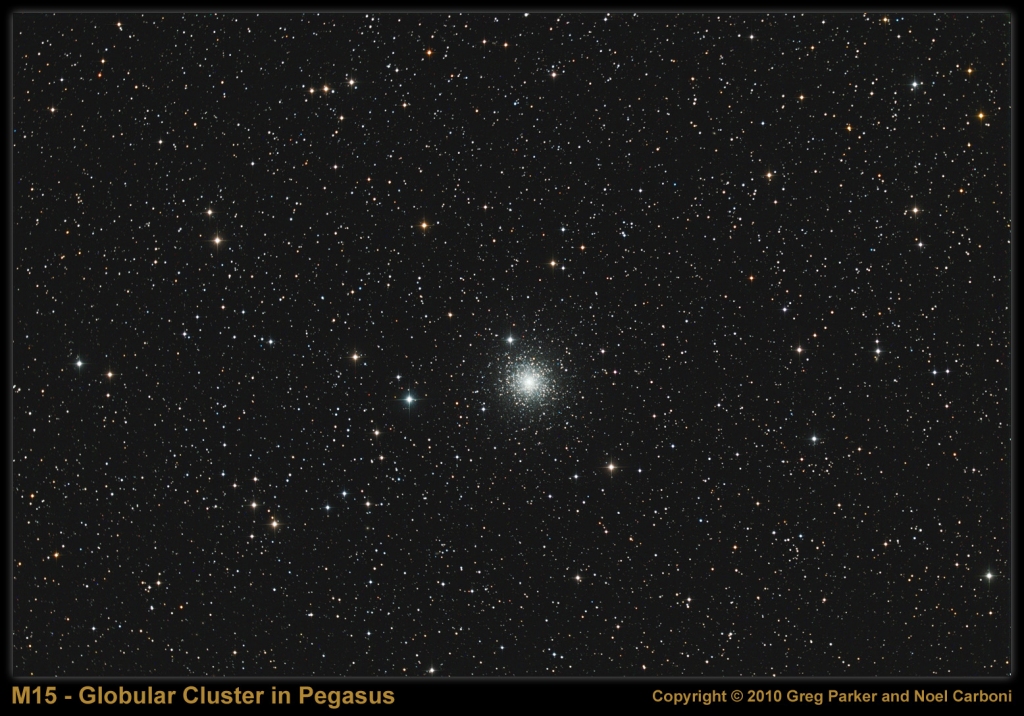
Another recent capture from the New Forest Observatory processed by Noel Carboni (I don’t “do” globulars 🙂 Here is a nice wide field view of globular cluster M15 in the constellation Pegasus caught using the Hyperstar III and SXVF-M25C one-shot colour camera. The C11/Hyperstar III/SXVF-M25C is a truly superb combination for fast capture of clusters and star fields – a great dataset can be obtained in a single (4-hour) evening’s imaging.
Managed to get some good data on this open cluster in Cassiopeia – and please sit down – actually processed this one myself 🙂 A very nice region in Cassiopeia with two other open clusters also in the field of view. Now we come to the sadder bit – I’ve definitely reached THAT age – I hadn’t realised I’d already captured this region (and a lot more) in an old Sky 90 image I called “5 clusters and a nebula” which featured Ruchbah in the bottom right hand corner. Not too good really as I can’t waste a good evening’s imaging by (accidentally) going over old objects. Never mind – I’ll take a bit more care next time and check through the old datasets to see that this doesn’t happen again.

I have asked some friends to put up the Golden Solid angle on their sites to try and find where this might occur in Nature. Some people in trying to help with a reply have gone astray with both the mathematics involved (which aren’t that complex) and the concept. So here I will try to explain a little more about the Golden Solid angle (and solid angles in general as this doesn’t seem to be a generally understood concept).
An ordinary (planar) angle is defined by considering a circle of radius r (make r=1 for simplicity). Now consider a length of arc on the circumference of the circle of length L, this will subtend a planar angle at the centre of the circle defined as L/r = L radians. Now the total circumference of a circle is 2 x Pi x r so that if again we have r=1, then the total angle about the central point of a circle is 2Pi radians. 2Pi radians is therefore equivalent to 360 degrees, Pi radians is equivalent to 180 degrees, and Pi/2 radians is a right angle. So far so good I hope.
Now let’s move onto the slightly more involved concept of a SOLID angle. This is no more difficult in reality to the planar angle, it’s just that we don’t use it much (if at all) in every day life.
The unit of solid angle is the STERADIAN and it is defined as follows. Consider a sphere of radius r, and consider some area on the surface of the sphere of area A. Then the solid angle subtended by the area A at the centre of the sphere is A/r x r steradians. The total surface area of a sphere of radius r is 4 x Pi x r x r so by using our definition of solid angle we see that the total solid angle about a point is 4 x Pi x r x r / r x r or simply 4Pi steradians (this is precisely why 4Pi turns up in the permeability of free space – but that’s another story).
Solid angle in steradians (or in square degrees) is of importance to astronomers too as it gives an indication of the size of an object in the sky – but as solid angle isn’t generally understood this also means that the apparent size of objects in the sky is also not well-understood. When astronomers say that the Sun and Moon subtend about half a degree – they are talking PLANAR degrees and that the Sun and Moon are about half a degree in (planar) diameter. That’s fair enough, but to put things into perspective we should know what looking out into one hemisphere means in terms of steradians (or square degrees) as it is only by looking at the “sphere of space” above us in this way that we can get some measure of how BIG our total field of view is. A hemisphere is 2Pi steradians and if we convert this to square degrees we can get some idea of how big the celestial sphere is for an observer with a telescope with a typical field of view of 1 square degree.
We can go back to our PLANAR definition of angle to work this one out.
Pi radians = 180 degrees, so
Pi x Pi steradians = 180 x 180 square degrees, so
4Pi steradians = whole celestial sphere = 4 x 32,400/Pi square degrees = 41,252.96 square degrees, so
2Pi steradians = celestial hemisphere = 20,626.48 square degrees.
So our observer with a 1 square degree field of view would have a roughly 1 in 20,000 chance of randomly hitting a selected object – it gives an indication of how BIG it is up there!
As a corollary: 1 steradian = 3,282.81 square degrees or equivalently 1 square degree = 3E-4 steradians.
Returning back to the Golden Solid angle!
We now consider a sphere whose surface area has been divided into two, one of area unity and one of area phi (the golden ratio or 1.618…) and the unity surface area will subtend some solid angle, let’s call it gamma, at the centre of the sphere. In exactly the same way we define the Golden Ratio on the line, or the Golden angle for the circle, we can come up with an equation for the Golden Solid angle for the sphere:
(4Pi – gamma)/gamma = 4Pi/(4Pi – gamma) which is a quadratic in gamma which can be solved in the usual way to give:
gamma = 1.52786Pi steradians or 15757.2 square degrees. If you (for whatever reason) wanted to take a slice through the sphere to see what PLANAR angle this solid angle corresponded to you would get an angle of 152.7 degrees – though I’m not sure what use this information is except that it is NOT the same as the Golden planar angle of 137.5 degrees.
For completeness: The solid angle corresponding to the Golden angle of 137.5 degrees is 1.275Pi steradians.
So I return to my original question – anyone seen the Golden Solid angle anywhere in Nature???
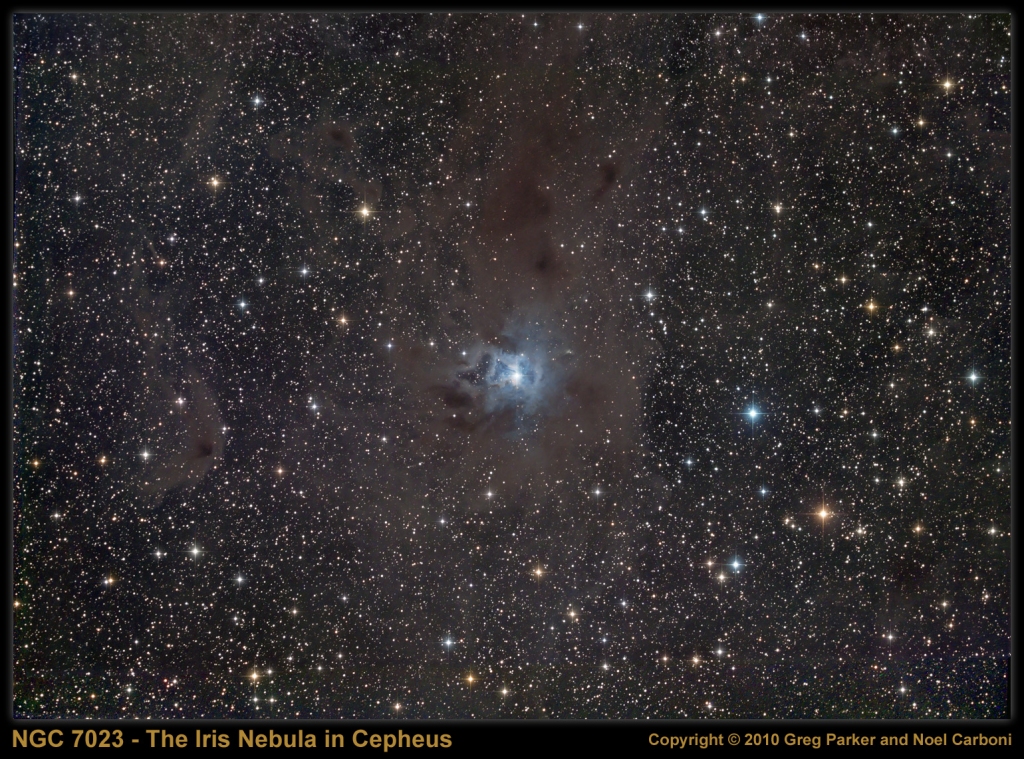
Noel has just added some more data I recently took of the Iris nebula to our original image. Second data set added 15 x 15-minute subs to the original 3 hours and 45 minutes worth of 200 second subs – so this one goes nice and deep as can be seen by the dust clouds.
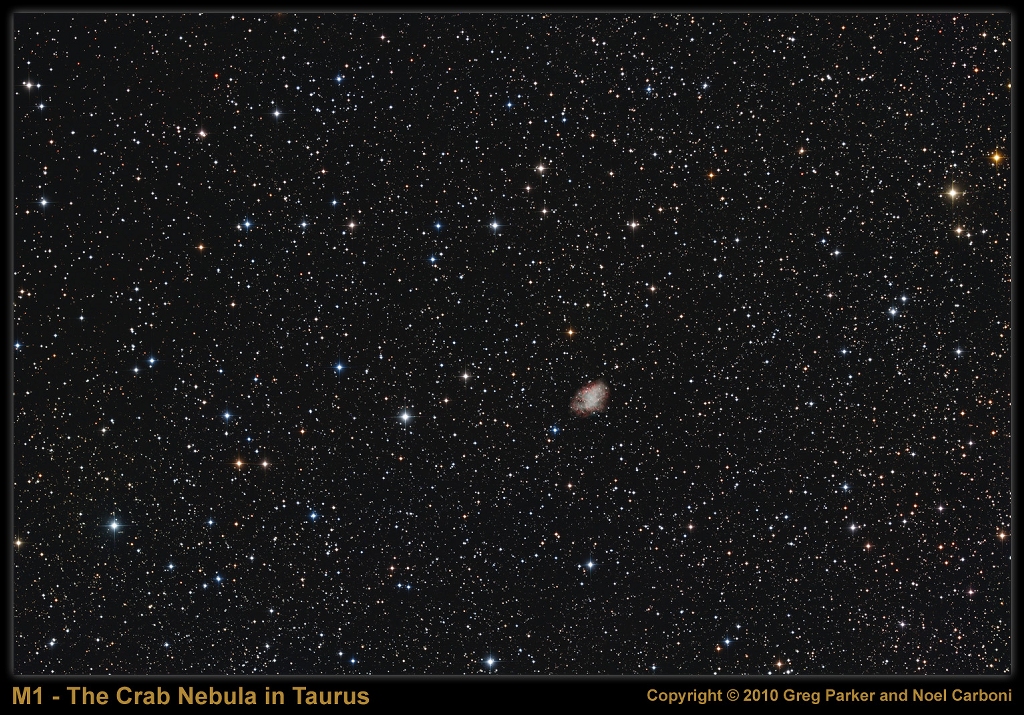
This data was collected on January 8th 2010 (I have not imaged since then due to bad weather) and I went for this region not to get the Crab nebula (which I knew would be very small in the field of view) but to try and capture an asteroid or 3. M1 lies very close to the ecliptic, and whenever I have previously imaged objects close to the ecliptic I have always bagged a few asteroids too, usually some pretty bright ones. Clearly as I had gone out with the intention of getting an asteroid – there were none visible in this data! So all we have is a lonely looking Crab Nebula (a supernova remnant). Image recently processed by Noel Carboni using averaged data (rather than SDmask stacked data).
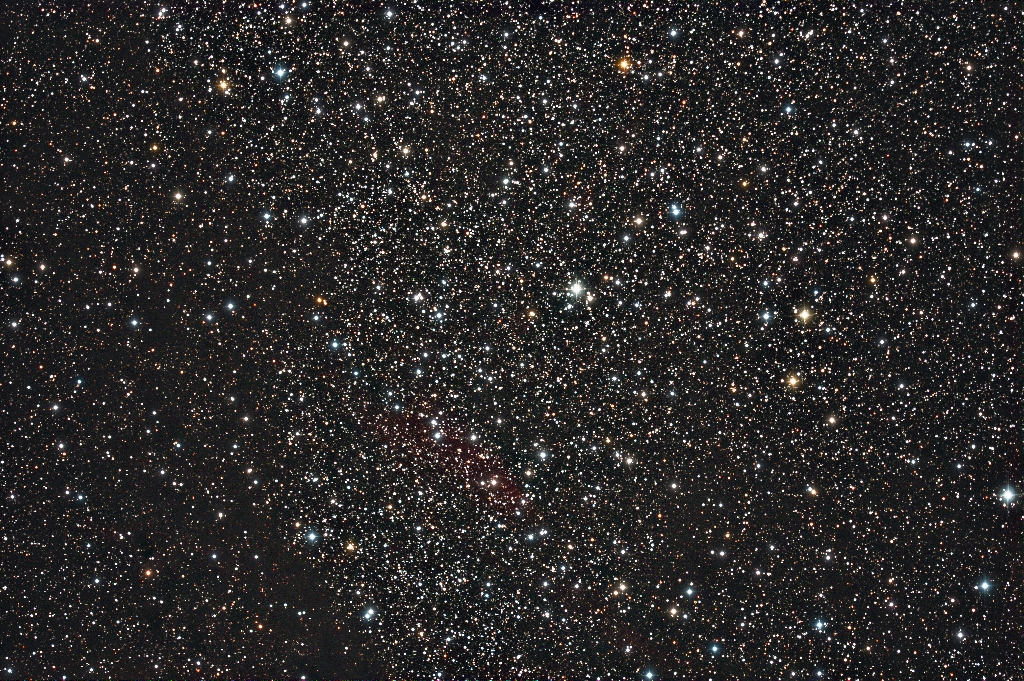
This is the second image from a while back that I took in the wrong place because the finder scope was off. This should have been IC2169 but is instead a region centred on RA 96.82 degrees DEC -12.99 degrees – the only thing it has in common with IC2169 is that it is also in Monoceros 🙂 However, this image is a little more interesting than the last one. Note the extensive dark nebulosity off to the left of the FOV and the very faint emission nebulosity lower/left centre. There’s also plenty more stars in this image as well as a few faint fuzzies in the background. Just goes to show how much is out there in just about any region of space if you image deep enough. This was 20 subs at 6-minutes per sub, so this goes pretty deep as it is a Hyperstar III image.
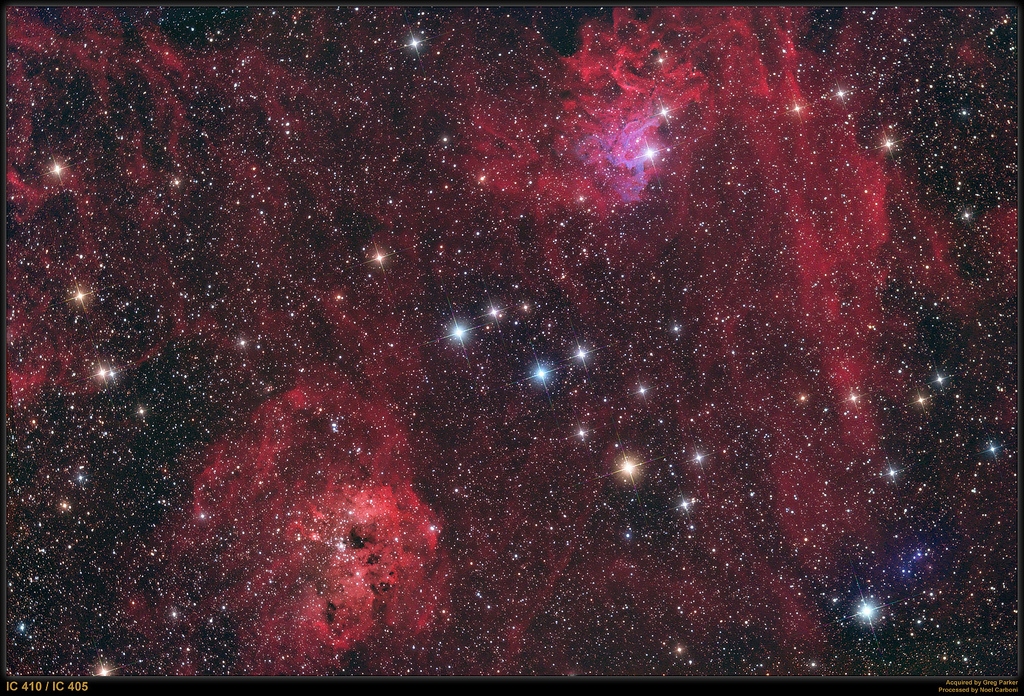
Noel Carboni has just re-processed an earlier image of ours – IC405 & IC410, the Flaming Star nebula and companion in the constellation Auriga. Auriga is sitting overhead right now during our crisp winter evenings and it is in a perfect position for imaging the many clusters & nebulae that lie within. This image features in our Springer publication “Star Vistas” published Spring 2009.
Went over the New Forest today between North Weirs and South Weirs and took this shadow self-portrait. It clearly illustrates just how low the Sun is at this time of the year – this photo was taken at around mid-day!! Lot’s of bright sunshine and clear blue skies but freezing cold. Also in the evening we have a very intrusive Moon right now which severely hampers broadband imaging 🙁