
Took this “Little Planet” shot of the observatories today as a record. Brilliant sunshine made the PTGUI blender panic, but I’ll just leave as is for now.
Took this “Little Planet” shot of the observatories today as a record. Brilliant sunshine made the PTGUI blender panic, but I’ll just leave as is for now.

Picture of the Week is gorgeous M13 – the Great Globular Cluster in Hercules.
Again, many hours have gone into this one using several different cameras, several different versions of the Hyperstar, and also the Sky90 refractor at f#4.5.
Another object I have returned to time and time again, and yet another object I really need to steer clear of in future as I don’t think I am going to be able to improve on it much (if at all) from my current location.

Last night’s ISS pass kicked off around 10:23 p.m. and was a nice 6-minutes long. Ursa Major again centre of image (right way up this time) with Arcturus at the bottom of the shot.

Last night was a 6-minute pass of the ISS starting at 10:26 p.m. As the sky was still fairly light I took (roughly) 20-second exposures. In the middle, upside down, you can see Ursa Major. Follow the handle of the plough up to the top of the frame and the bright star is Arcturus. As you can see there was also a very bright Moon (and quite a lot of broken cloud).
Again no idea why the funny image – click on it to see what it should look like.

Picture of the Week is my many total imaging hours M31 – the Andromeda galaxy. Lost count on the total number of Sky90/M26C OSC CCD hours that have gone into this one. Probably 15 or more and certainly well within the diminishing returns region for my location. Another object I need to keep well away from so that I can grab more new stuff, and not waste valuable imaging time trying to improve something that cannot be improved, without a substantial increase in total imaging hours.
This object has a special place in my heart as it was the first image I took with the new (then) M25C OSC CCD on a single Sky 90, piggy-backed on the Celestron Nexstar 11 GPS SCT. It was also the first “all-nighter” I pulled, running right through into sunrise. Finally the colour was all wrong because of something to do with the camera firmware, but that didn’t stop Noel Carboni reaching into his Photoshop magic trick box and getting the true colour into the image.

Unbelievably it was clear enough last night to have a go at capturing the 9:41 p.m. 7-minute space station pass.
I used the Canon 15mm fisheye lens on the Canon 5D MkII ISO 100, f#2.8, bulb setting, and took ~10-second exposures as the sky was so bright. I moved the camera half-way through the pass (that’s the gap) to get more of the pass in. I won’t do that again! However, I’m pretty sure I have done this in the past with no gap appearing. Of course I have no notes on how I managed to do this which seems to be the story of my life at the moment.
There’s something like 10 days in a row where we have 7-minute ISS passes (near Bournemouth) so hopefully I might get one or two more tries at this.

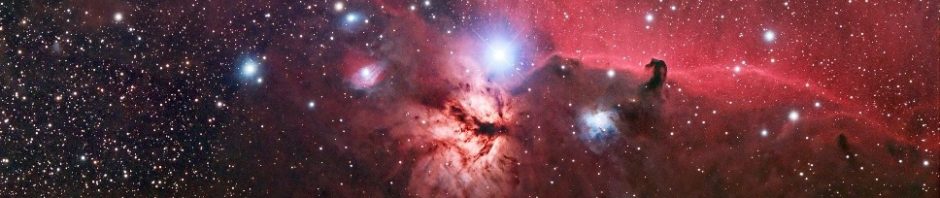
Picture of the Week is the Flaming Star and Tadpoles nebulae (IC405/IC410) region of Auriga. The Flaming Star nebula has that very nice patch of reflection nebulosity (blue) at the top.
This is the accumulation of many hours (certainly more than 12-hours) of data on the Sky90 array using the M26C OSC CCDs. Sub-exposure time mostly 20-minutes.
This is yet another image that doesn’t benefit much from a few more hours of additional data, so this is another one I can call completed from this site.

Best group of Sunspots I’ve seen in years. Projection method. No wonder the aurora is so good right now 🙂
I have no idea why the preview looks like that – click on the image to see what it should look like.
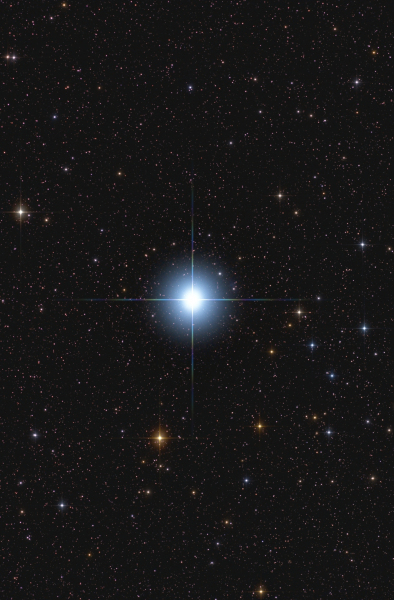
Unbelievably it was actually clear last night AND there was no Moon. Choice was between Arcturus and Spica, and as I’d only done Spica once before with the Sky90 array, Spica won.
Just as with the Sky90 array image, Spica is deep down in the murk towards the south and there is flare around the brighter stars which automatically gives the Akira Fujii effect for free.
Only managed to get 12 x 5-minute subs with the 200mm lenses and the ASI 2600MC Pro CMOS camera before Spica hit the Meridian and I called it a night.
As you can see Spica is one of the brightest bluest stars in the night sky. It is easily found by following the curve of the handle of the plough down to brilliant Arcturus and then continuing on the curve down until you arrive at Spica.
POSTSCRIPT: Spica is NOT one of the brightest bluest stars in the sky – it is THE brightest bluest star in the sky.
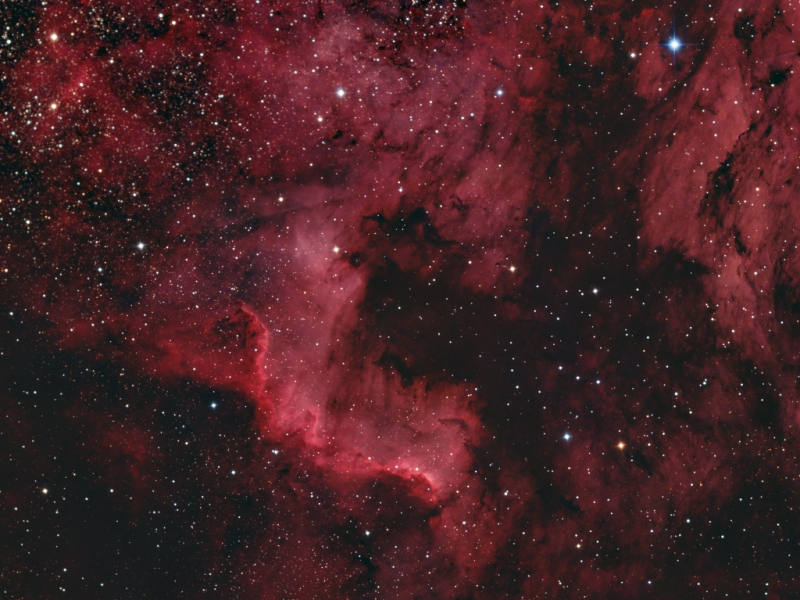
Picture of the Week this time is a Sky90 MiniWASP array composite of the Cygnus Wall, Weasel, and Pelican’s Head region. I seem to get drawn to this area every year as the new imaging season starts. Well over 8-hours of data on this one and the nebulosity has been enhanced by using some star reduction courtesy of Russ Croman’s StarXterminator and Noel Carboni’s plug-in to run StarXterminator in a way that allows gradual star reduction rather than total star elimination.
