Deep Sky Companions: The Messier Objects (Stephen James O’Meara)

Deep Sky Companions: The Messier Objects (Deep-sky Companions) (Deep-sky Companions) When you first start observing or imaging, the Messier list of objects is a very good place to start looking for nice deep-sky objects in the Northern Hemisphere.

Stephen James O’Meara has produced a beautiful reference work on the Messier objects in this “Deep Sky Companions” masterpiece.  Each Messier object is carefully described by Stephen as it appears to him through a modest refractor.  In addition, a very useful black and white photograph accompanies each object so you can be sure that you’re looking at the right thing.

I refer to this book [as well as Stephen’s other 3 books that I will recommend] on an almost weekly basis.  Full of very useful information and background detail – very highly recommended!

You can purchase the book at Amazon or any other good book retailer.
Posted in Recommended Reading | Leave a comment

Starscape II – Opening Night

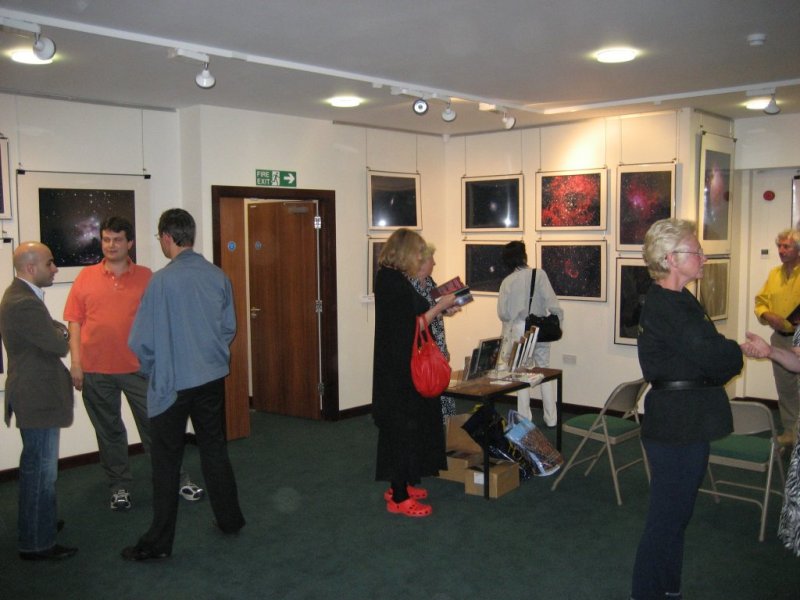
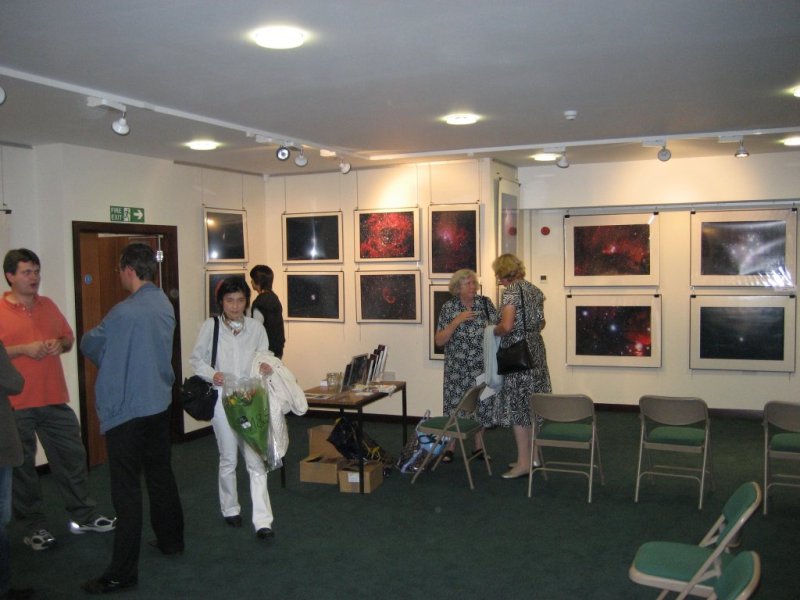
Opening night was very busy with over 120 people attending!  This was quite a lot more than I was expecting, but the hall is good for parties up to 200, so there was some spare standing room. 

Met up with some mates I hadn’t seen in a long time, as well as some of the Trade delegates who have supplied me with superb equipment. 

A Professor of Computing helped me out when the first PowerPoint slide didn’t appear to fire off the soundtrack, and once that was sorted, we were off. 

Drinks, lots of discussion, and plenty of questions, including the inevitable “are the colours real?” 

Don’t forget – the Exhibition runs until Friday 24th August, admission £1 only with children free – 10.30a.m. until 4.30p.m. every day.

Posted in Starscape II | Tagged , | Leave a comment

Astronomy Now Magazine (September 2007 Issue)

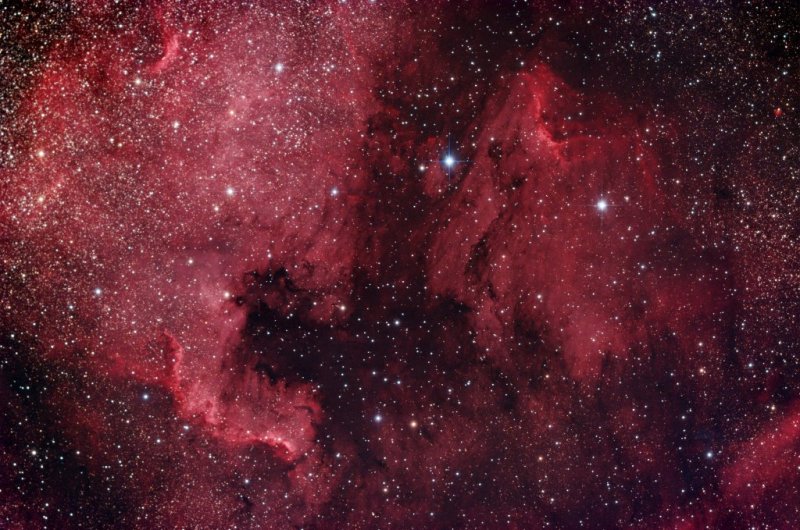
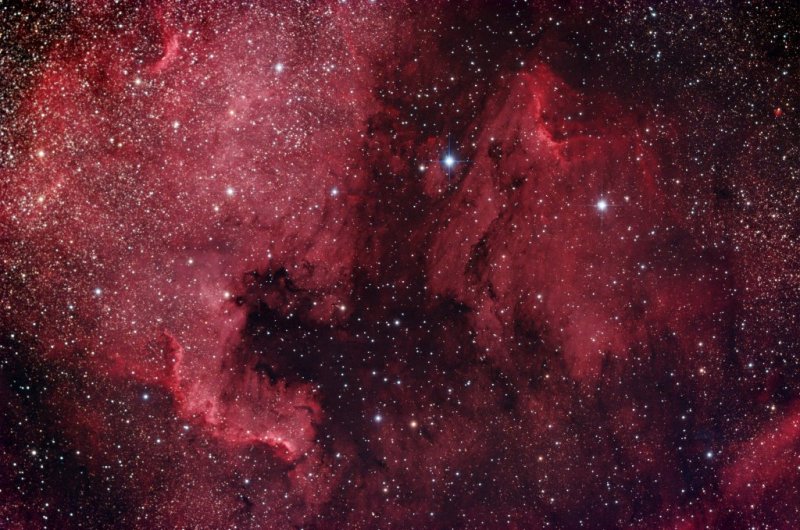
Just came home on Wednesday 15th August to find we have Picture of the Month in this Month’s (September 2007 Issue) Astronomy Now magazine.  Astronomy Now have published our wide field picture of the The North America Pelican Nebula.  Taken with the Takahashi Sky 90/SXVF-M25C combination, this is only around 4 hours or so of total exposure time, which is at the lower end for my work with the little Tak as I normally use a minimum of around 8 hours for nebulae.  Noel has managed to keep really good star colour as you can see, while bringing out all the faint stuff in the region of the Pelican.

Posted in Astronomy Now, Sky 90 and SXVF-M25C | Tagged , | 2 Comments

Astronomy Picture of the Day [APOD]

Today, Astronomy Picture of the Day [APOD] have published one of our most recent images, that of Messier 67 (M67) in the constellation Cancer.

Gathered at the center of this sharp skyview are the stars of Messier 67, one of the oldest known open star clusters. In fact, though open star clusters are usually much younger, the stars of M67 are likely around 4 billion years old, about the same age and with about the same elemental abundances as the Sun. Continue reading

Posted in APOD, Sky 90 and SXVF-M25C | Tagged , | Leave a comment

mini-WASP Array Project – Part 2 – A Likely Solution

In my last post I was at the point of deciding which refractors and CCD cameras to use.  I think I’ve now solved that dilemma!

Having gone through many combinations and permutations I am thinking the best solution for me is as follows: Continue reading

Posted in mini-WASP Array | Comments Off on mini-WASP Array Project – Part 2 – A Likely Solution

mini-WASP Array Project – Part 1 – The Problem

As I said in the project announcement, living in the UK we have a major problem to contend with trying to pursue our hobby – the weather!  There are very few good clear Moonless nights to take those perfect images.  I have also compounded the problem by moving from a very fast (Hyperstar) imaging system that worked at f#1.85, to a much slower refractor-based system working at only f#4.5, i.e. six times slower. 

The problem I am trying to solve is how to get as much image data as possible in the short time allocated to us during the year.  One way of increasing the data is to parallel up the imaging, that is, to have several identical optical imaging systems all imaging the same object at the same time. 

Continue reading

Posted in mini-WASP Array | Comments Off on mini-WASP Array Project – Part 1 – The Problem

Starscape II Exhibition (August 2007)

We are pleased to announce that the Starscape II Exhibition will open at 7.00 p.m. on Friday 17th August 2007 at the Brockenhurst Village Hall – which is within short walking distance of Brockenhurst main line station.

The exhibition is in support of the Brockenhurst Village Trust Stage Completion Project and is kindly sponsored by Exxon.

It will be open from the 18th August 2007 until the 24th August 2007 between 10.30am and 4.30pm.  Admission is £1 for adults and children admission is free.

We will be showing our latest images and Greg will be giving a talk about imaging deep-space objects (DSOs) at 7.30pm on the opening evening (definitely something not to be missed).  Opening night charges are £5 with free admission for Trade and Press delegates.

Note: Bar facilities will be available on the opening night only. 

So, please come down and have a look, ask questions and mix with other Astronomy enthusiasts! Download the Starscape Brochure to find out more about what we will be showing – but note – there are 19 new images to see in the Exhibition that you won’t find in the brochure!

[download#3#image]

Click the download icon to download a PDF version of the brochure.

Posted in Announcements, Starscape II | Tagged , | Comments Off on Starscape II Exhibition (August 2007)

Sir Arthur C Clarke’s Tribute to Sir Patrick Moore’s “The Sky at Night”

We are incredibly proud that we have been given permission by Sir Arthur C Clarke to publish his tribute to both the BBC television programme The Sky at Night and to Sir Patrick Moore.   If you do nothing else today – READ THIS!

Continue reading

Posted in People and Places | Comments Off on Sir Arthur C Clarke’s Tribute to Sir Patrick Moore’s “The Sky at Night”

The Brightest Known Object in Our Universe

According to the Guiness Book of Records this Quasar in the constellation Lynx is the brightest known object in our universe and who are we to argue with them [oops – see the Postscript below]! Continue reading

Posted in Deep Space Objects | Comments Off on The Brightest Known Object in Our Universe

Sky Atlas 2000.0 (Will Tirion and Roger W. Sinnott)

Cover Picture of the Book  If you are to explore the heavens – you need a good map to guide you.
In my opinion there is only one star atlas you need to consider, Will Tirion and Roger W. Sinnott’s “Sky Atlas 2000.0”. 

Be prepared, this is quite big when it comes through the post measuring some 30 x 42 cm!  Each page has large clear maps showing stars, clusters and nebulae.  A must have book

You can purchase the book at Amazon or any other good book retailer.
Posted in Recommended Reading | Leave a comment