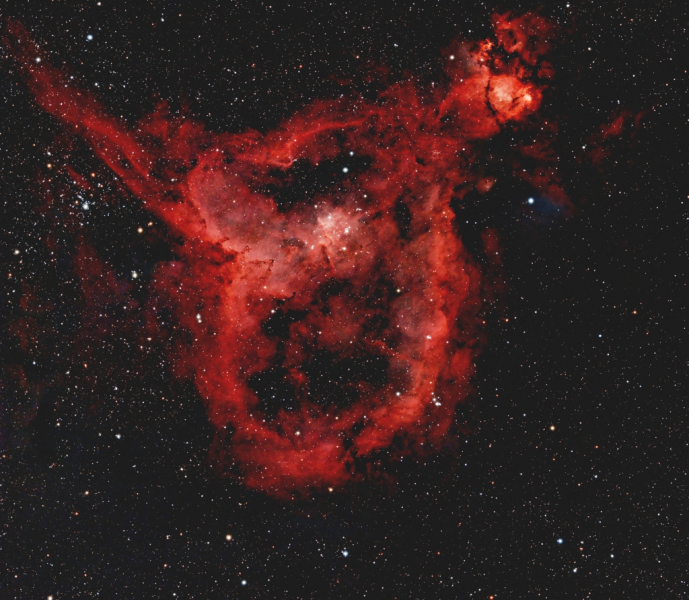
Veil Nebula – All the Data I Have

This image of the Veil nebula in Cygnus incorporates all the data I have on the object. So this image includes Hyperstar III on the C11 data, Sky90 (2-frame mosaic including narrowband) data, and the Canon 200mm lenses with the Optolong-Pro filter data. In total this will be in excess of 40-hours exposure time. If I can get it, I will add more Canon 200mm lens data as and when.

Posted in 200mm lens and ASI 2600MC-Pro camera, Canon 200mm prime lens, Deep Space Objects, Hyperstar and SXVF-M25C, Hyperstar III and SXVF-M26C, mini-WASP Array, Sky 90 and SXVF-M25C, Sky 90 and SXVF-M26C, Veil Nebula | Leave a comment

Today’s EPOD

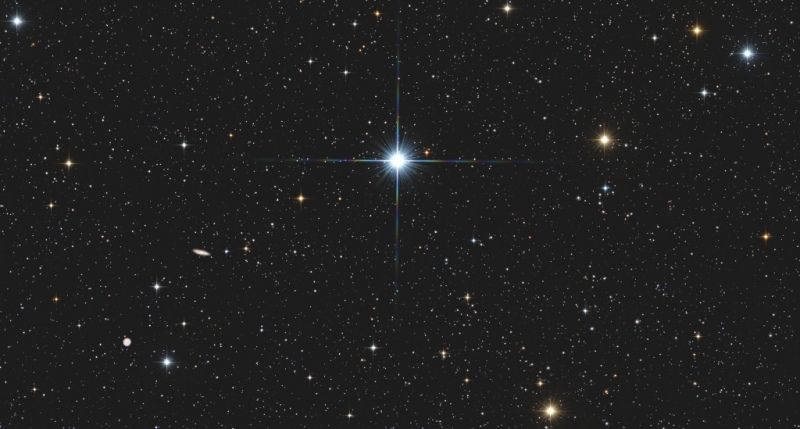
Got today’s EPOD – https://epod.usra.edu/ – with the recent Sadr and the Butterfly Nebula – taken with the Canon 200mm prime lenses and the ZWO ASI 2600 MC-Pro CMOS cameras. Thank you Jim for continuing to publish my work.

Posted in EPOD | Leave a comment

Filters on the Hyperstar 4

My usual filter on the Hyperstar 4, on a C11, with an ASI 2600MC Pro CMOS camera, is a simple UV/IR cut filter. And this does the job admirably. But in my Bortle 4.5 zone I would like to filter out some of the background rubbish and get even more performance out of the Hyperstar.

To this end, I have tried an Optolong L-Enhance filter which filters in the H-alpha and OIII and filters out the rest. Doesn’t seem to help the Hyperstar much as far as I can see, which just means the filter is not good at f#2. Not too surprising really, and pretty much as expected. However, I switched it over to the Canon 200mm prime lenses where it would provide an f#4.2 aperture – and the results are superb. Win some lose some.

Just seen that Starizona also sent me an Optolong L-Extreme filter as well. As I haven’t tried this out on the Hyperstar yet, I just fitted it this morning. I will do a test run on an object where I already have plenty of UV/IR cut filter data to compare it with (probably the Pelican nebula) and I will get back to you with the results. I am expecting that, once again, the results are inferior to a plain UV/IR cut filter, but you never know.

I used the Optolong L-Extreme filter to image the Gamma Cassiopei nebulosity with 15-minute subs! Now 15-minute subs with the Hyperstar are as you know, nothing to be sniffed at. And the result? Very disappointing unfortunately (for 15-minute subs).

So it is as expected, I don’t have any narrowband filters to hand that will help me reduce my local light pollution that work well at f#2. Any filtering will therefore be carried out on the 200mm lenses or the Sky90 array only.

Posted in Hyperstar 4 and ASI2600MC-Pro | Leave a comment

Carbon Star – T Cancri

A reprocess.

Posted in mini-WASP Array, Sky 90 and SXVF-M26C | Leave a comment

M31 – The Andromeda galaxy

A reprocess.

Posted in mini-WASP Array, Sky 90 and SXVF-M26C | Leave a comment

The Veil nebula in Cygnus

This is a composite image comprising 8-hours of 20-minute subs taken last night on the Canon 200mm prime lenses, together with a 32-hour 2-framer taken on a single Sky90 including Ha and OIII narrowband data. It still needs a LOT more 200mm lens data.

Posted in 200mm lens and ASI 2600MC-Pro camera, mini-WASP Array, Sky 90 and SXVF-M26C, Uncategorized, Veil Nebula | Leave a comment

MiniWASP Statrep

For some totally unknown reason I don’t think I’ve published the latest (stable?) incarnation of the MiniWASP array. So here it is!

The lower section of the MiniWASP (the black Aluminium box housing) contains 3 x Sky90s and top right is an 80mm guide scope with Lodestar camera. All 3 Sky90s have the f#4.5 reducer-corrector and the cameras are SX Trius26C OSC CCDs.

On the top of the frame there are 2 x Canon 200mm prime lenses with ASI 2600MC Pro CMOS cameras on the back. There is a USB controlled auto-focuser on each lens which makes imaging with this part of the system a complete doddle. Between the 200mm lenses is a 60mm Altair finder-scope with a webcam fitted on the back.

Posted in 200mm lens and ASI 2600MC-Pro camera, Canon 200mm prime lens, News, Sky 90 and SXVF-M26C | Leave a comment

Life on Earth

Earth was created about 4.5 billion years ago, first life appeared about 4 billion years ago. So as soon as Earth was cool enough for complex life molecules to assemble, there they were, complete and ready to go. Now fast forward 4 billion years to the present day and we still have that same original form of DNA populating the planet, but we have not (it seems) produced any new complex life molecules in all that time, it’s just the same DNA base, all the way back to the beginning. That is ridiculous. It is ridiculous, both in that life arrived so quickly on Earth, (almost, it seems, as quick as was chemically possible), and it’s also ridiculous that there has been no DNA successor/improvement/upgrade for 8 times the wait for first life to appear.The life base is still the same DNA double-helix structure. There is only one logical explanation taking all of this into account. The first life molecule(s) came from off planet, either through panspermia, or seeded by extraterrestrials. Whatever the actual origin, an off-planet source for DNA means that there is life elsewhere in the Universe, and it will be DNA-based life as well!

To believe that DNA could have suddenly appeared on Earth, complete, formed by natural processes, as soon as Earth was cool enough – and yet there has been no sign of any other sudden appearances of life-molecules in the 4 billion years since then, is not a very scientific observation of the facts.

Posted in News | Leave a comment

The Origin of Life

Now here’s the problem – and I think it’s a real biggy. I asked a while back if there were any double helical molecules anybody knew of that were NOT associated with life. Looks to me like there aren’t any, even very simple ones just a couple of coils long.
The Earth is over 4.5 billion years old, and yet during those 4.5 billion years no double helical molecule has been produced anywhere, I’m not talking DNA here thousands of coils long with many tens of thousands of base-pairs, I am talking ANYTHING, however short, with a double helical structure. Just to recap – with over 4.5 billion years behind us, no double helix apart from life.
The first life appeared on Earth as soon as it was cool enough to not break up complex molecules, and this seems to be around 4 billion years ago. So now, get this, life appeared on Earth just 0.5 billion years after it coalesced from space junk, and yet we wait another 4 billion years and no double helical molecule, no matter how simple in form, comes about. Don’t you find that odd?
There’s only one possibility as far as I can see. If a life molecule was present here on Earth just 0.5 billion years after its formation, then that molecule came, intact, from elsewhere. So this means either Fred Hoyle’s “Panspermia” where the life molecule arrived on a comet or some other space debris, or that the planet was intentionally “Seeded” by an advanced race. Note, if the “Panspermia” theory is true, then life exists somewhere else “out there”. If the seeded by little green men theory is true, then life definitely exists “out there”.
Whichever way you cut it – it looks like there is life “out there”.
How interesting.
Posted in News | Leave a comment

GAIA

Re the deluge in Libya – following the deluge in Greece which followed the wildfires in Greece.

Gaia is pretty pissed off you know. She’s making it clear for everyone to see, but nobody seems to be taking any notice.

Posted in Uncategorized | Leave a comment