Update on the Configuration of the Sky90 Array

Having proved the efficacy of the utterly superb Optolong L-Enhance filters on the 200mm lenses (with ASI 2600MC Pro CMOS cameras) – it was clearly time to fit the same thing to my Sky90s (with Trius M26C OSC CCDs).

2 of the Sky90s have filter wheels attached so now they will be configured with the following filters:

  1. UV/IR cut filter.
  2. Optolong L-Enhance filter.
  3. R75 (infrared) filter.
  4. SII narrowband filter.

The third (main) Sky90 will just have a 52mm UV/IR cut filter so this is the scope that will be used to get the star colour. As the 3rd Sky90 is on the same level as the guide scope, I will be able to image with this (UV/IR cut filter) Sky90 at the same time as I image with the 200mm lenses. More data is good data.

Posted in mini-WASP Array, Sky 90 and SXVF-M26C | Leave a comment

Additional Hyperstar 4 Data for the Rosette

I got 29 x 4-minute subs on the Hyperstar 4/ASI 2600MC Pro CMOS OSC CCD last night which I added to the 10 x 4-minute subs taken last year. This is the result. Not a huge improvement – but a little improvement.

Posted in 200mm lens and ASI 2600MC-Pro camera | Leave a comment

A Sharper Trapezium

As I have access to the original data, I was able to look through the 50 subs and then threw out 16 which had “blobby” stars. So here is the sharper result using only 34 of the original 50 x 10-second subs. This was at f#6.3 using the Celestron reducer on the back of a C11 with the tiny little 1.4MPixel H9C OSC CCD.


Posted in Reducer and SXV-H9C | Leave a comment

Sometimes Your First Guess Turns Out to be the Best

Well this is quite extraordinary. I discovered a huge pile of DVDs last week and I just spent a few days downloading them all onto an HDD. The data was all very old (mostly around 2005) and is all taken with the original Hyperstar (no collimation or rotation adjusters) on a C11 with a tiny little H9C OSC CCD (1.4 Mpixels). Now as I had only JUST started off imaging, I knew absolutely nothing about sub-exposure times, or basically anything, so these two images were taken with 30 – 40-second subs, and there were 150 – 200 subs stacked for each image. As you can see – the Trapezium region of M42 is not completely blown out – unlike all my later “better” work!! So by pure luck I was actually doing better early on when I didn’t know what I was doing compared to later on when I actually thought I’d learned a few things. This is not the first time that my initial best guess turned out to be almost optimum 🙂 These images are from February 2005.

Posted in Hyperstar and SXV-H9C | Leave a comment

At Last!!! It is Now “Out There” The Solid Golden Angle

Well good old Wolfram Research came through and they have published my Solid Golden Angle in their Notebook Archives. So at least it is now “out there” with a name associated with the discovery.

https://notebookarchive.org/the-golden-solid-angle–2022-12-dtu824g/

Posted in Projects | Leave a comment

What is the Nature of Reality?

I am 68 years old, nearing 69 and I have been retired since 2010. Therefore I have no job to lose by writing stuff that you might think could get me committed. And also I don’t have that many years ahead of me to leave this subject dormant for much longer. So here’s a couple of the weirdest observations from my life that might help someone with far greater intelligence than me, piece together what the Nature of Reality is.

The first extremely odd experience was from when I was working as a Research Scientist at the Philips Research Laboratories, Redhill, Surrey. I had just spent weeks putting together a pretty complex piece of measuring kit, inside a screened room, in order to measure the energy levels of deep-levels in Silicon. Now before you turn off it doesn’t really matter what that all means, it just means I am doing measurements on Silicon at very low temperatures and I look at the rate at which impurities in Silicon release electrons (or holes) as a function of temperature. So I had built the kit – but I actually knew nothing about the results I was due to get. I had not read any papers by other people who had done exactly the same thing, so I went about collecting the data not really knowing what I was doing. So I spent a couple of hours collecting the data, plotted it out – AND – the result was complete rubbish. The data points were all over the place and made no sense. I went off to lunch. Before returning to the experiment I went to the library and read up on what I should be expecting. You can see what’s coming a mile away can’t you? When I returned to the experiment and retook the data I of course got the expected curve from which it was a simple matter to extract the impurity’s energy-level. That’s exactly what happened – I’m saying no more 🙂

The second weird experience is even more way out and might have something to say about “the observer” in Quantum Mechanics.

I had been married to my wife for a good number of years, and she had begun to suspect there was something a little odd about how I observed (or rather didn’t observe) the World. As a Scientist, I am as Clouseau said “Trained to observe” – but actually that’s a bit of a joke where I am concerned. So what my wife did during the course of a morning, was to completely change what she was wearing to see if I would notice. Of course I didn’t notice. But when she’d done about the 4th change of clothes she was getting a bit fed up and said “Don’t you notice anything different?” That was enough to kick in some dormant part of my brain and although I didn’t actually SEE it I said, “You have been changing your clothes to see if I would notice”. So that gives you the background to an even more weird case of no observation.

It was my 50th Birthday and annoyingly I had to go into my University spin-off company that morning (I hate doing anything on my Birthday). My secretary Jilly was already in and she got up to make me a cup of tea which was the usual morning ritual. I walked across to my office and sat down and turned on the computer. At this point Jilly came wandering across without the tea and that was the trigger this time. Like something out of the Star Trek transporter, suddenly all these cards and decorations appeared out of nowhere in my office. Jilly stood at the door and said – “You didn’t see them did you?”, I said “Of course I did (laughing)” – She was not to be so easily fobbed off “No you didn’t she said” – and walked off to get the tea.

What I hadn’t known about all this was that Jilly had phoned up my wife earlier in the week to see if it would be o.k. to decorate my office. My wife had told her that it would be fine, but that I probably wouldn’t even notice. So Jilly had be forwarned which was a pretty dirty trick. However, that’s what happened.

So what has this got to do with Reality? In Quantum Mechanics a lot of weight is placed on “the Observer”. So what if, as in my case, the Observer doesn’t actually observe (the event). Did the event happen, or didn’t it. The event may not have happened as far as I was concerned – but does that mean that the event didn’t occur at all?

So what do I think happened in this very weird case? It felt like a Schrodinger’s Cat situation, where the cat is both dead AND alive until it is observed. The way all the cards and decorations appearing shimmering into existence was like the trigger (Jilly) had kicked something off in my Mind which in turn collapsed the wavefuntion of the cards and decorations. Up until that point (of the trigger) the cards and decorations were in a superposition state – they were both there – and not there – and it was only with the collapse of the wavefuntion (caused by me, the observer) that they appeared to be there.

As I said – if you are a better Physicist than me – this will probably give you the clue as to what the Nature of Reality is in terms of Quantum Mechanics. I don’t actually have the answer myself.


Posted in Projects | 2 Comments

Composite IC410 IC405

This is a composite image of the IC410/IC405 region taken using a Sky90 refractor with an M25C OSC CCD and a pair of Canon 200mm prime lenses with ASI 2600MC Pro OSC CMOS cameras. The Sky90 data was 5-hours and 37-minutes of RGB and 6-hours of H-alpha, and the 200mm lens data was 19-hours of RGB giving a total exposure time of 30-hours and 37-minutes.

Posted in 200mm lens and ASI 2600MC-Pro camera, mini-WASP Array, Sky 90 and SXVF-M25C | Leave a comment

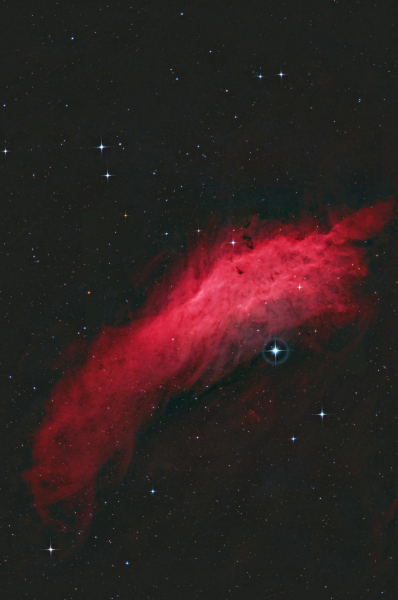
Definitive 200mm Lens Image of the California Nebula Processed by Noel Carboni

Noel worked his magic on this superb California nebula process which shows the extent of the “nose” on the front end of the nebula which is often missing in smaller field-of-view images.

Posted in Canon 200mm prime lens | Leave a comment

Composite Rosette nebula

This image is a composite of Sky90 and Hyperstar 4 data only.

Posted in Hyperstar 4 and ASI2600MC-Pro, mini-WASP Array, Sky 90 and SXVF-M26C | Leave a comment

The Heart of the Rose

This is the central region of the Rosette nebula. This is a composite image created using RegiStar and comprises original Hyperstar, Sky90 and Hyperstar 4 data exceeding 15-hours of total exposure time.

Posted in Hyperstar 4 and ASI2600MC-Pro, Hyperstar and SXV-H9C, mini-WASP Array, Sky 90 and SXVF-M26C | Leave a comment