Composite M31 Using the C11/Hyperstar4/2600MC Pro camera

Here is a composite image of M31 using all the C11/Hyperstar4/2600MC pro camera data I could find. this is around 6-8 hours of 3-minute subs.

Posted in Hyperstar 4 and ASI2600MC-Pro | Leave a comment

M31 – First Image of the New Season

Got out for the first time last night for this new season – clear Moonless night – pretty much perfect conditions.

I meant to image the Altair region with the 200mm lenses – BUT – one of the 2600MC Pro CMOS cameras decided to die on me putting the kaibosh on that project.

So I fired up the C11 Hyperstar 4 with a working (fingers crossed) 2600 MC Pro and managed to get 52 x 3-minute subs on M31 (with 60 subs in total taken).

My processing is pretty poor, but the potential of the image still comes through.

Posted in Hyperstar 4 and ASI2600MC-Pro | Leave a comment

The IC2087 Region of the Taurus Molecular Cloud

This is a 2-frame mosaic using the Canon 200mm prime lenses and the Trius M26C OSC CCDs. The left hand side of the frame is the IC2087 region and the right hand side has the bright star SAO76573 in the centre – north is up. Each frame is 10-hours of 20-minute subs so the whole image is 20-hours in the making. This region is just a small part of the massive Taurus Molecular Cloud.

Posted in Canon 200mm prime lens, mini-WASP Array | Leave a comment

Star SAO76573 in the Taurus Molecular Cloud

Final reprocess for today. Another 200mm Canon prime lens image with the Trius M26C OSC CCDs, but this time just a single-framer. The central star is SAO76573 and from its dusty surroundings you might guess it sits in the Taurus Molecular Cloud. North is to the left and this image is meade up from 30 x 20-minute subs so 10-hours of data in this one. North is to the left.

Posted in Canon 200mm prime lens, mini-WASP Array | Leave a comment

Procyon and Gomeisa – Canis Minor

Reprocess number 2 for today and another 2-frame mosaic from the 200mm Canon prime lenses and the Trius M26C OSC CCDs. This time it is Procyon (bottom left) and Gomeisa (top right) which make up the constellation Canis Minor. Approximately 6-hours of 10-minute subs in this one.

Posted in Canon 200mm prime lens, mini-WASP Array | Leave a comment

Arcturus reprocess

Another reprocess – this time of the 200mm Canon prime lens data (with Trius M26C OSC CCDs). This is a 2-frame mosaic of Arcturus – so this is a BIG field of view. Around 4-hours of 5-minute subs in total. North is up.

Posted in Canon 200mm prime lens, mini-WASP Array | Leave a comment

Tarazed and Barnard’s “E”

A reprocess of some old 200mm lens data using the Trius 26C OSC CCD camera. This is 22 x 10-minute subs on the Tarazed/Barnard’s “E” region. This year I will try to get a 2-framer of this region including Alshain and Altair as well as Tarazed.

Posted in Canon 200mm prime lens, mini-WASP Array | Leave a comment

More Mirror Magic

Quite some time ago I wrote up a piece on how a vertically oriented mirror laterally inverts an image (it doesn’t by the way). People quite often ask, if a mirror inverts laterally, then why doesn’t it invert vertically as well. In other words, if a mirror inverts left-right, then why not top-bottom. That is an extremely good question as it turns out, and the answer carries on with the same theme of SYMMETRY. We get left-right inversion (or apparent inversion) when the mirror is positioned VERTICALLY. So what happens when the mirror is positioned HORIZONTALLY? The above image of the reflection of a tree in calm water (the mirror) shows you what happens. Yep – there’s the top-bottom inversion for all to see. Symmetry considerations can be an extremely powerful technique for solving some (apparently) difficult problems.

Posted in News, Projects | Leave a comment

M31 – The Great Spiral Galaxy in Andromeda

Here is a composite image of M31 comprising 2 sets of Sky90/M26C OSC CCD data.

Posted in mini-WASP Array, Sky 90 and SXVF-M26C | Leave a comment

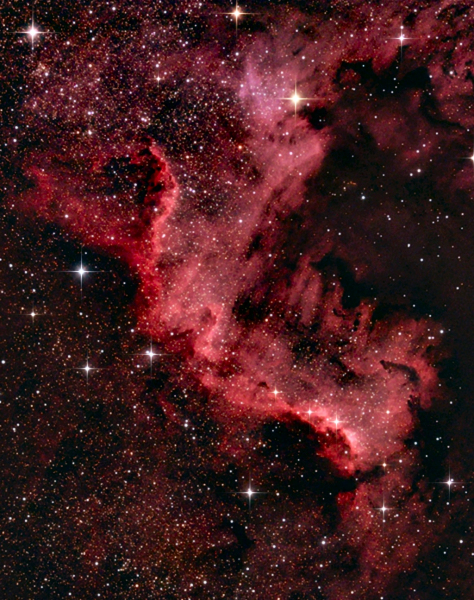
The Cygnus Wall

A real blast from the past. Just came across this one and tarted it up a little on Paint Shop Pro. This is the Cygnus Wall region of the North America Nebula. I cannot remember the year this was taken (probably either 2011 or 2012) but I do remember it is a 2-framer with the original Hyperstar (no collimation or rotation adjusters) and the tiny little H9C OSC CCD.

Posted in Hyperstar and SXV-H9C | Leave a comment