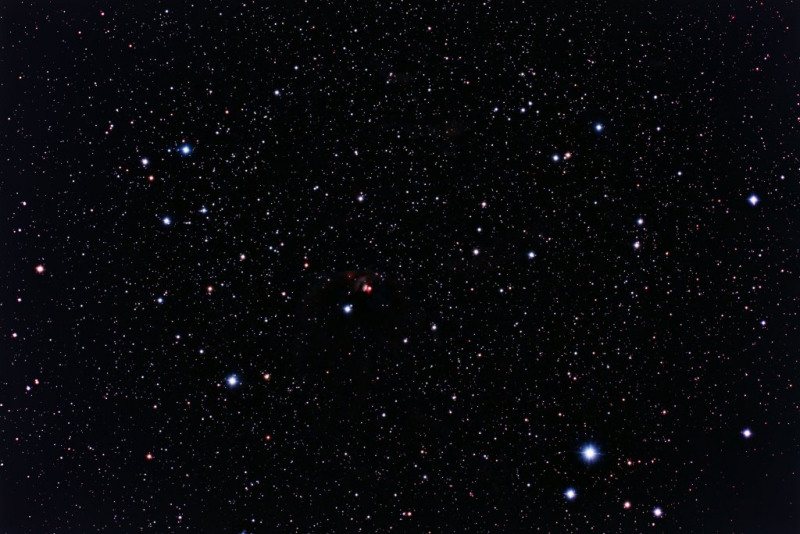
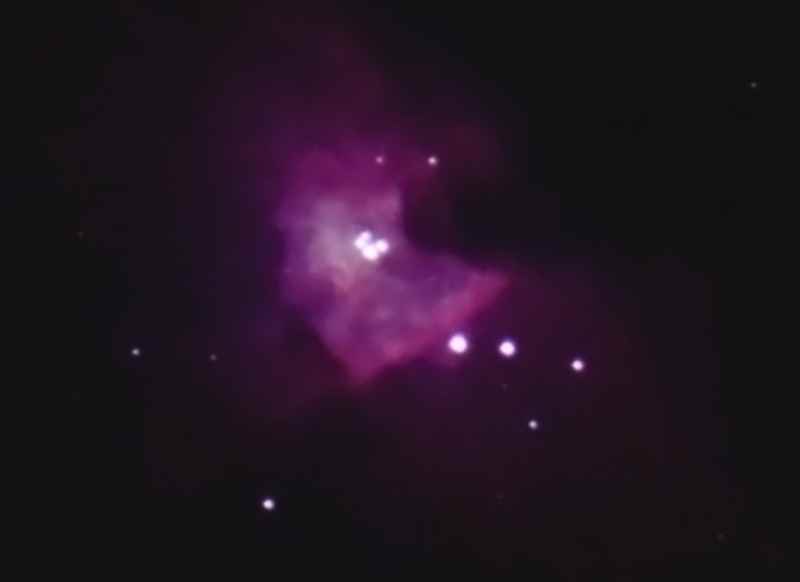
How did I image the Trapezium with 30-second subs on the Hyperstar 4?

I said I wouldn’t divulge the secret if the result was good. As the result wasn’t particularly good, I’ll tell you how it was done. The ultra-fast Hyperstar 4 at f#2 will blow the core of M42 (the Trapezium region) with anything over 1-second exposures. I suppose you could use even shorter exposures, but then you would be adding more camera noise to the image as well as having the poor SNR of a short exposure. So my idea was to take longer exposures, to get away from the camera noise, by reducing the luminosity of the core region. But how can you do that? I was given the idea over 17 years ago when I was visually observing the core region with the C11 at its native f#10. I couldn’t see the Trapezium stars of course, as the region was just too bright – but then a cloud drifted across M42, and just for a moment I saw the Trapezium stars, very clearly. So there was the clue. To mimic the cloud I bought a Neutral Density Filter (10 stops) and it certainly did a great job in cutting down the luminosity, but the resulting image at f#2 is a bit disappointing as the region takes up too little space in the whole field of view. So although the idea works, in principle, it’s not the best way to image this one.
Posted in Hyperstar 4 and ASI2600MC-Pro | Leave a comment

Struve’s Lost nebula with the Hyperstar 4

Clear Moonless sub-zero night last night so I was expecting some great results from the Hyperstar 4.

Managed to get 25 x 5-minute subs with good collimation, and the above image is the result. It’s terrible. Virtually no dust which came out well using the Sky90 array.

Must admit, the sky did look rather light, and I guess it was full of ice crystals. First time I’ve had that as an issue.

Posted in Hyperstar 4 and ASI2600MC-Pro | Leave a comment

The Trapezium region of M42, the Great Nebula in Orion

This is the result of 60 x 30-second subs on the Hyperstar 4 with the C11 and a secret ingredient optical device. Still plenty of noise even with 60 subs, so it looks like I’ll be needing nearer 200 subs to get the noise down. However as these 60 subs took up 3Gb, and then de-Bayering and processing added another 9Gb, it looks like this data will be needing its own hard drive just for this one image!

Posted in Hyperstar 4 and ASI2600MC-Pro | Leave a comment

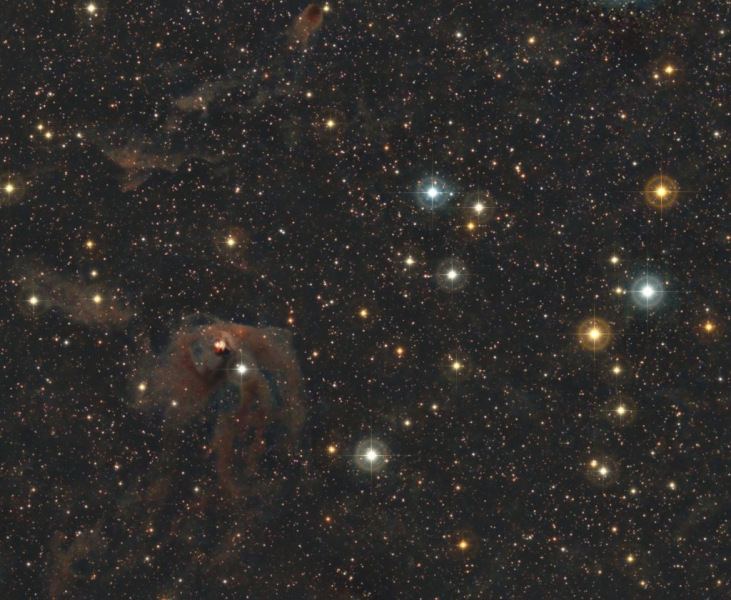
Struve’s Lost Nebula

This is a composite image using DSS2 data and my own Sky90 data of the Struve’s Lost Nebula region. If I ever get the skies, I will need to get a lot more data on this one.

Posted in mini-WASP Array, Projects | Leave a comment

Christmas has come a little early this year.

Yesterday I received a couple of deliveries to completely upgrade the MiniWASP array, both the 3 x Sky90s and the 2 x 200mm Canon lenses. I am glad the weather continues to be awful as it means I’ll be able to get everything put together in readiness for a clear sky.

I also got some optics for the Hyperstar 4 on the C11. I am hoping that with this piece of kit I’ll be able to take 30-second to 1-minute subs of Orion’s core and be able to pull out the Trapezium. If it works I’ll keep the magic ingredient to myself, if it doesn’t work, I’ll let you know what it is so you don’t go down the same blind alley.

Posted in Canon 200mm prime lens, Hyperstar 4 and ASI2600MC-Pro, News, Sky 90 and SXVF-M26C | Leave a comment

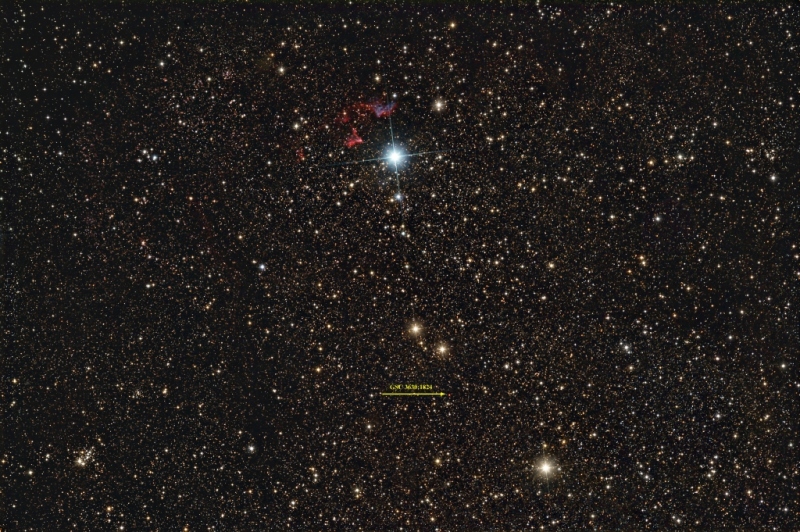
A Carbon star in the Gamma Cass region

I was just looking at an old Gamma Cass image (for another reason) and saw a bright red dot for the first time. Yep, it was a Carbon star that had been there all the time and I hadn’t noticed. GSC 3680: 1824  COeV.


Posted in Canon 200mm prime lens, Deep Space Objects | Leave a comment

M42 and the Running Man

After the CTB1 experiment – M42 was well-placed in the South and I managed to get 10 x 3-minute subs before the cloud rolled in from the West. This is pushing me to get 100 x 3-minute subs just to see what it looks like.

What is very interesting from this image is the lack of ghost flaring from the very bright stars. The Hyperstar 3 gave a lot of ghost flaring from bright stars, but in the Hyperstar 4 Starizona seem to have got on top of that problem. Well done Starizona!

Posted in Deep Space Objects, Hyperstar 4 and ASI2600MC-Pro | Leave a comment

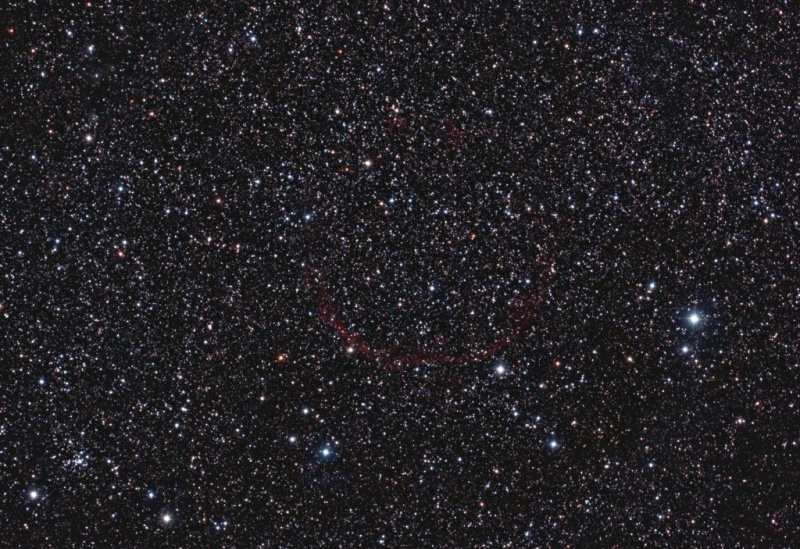
My Nemesis – CTB1 – but with a ray of hope.

The faint red ring that you can hardly see in the centre of this image is supernova remnant CTB1 in Cassiopeia. I have tried imaging this one for years, and this is what I usually end up with. I thought I was being clever this time, so I took 9, 12, 15, 18, 21, 24, 27 and 30-minute subs with the Hyperstar 4 – Yes, that’s a 30-minute sub exposure with the Hyperstar!! And the above is the result – why?

Didn’t think this one through enough. Now I’m pretty sure that with my sky background, I am not getting much signal to noise ratio improvement PER SUB for sub-exposures much beyond 10-minutes. So the above image, signal to noise ratio-wise, is little more than 8 x 10-minute subs. Now you can see, the result is not too surprising. If instead I had taken 48 x 10-minute subs (the usual 8-hours for a good quality image that I have found, experimentally, over 17-years of doing this stuff) then I would have got a 7-fold increase in the signal to noise ratio and almost certainly a far better looking CTB1.

So the quest for a decent CTB1 image continues.

Posted in Hyperstar 4 and ASI2600MC-Pro, Projects | Leave a comment

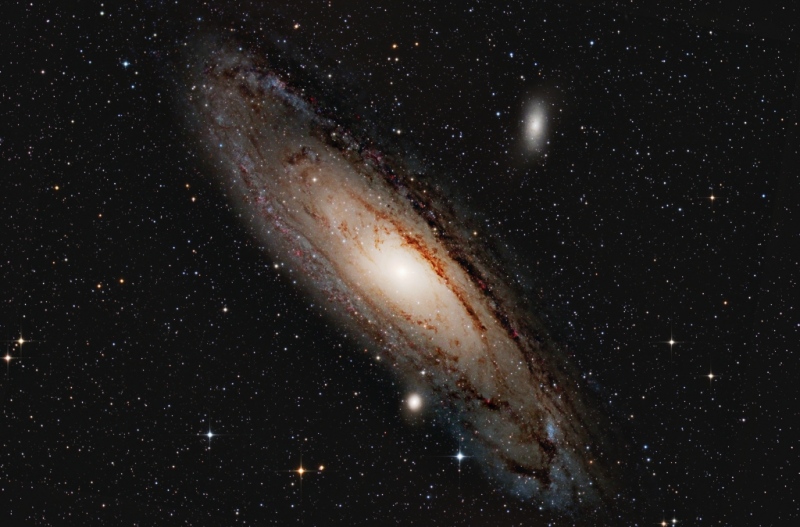
The Andromeda Galaxy, M31.

This is a composite image incorporating very recent Hyperstar 4 data with very old Sky90 data.

Posted in Deep Space Objects, Hyperstar 4 and ASI2600MC-Pro, Projects, Sky 90 and SXVF-M26C | Leave a comment

Another 7-minute ISS pass from earlier in the month.

Here’s another long 7-minute pass of the International Space Station from earlier this month (I’ve only just got around to processing the 17 frames of data). Annoyingly, as you can see, I didn’t continue long enough off the right hand side of the frame as I thought the ISS was out of the field of view. Lesson learned.

Posted in News, Projects | Leave a comment