And from a couple of nights ago – here is the Sadr region with the Canon 200mm lens array using 10 x 15-minute subs.
Should get some more time on this one and then try to grab the frame to the right as well.
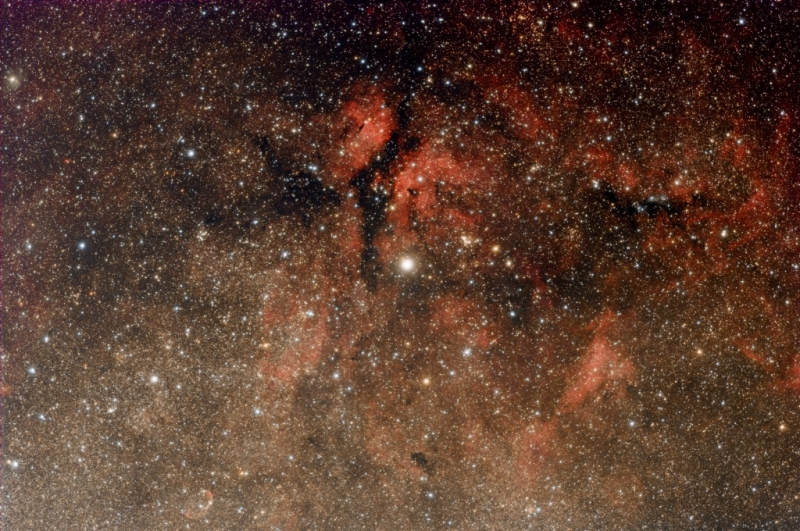
And from a couple of nights ago – here is the Sadr region with the Canon 200mm lens array using 10 x 15-minute subs.
Should get some more time on this one and then try to grab the frame to the right as well.
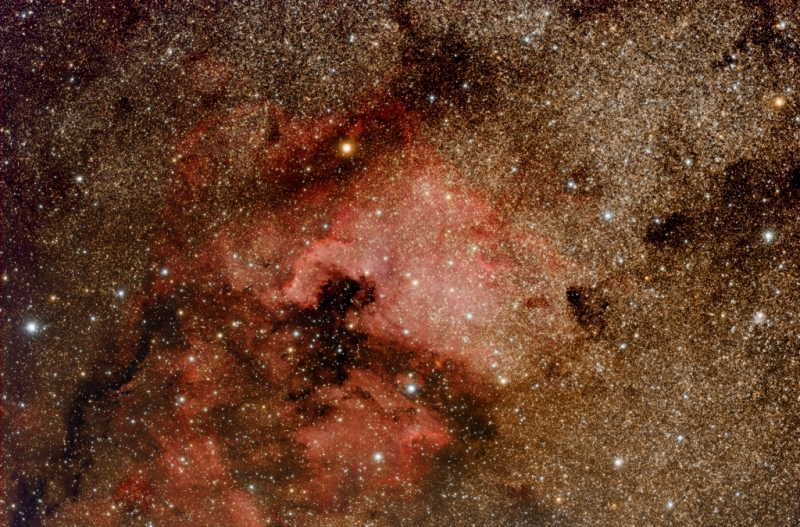
Got the 2 x Trius M26C cameras VERY flat and very well focused last night before starting a run on the North America nebula region.
Managed to get 17 x 20-minute subs before the Moon rose above the rooftops in the NE. Result below.
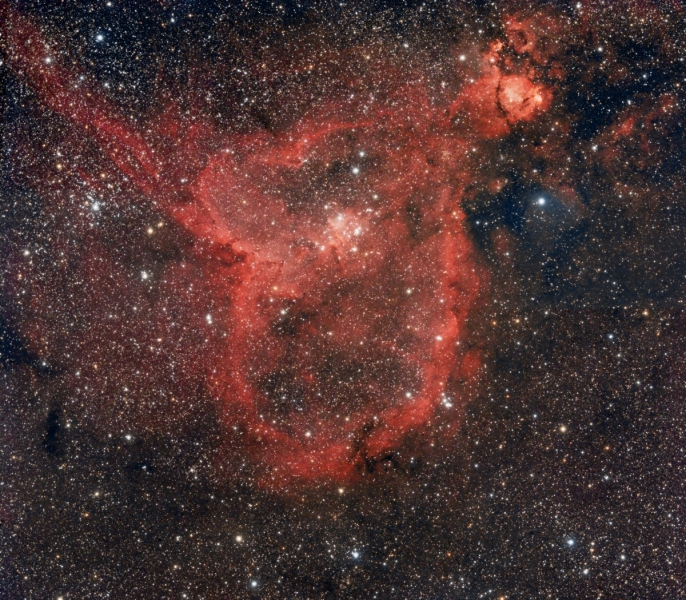
Here is the New Forest Observatory Image of the Month – last bit of data acquired only last night.
This is a 2-framer of the Heart nebula region taken using the Sky 90 array and the M26C OSC CCDs. The lower frame (captured last night) is 8-hours worth of 20-minute subs and the upper frame is 5-hours worth of 20-minute subs. The frames were assembled in Registar and processing was carried out in Photoshop CS3 using Noel Carboni’s Photoshop Actions for Astronomy.
Although this could do with still more data I need to move onto something new for my next target.
Got today’s Earth Science Picture of the Day (EPOD) with a Sky90 array shot of the Carbon star La Superba.
Thank you Jim at EPOD for continuing to publish my work.
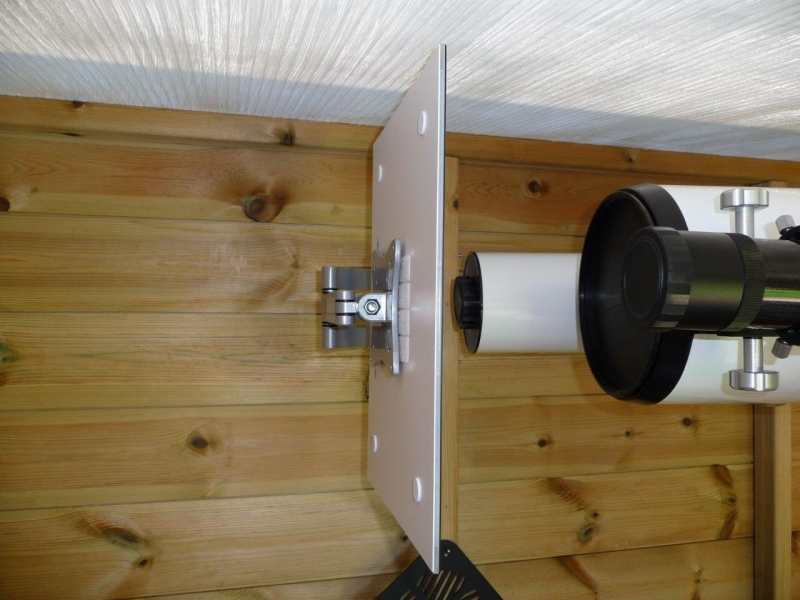
Peter Rusling has also used one of the Amazon supplied light panels for taking flats. He says:
“I’ve bought one of these excellent panels and thought I’d share that the light USB L4S version will mount safely on a £15 articulated TV arm in an obsy using Velcro. This allows me to position it up against either of my scopes and has the added bonus of providing an observatory light (albeit white) when stowed against the wall.”
A picture of Peter’s setup is shown below.
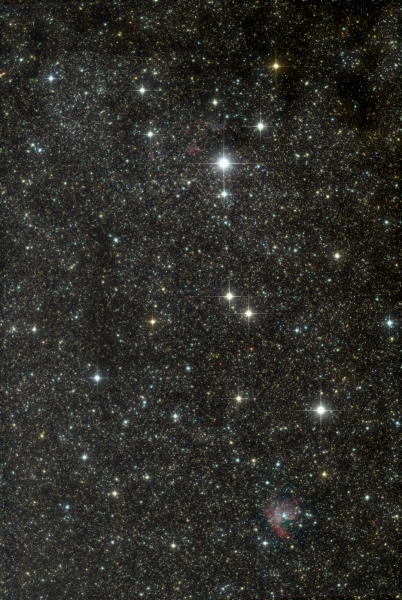
I have decided that the image for this month is the one you can see below – the very deep Canon 200mm prime lens single-framer of Cassiopeia from the Gamma Cass nebula (IC59/63) all the way down to the PacMan nebula. Although the nebulosity is nothing to write home about – the star field came out very nicely. And this got me thinking (always bad) – I now need to see how narrowband filters perform on this rig, so it is possible (if I get the weather) that this Image of the Month will also appear as a couple more images of the month as I add in some narrowband data.
I have incorporated narrowband data into earlier RGB work using the Sky 90 and M25C camera. Images include, the whole of the Veil nebula, the Horsehead nebula region, the M42 region, the Jellyfish nebula region, the IC1396 region, and finally I added some H-alpha data to the M31 image to bring out the emission nebula regions in that galaxy.
Check out the images of Caph and Ruchbah on today’s EPOD – both images are Canon 200mm prime lens 2-framers using the Trius M26C OSC CCDs.
And thank you Jim at EPOD for once again publishing my work.
From two nights ago here is a single-framer using the 200mm lenses and the Trius M26Cs of the region in Cassiopeia running from the star Navi all the way down to the PacMan nebula. This is 21 subs at 15-minutes per sub.
This is just 10 x 15-minute subs using the Canon 200mm prime lenses and the Trius M26C 10-megapixel OSC CCDs from last night (30/08/2016).
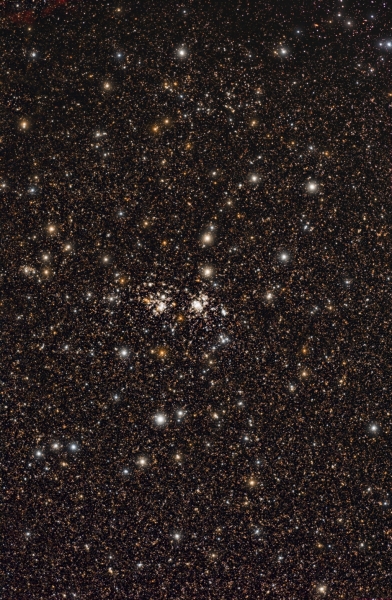
Last night I got the top 2 frames of an image I started last year. This is the central region of Lyra taken using the Canon 200mm prime lenses and Trius M26C OSC CCDs. I have deliberately accentuated the contrast showing the “dark lanes” running through the region and I am in the process of checking that they correspond to the dark lanes seen by other imagers who have taken wide fields of the same region.
This is the first 4-frame mosaic taken with the Canon 200mm lenses.