This is a great week for long ISS passes

On the night of the blue supermoon (31st July) I looked out of the window to see the ISS passing over the Moon (so I missed a great photo-opportunity) around 10:00 p.m.

I hadn’t been keeping an eye on the ISS pass times lately so the same evening I took a look and was surprised to see that there were long 6-minute passes on just about every night of the following week 🙂

So on the evening of 01/08/2015 at 10:33 p.m. I was ready and waiting outside with the Canon 5D MkII and the Canon 15mm fisheye lens.  Beautiful long 6-minute pass.  Also there will be 2 tonight at 9:41 p.m. and 11:17 p.m. so I am hoping the weather will be kind.

Posted in News, Projects | Leave a comment

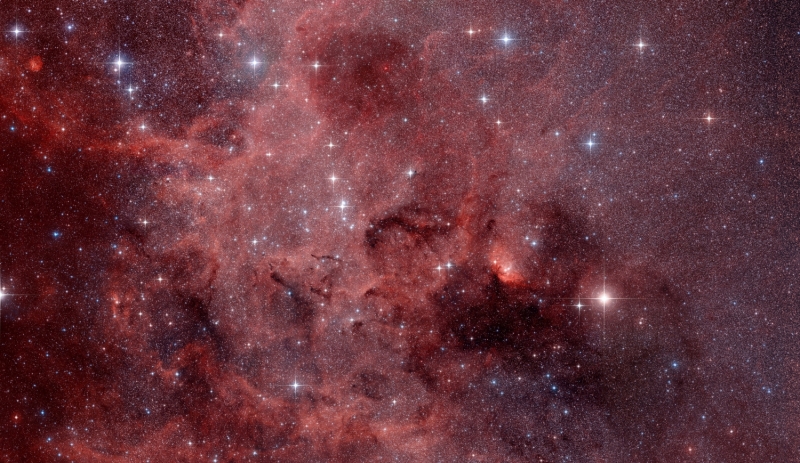
Mega-mosaic of the Tulip nebula region in Cygnus – EPOD

Today’s Earth Science Picture of the Day (EPOD) is the large DSS2 data mosaic I put together of the Tulip nebula region in Cygnus.

DSS2 data was downloaded (red and blue channels) and Noel Carboni’s actions were used to create an artificial green channel.  The RGB data was then further processed in Photoshop CS3 before the individual frames were stitched together using Registar.

This is EPOD number 69 – thank you Jim for continuing to publish my work 🙂

Posted in EPOD | Leave a comment

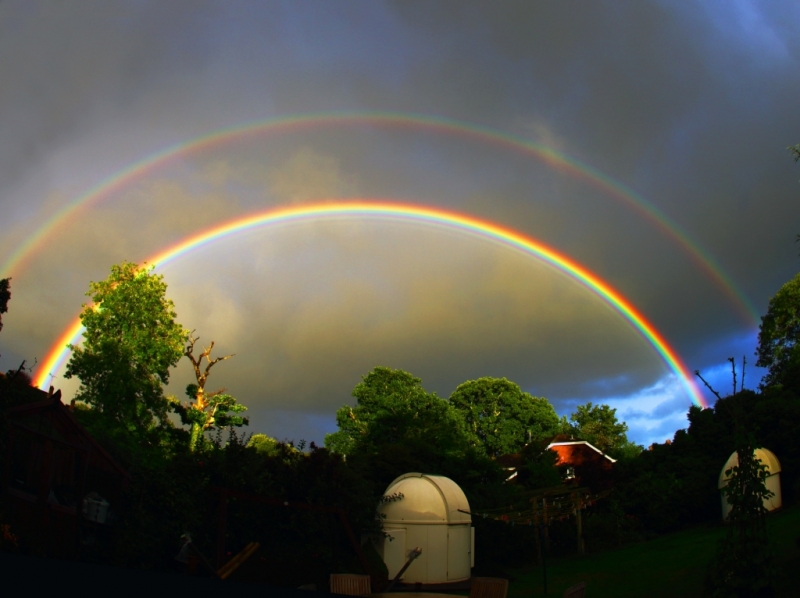
Double rainbow over the New Forest Observatories

Taken at 8:25 p.m. on 26/07/2015 this image shows a double rainbow over the New Forest Observatories – and more.

This morning I pushed up the contrast and saturation of the image to take a better, closer look at the rainbows.  I was surprised to see a bunch of blue/violet mini-bows on the inner edge of the primary bow.  Knowing nothing about rainbows I looked this up.  Found out this is what is called a SUPERNUMERARY rainbow.  Live and learn 🙂 🙂


Posted in News | Leave a comment

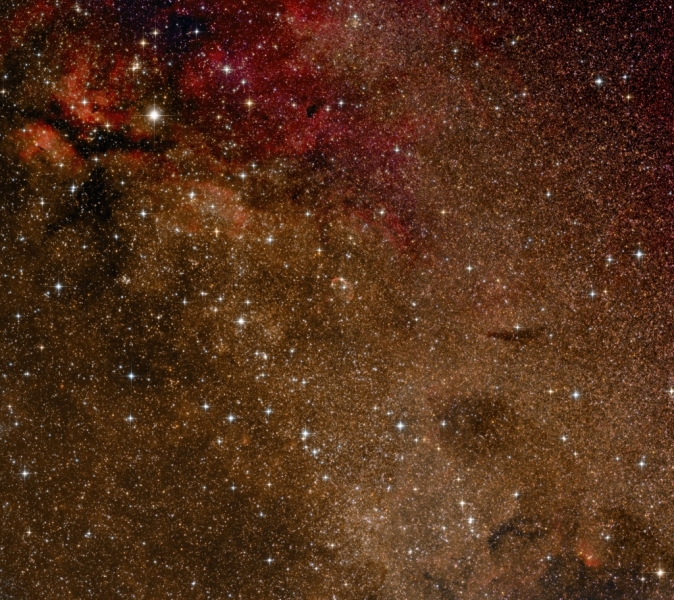
The MegaWASP array does the Crescent region in Cygnus

Last night, for the first time since I put it together, I have been able to use the 2 x Canon 200mm lenses (and M26C Trius cameras) as intended.

The whole idea with this rig was to get two horizontal frames for a very large FOV mosaic, so that the overall frame would be almost square.  The other reason for going for 2-framers with the 200mm lenses is that time-wise I would be able to do the equivalent of a single (200mm) frame with a 4-framer using the Sky 90s, and as there are 3 Sky 90s then it would almost take the same time as well – so pointless doing a single frame with a single camera on the 200mm lens.  Not so pointless with 2 lenses, but I didn’t have 2 when I was working this all out months ago.

Carrying on.  I had 3 hours of imaging time from 11:00 p.m. until 2:00 a.m. when the Crescent would transit so I managed to grab 10 x 15-minute subs on the left hand frame and 12 x 15-minute subs on the right hand frame.  A single frame measures 398 x 267 arc minutes.  Not enough time spent on this for a high quality image but at least it shows that the general principle works as expected.  Now all I need is some longer nights, some clear Moonless skies – and this kit will ROCK 🙂


Posted in Canon 200mm prime lens, mini-WASP Array | Leave a comment

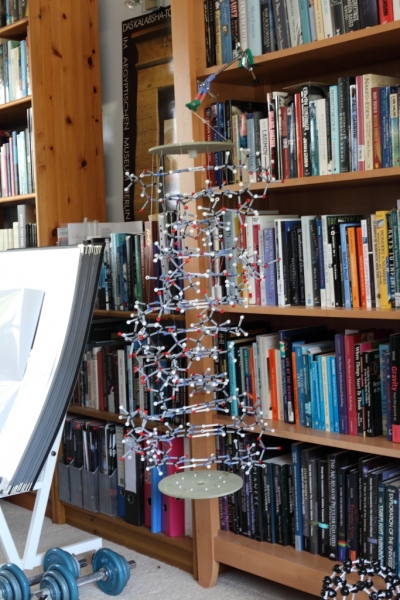
Cochrane’s of Oxford 12 base-pair DNA model kit

I have just assembled this DNA model that comes from Cochrane’s of Oxford.  It is extremely well thought out and the instructions for assembly are quite excellent given the complexity of the thing being put together.  When I first saw this kit I thought that it was a little expensive for what was being offered – I now think it is very good value for money indeed!

Posted in News, Projects | Leave a comment

Contact Parker Technology for portable high-power, high-speed flashguns

The Licence Agreement between Laserscribe Ltd. and Parker Technology was formally terminated on 01/07/2015.

If you wish to purchase custom built high speed electronic flash equipment contact Prof. Greg Parker at Parker Technology.

Posted in News | Leave a comment

You too can make your own high resolution deep-space images – without a telescope!

You too can make your own full-colour, high-resolution, deep-space images, just like the Tulip nebula mega-mosaic below – and you don’t even need to own a telescope.

However, you do need a copy of Photoshop and a copy of Noel Carboni’s Astronomy Actions for Photoshop.

The first thing you need to do is get your hands on the data which you will process into a full-colour image – I have described this process in an earlier Astronomy Now article – so if you are an Astronomy Now subscriber, look the process up there.

You will grab the data from the SkyView Query Form site.  Put in the co-ordinates of the object you want a picture of (or the object name) in the box at the top.  Go down to where it says what datasets are available and click on DSS2 red AND blue data.  Where it asks for image quality data put in 6000 pixels and leave the rest unchecked – this will give you a 6000 x 6000 pixel image at the highest spatial resolution on offer.  Send off the query and it will download the images to your monitor.  Go to the bottom of each image and click download the FITS files.  You will now have the red and blue channel data for your chosen object.  Now we need to process the data.

Open up Photoshop – and in Noel’s actions click on “Construct RGB image from channel files”.  This process expects you to supply red, green and blue channel data – but as you only have red and blue channel data you need to put the blue channel data into the green channel when the program asks you for it.  Go through the construct RGB process and at the end you will have a colour image of your object – but in the wrong colours as you didn’t provide any green channel data – fear not – Noel’s actions will come to the rescue!  Now click on “Synthesise Green Channel from Red and Blue” and Noel’s Actions will create an artificial green channel for your image giving something that looks a bit closer to “real” colour.

Now all you need to do is tweak the image in Photoshop to get something closer to what you are looking for.  I actually take the image into Paint Shop Pro at this point as it has a couple of very powerful “one click” processes.  I use the contrast enhancement tool on Darker/Normal/Normal and the saturation enhancement tool on More Colour/Normal – to get the image looking more how I want it – I then take it back into Photoshop for further cleaning up and to put on any (Noel Carboni) star spikes if I feel they are appropriate.

And that’s it.  You can produce deep-sky images of a quality far better than you can grab from your back garden with mega-expensive kit, and do it in far less time than it would take you to get just the data.  Makes you wonder why we actually bother to do it the hard way!
Posted in Deep Space Objects, News | Leave a comment

Tulip nebula in Cygnus – The Full Monty

I have been putting together a full-colour mega-mosaic of the Tulip nebula region in Cygnus using the wonderful DSS2 data.

As this is a pretty huge mosaic you can imagine the dataset was getting a bit unwieldy – and in fact my computer was starting to fall over – it couldn’t handle all the data.

So for now, until I get my hands on a Quantum Computer – this is it.  Won’t be adding any more to this one.

Printing out right now at A1-size on the HP Deskjet 130 6-colour printer.

Enjoy 🙂

Posted in Deep Space Objects, News | Leave a comment

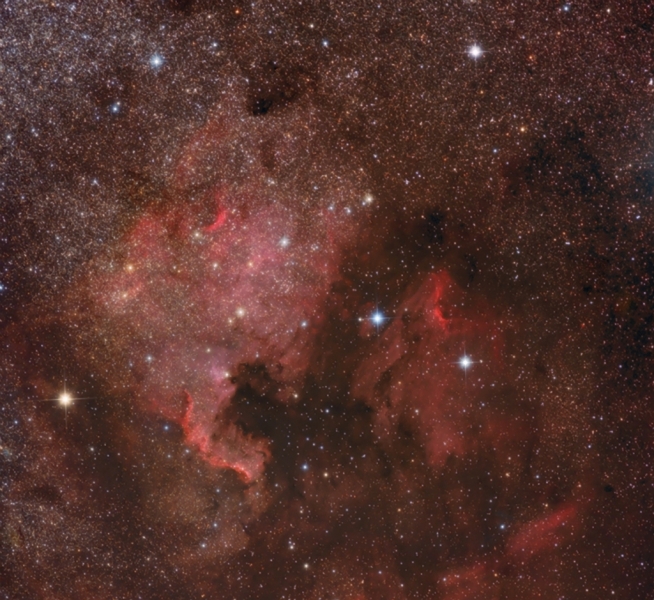
North America & Pelican nebulae composite

The recent 200mm/M26C data composited reasonably well with earlier 200mm/M25C data.  Unfortunately one camera was in portrait mode and the other in landscape mode – so I only got the overlapping square bit in the middle 🙁

Posted in Canon 200mm prime lens | Leave a comment

Earth Science Picture of the Day (EPOD)

Got today’s EPOD with a winter-to-summer solstice solargraph using a 4-inch diameter drainpipe and a piece of A4 size photopaper 🙂

Thank you Jim at EPOD for continuing to publish my work.

Posted in EPOD | Leave a comment