Earth-based telescopes will outdo Hubble in resolution by a factor of 16

This is a well-known fact, apart from a certain misinformed person (Professor?  I somehow doubt it) who felt it necessary to impart his faulty “knowledge” at a talk I gave at the Lymington Yacht club.

For the benefit of the misinformed individual there is an interesting article that can be found here:  http://www.nature.com/news/astronomy-laser-focus-1.16741?WT.ec_id=NEWS-20150127  which spells out in detail how adaptive optics gives large ground-based telescopes the edge in resolution over Hubble (as I actually said at the end of my talk but which obviously went straight over the head of said Yachtie).  However, to any thinking person it shouldn’t come as too much of a surprise should it?  The new Extremely Large Telescope (ground-based) will have 16x yes that is SIXTEEN times the resolution of Hubble.  But it’s hardly a fair race when you are putting a 39-metre mirror (the ELT) against the piddling little 2.4-metre mirror of Hubble is it?  Yes you need the adaptive optics to get the best out of ground-based telescopes, but it is hardly surprising (to most people) that the huge ground-based telescopes can outdo Hubble in terms of resolution.
 

Posted in News | Leave a comment

Photography courses at the New Forest Observatory

The 2015 prices for all photography courses remain the same as for 2014 🙂

Whether it is DSLR photography (macro, micro, high-speed, Nature or specialist) or deep-sky imaging – the New Forest Observatory has a custom made course for you.

Posted in Photographic courses | Leave a comment

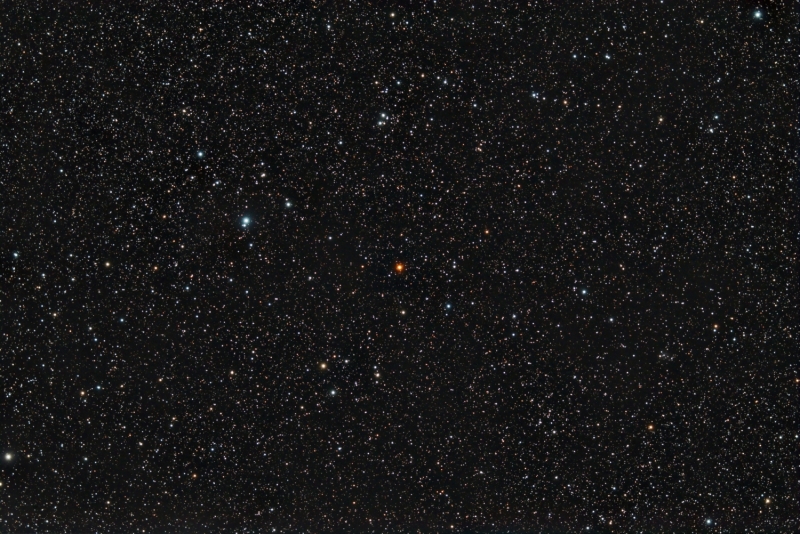
Carbon star SAO 77516

Managed to get the mini-WASP array set up early last night, imaging by 6:10 p.m., just as well as clouded out by 8:10 p.m.

Set up on Carbon star SAO 77516 in Taurus, was going to do M1 but then saw there was a Carbon star nearby and went for that instead.

30 x 10-minute subs – plenty for a star field shot 🙂

Posted in mini-WASP Array | Leave a comment

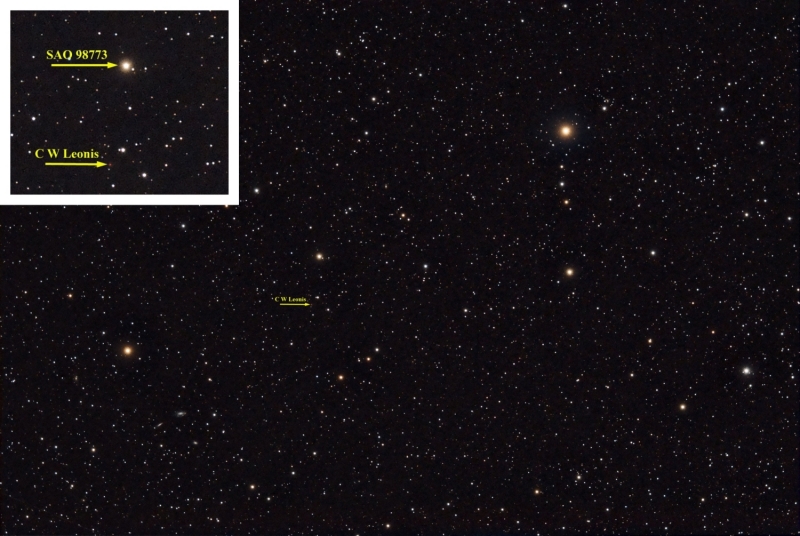
C W Leonis with insert

Here is the full frame C W Leonis image with a magnified insert.

Posted in mini-WASP Array | Leave a comment

C W Leonis or IRC +10216

Managed to get 12 x 20-minute subs on this one from the mini-WASP array late last night.

This is possibly the brightest star at 5um wavelength in the galaxy – so I wasn’t actually expecting to see ANYTHING at visible wavelengths.

But there it is 🙂  Carbon star C W Leonis or IRC +10216 – a pretty unimpressive looking image, and possible the one I am the most pleased with.

Posted in mini-WASP Array | Leave a comment

Astronomy Now article on the mini-WASP array

There is a 4-page article in the February 2015 issue of Astronomy Now on the mini-WASP array at the New Forest Observatory.

To save trawling through the last 2 years of development on this site, buy the Feb 2015 issue of Astronomy Now and get the whole story in one place 🙂


Posted in mini-WASP Array, News | Leave a comment

Today’s Earth Science Picture of the Day (EPOD) is a Lunar Halo over the New Forest Observatory

Got today’s EPOD with the recent Lunar Halo image 🙂

http://epod.usra.edu/

Thank you Jim at EPOD for continuing to publish my work.

Posted in EPOD | Leave a comment

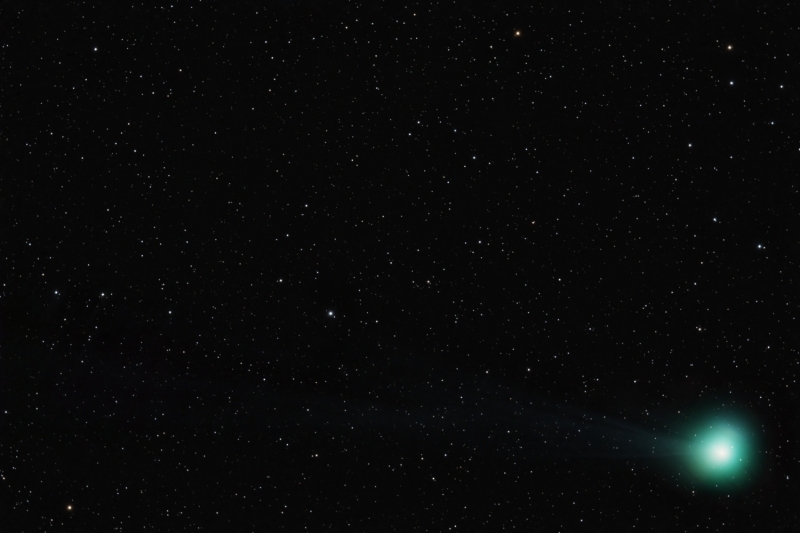
Comet Lovejoy C/2014 Q2

Taken on the evening of 16/01/2015 using the mini-WASP array and 2-minute subs (around 90 in total).

Not very impressive and I won’t spend any more valuable imaging time on this one.  I was lulled into a false sense of security with my earlier Hyperstar work on comets where a 4-minute sub brought out even the faintest detail.  With the array at f#4.5 it is asking a bit much to see the extent of the very faint tail with only a 2-minute sub.  The comet is moving quite quickly so I didn’t want to use longer subs as there would have been more comet movement in that time leading to a soft image.  Also – the VERY long comet tail means a multi frame mosaic if I were to use the Hyperstar III.  Not out of the question, but a bit of a pain to organise.  I may leave it at this for comet Lovejoy C/2014 Q2 and enjoy other people’s better efforts.

Posted in mini-WASP Array | Leave a comment

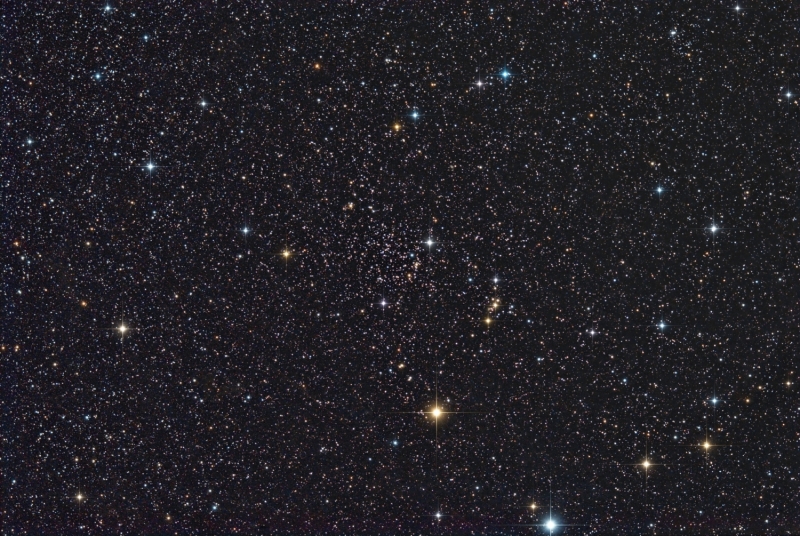
NGC 1817 an open cluster in Taurus

Managed to get 12 x 20-minute subs on this one before total cloud cover last night – nice Moonless conditions – but a ton of water vapour in the air (seen using the standard torch test).

Glad I got something at least, only reason for dropping in on this one was that it was in a good region of the sky for me.

Posted in mini-WASP Array | Leave a comment

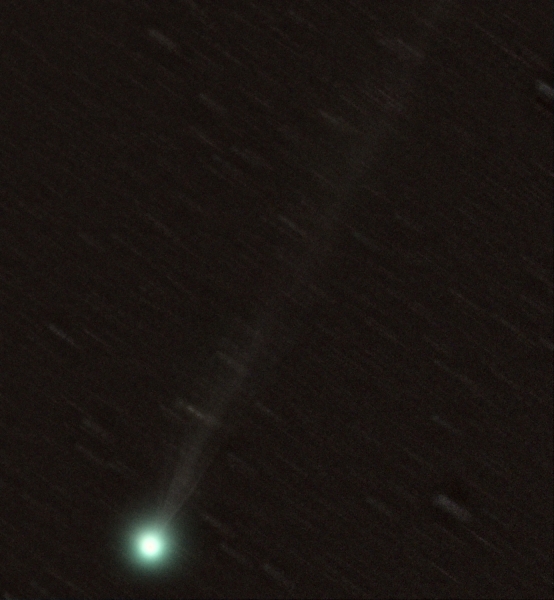
Comet C/2014 Q2 Lovejoy with the 200mm Canon lens and M26C OSC camera

This is not only the worst comet image I have ever posted – it is also the worst image I have ever posted.

Still last night was a clear night – even if there was a blazing Moon up – and as beggars’ can’t be choosers I grabbed the chance to image C/2014 Q2 Lovejoy.

Only 4-minute subs and only 13 of them as well, but this was a good dry run IF we get a clear Moonless night when I can do the thing properly.

Some things to note.  I put the camera in portrait mode (long axis vertical) thinking this would be the best way to get the whole tail.  Problem was the tail was so far away from north that I would have been better off leaving the camera in landscape mode where the tail would have easily fitted along the diagonal.  So – the camera has now been returned to landscape mode.

Next – I used 4-minute subs in order to try and get the faint tail – trouble is the comet moves a fair bit in 4-minutes leading to a non-sharp looking image.  Next outing I need to drop to 2-minute subs.  Clearly I don’t want any Moon about if I want to get that faint tail.

Finally – that tail!!  Look at it!!  That is over 5-degrees long – WOWSER 🙂 🙂

Posted in Canon 200mm prime lens | Leave a comment