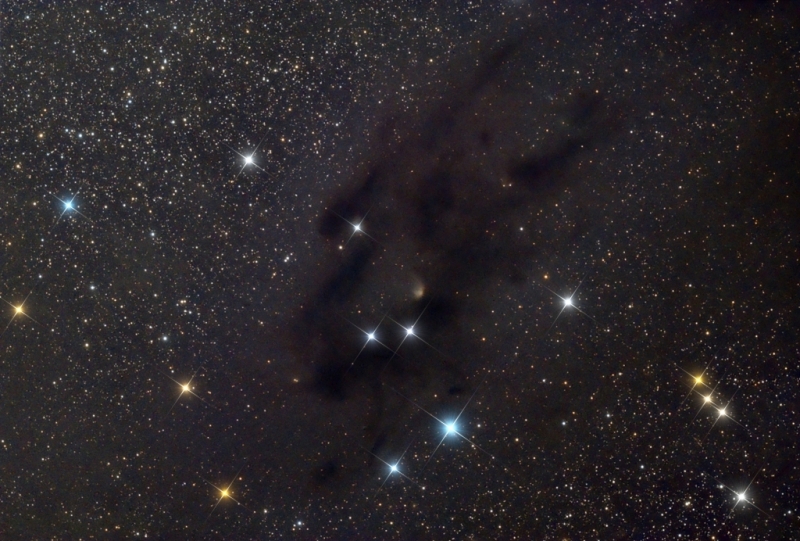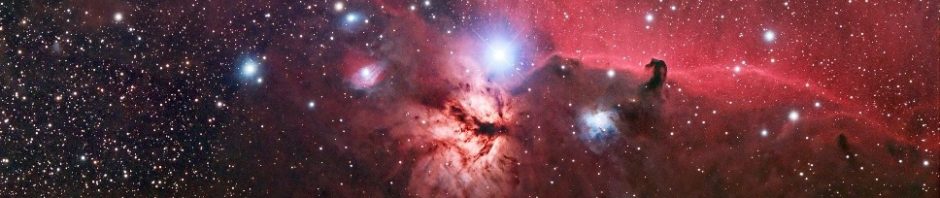
The 3rd (and final) Sky 90 has been fitted to the mini-WASP array 🙂
I will now be able to get 12-hours of data at f#4.5 in a typical 4-hour imaging session.
Provided that I get 4-hours of clear Moonless skies of course. Certainly won’t be tonight.
The 3rd (and final) Sky 90 has been fitted to the mini-WASP array 🙂
I will now be able to get 12-hours of data at f#4.5 in a typical 4-hour imaging session.
Provided that I get 4-hours of clear Moonless skies of course. Certainly won’t be tonight.
It is possible to get perfect stars right across the diagonal of an APS-size chip such as the Starlight Xpress M25C or M26C – but only if your Hyperstar imaging system is in very good collimation. Getting good collimation is not a trivial exercise, but once you have it set up then it only becomes a matter of very small tweaks if any mirror movement requires re-collimation.
The very first thing you must do is make sure that your imaging chip is perfectly normal to the optical axis. For the Starlight Xpress cameras mentioned above there are adjustment screws to move the camera chip with respect to the front plate which connects to your OTA. Starlight give a method here http://www.sxccd.com/maintenance_info/Aligning_CCD.pdf for getting the chip flat using a laser pen. I have found that this method works extremely well and you can get precise chip flatness very quickly and easily once you have gone through the process a couple of times. The only change I made to the Starlight setup was that I work in a vertical plane with the laser pen pointing upwards from the ground as using this geometry you don’t have the camera mounted sideways against gravity. Being vertically mounted makes it a lot easier to maintain the camera flat against whatever rotation holder you use.
With the camera chip perfectly flat to the front plate, fix the camera to the Hyperstar and get a good focus. I recommend the electric MicroFocuser and MicroTouch software for all your focusing. You can do it manually, but it takes much longer using that route. Get a good focus and take a 20-second image.
Unless you are extremely lucky you will find that stars towards the centre of the image look pretty good, but stars out towards the edge are “tailed” like comets – and this is the collimation needing adjusting. You will need the program CCDInspector to get really good collimation, and to get a numerical feedback that your collimation is good – but the initial “rough” collimation is done by eye by referring to the image on the monitor.
Pick any one of the Hyperstar collimation adjusters and move it either in or out a touch, where a touch is no more than a quarter of a turn. Retake the image and note the result on the outermost stars. It will soon become obvious which adjustments “push the tail” of the stars up into the main star until you end up with a decent looking round star. With the collimation adjustments made so that you can see you have decent round stars in all 4 corners, you are good to go, and you will get extremely good results from your Hyperstar – but you can fine tweak things a little better than your eye can pick up just looking at the monitor – and this is where CCDInspector comes in.
Take a 20-second image of a star field preferably without galaxies or nebulae in the field as these can “throw” the CCDInspector values out. Put CCDInspector into arc seconds mode rather than giving “pixels” output, as this gives you more accuracy in the next part of the setup. You will see values for the tilt in the X and Y directions, and the aim now is to get the smallest value you can for these. The next adjustments of the collimation screws on the Hyperstar are TINY, no big movements or you will throw away all your hard work so far. You now need to make tiny adjustments of the collimation screws on the Hyperstar and note their effect on the tilt X and Y values as you adjust them. You will need to write these figures down as relying on memory alone, especially if you are working out in the freezing cold, simply doesn’t work. You will also need to re-focus after each adjustment and this is why it is a very good idea to have computer-controlled focusing, otherwise this step will simply take far too long. Make adjustments to the collimation screws to get the smallest values you can for the tilt in X and Y in CCDInspector, and don’t forget to refocus after each adjustment. You will see that a natural by-product of small X and Y tilt values is a small value for the collimation and for the field curvature. Proceed iteratively until you get the smallest X and Y values possible.
Finally, when you have managed to get the Hyperstar collimated as best you can, it is a good idea to then re-run all your V-curves for FocusMax so that they apply to your new, nicely collimated system.
That’s all there is to it – Happy Imaging J
I have completed the initial experiments with the Canon 200mm lens piggy-backed on the C11, so yesterday I removed the kludge on the back of the C11 and re-instated the Hyperstar III – just in time for all the winter goodies.
The 200mm lens will go on the top plate of the mini-WASP with the other 200mm lens. One lens will have an M26C attached, the other will use the Canon 5D MkII – all bases covered.
Cloud last night meant I couldn’t focus train and collimate the Hyperstar III – but from the images I did download I could see there wasn’t too much sorting out to do.
So final steps before we’re up and running again, focus train using FocusMax and collimate the Hyperstar using CCDInspector.
Then image the goodies 🙂
There are 5 very nice Carbon stars in Andromeda that I would like to bag this month and this is the first I’ve caught – UY Andromedae with some nice faint fuzzies, and a couple of not so faint fuzzies. Nice area of Andromeda, worth visiting with a decent telescope for a browse around.
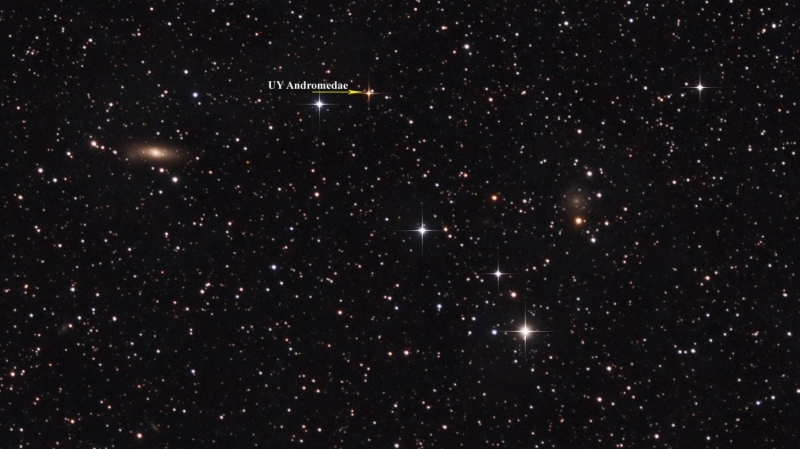
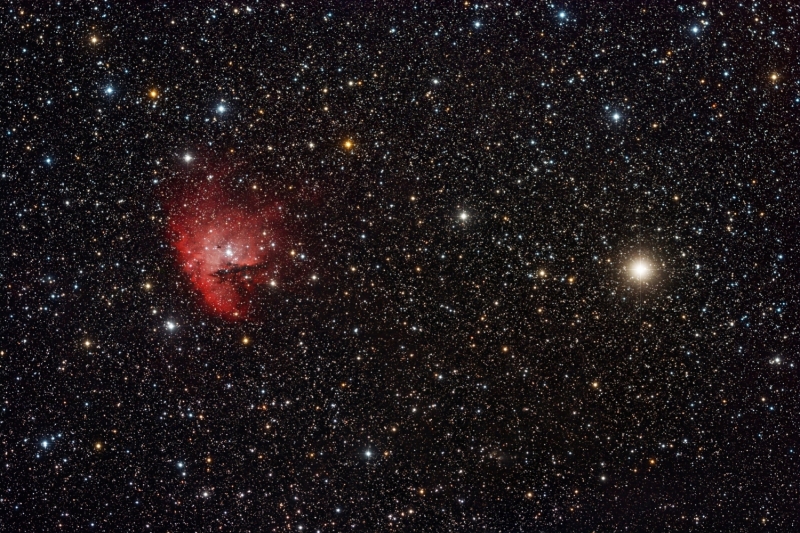
The mini-WASP array was again put into commission taking half hour subs of the Navi region of Cassiopeia – Navi is the central star in this image. Nearby lies Gamma Cassiopeiae and its associated nebulosity.
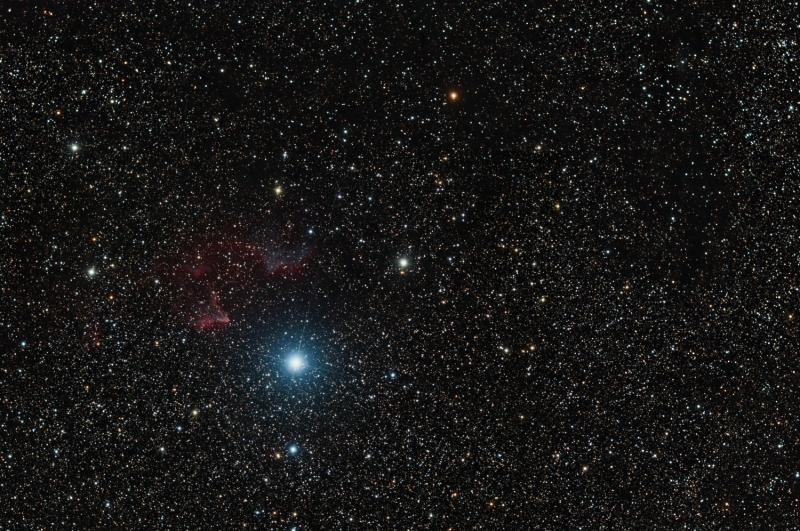
Several hour’s worth of half hour subs resulted in this deep view of the PacMan nebula and nearby bright star Schedar in Cassiopeia courtesy of the mini-WASP array.
The array is due for an upgrade at the end of this week with the addition of a 3rd Sky 90 refractor 🙂
Thor Heyerdahl, great adventurer and explorer would have been 100 today.
He created a great impression on a very young lad with his book “Kon Tiki” about an expedition aboard a balsa wood raft. I recall building my own wooden Kon Tikis and sailing them on St. Valentine’s Park pond.
Academics did not think much of Thor’s pronouncements, and likewise Thor didn’t think too much of Academics – something we both have in common.
Unfortunately recent DNA studies have shown that some of his migration theories are incorrect – but he showed us that practically such migrations were possible, even if they did not actually occur.
Great for thinking outside the box, great adventurer, great explorer, and a man who sought his own path without resorting to the support of others – a sorely missed, unique personality.
I recently discovered that Takahashi have discontinued making the Sky 90 – mad decision IMO. And this comes at a time when I was looking to replace the TS80 with a Sky 90 giving me a mini-WASP array with 3 x Sky 90 refractors and a 200mm lens – all with M26C OSC CCD cameras. By sheer coincidence an astronomer colleague found himself with a mint Sky 90 (collimatable version!!) for sale. Needless to say I have bought this together with the camera angle adjuster and the f#4.5 reducer corrector.
So the new mini-WASP configuration will be 3 x Sky 90 refractors and a Canon 200mm lens for imaging, and a Megrez 80mm guide scope.
I have this terrible niggle to put a 4th Sky 90 in the frame and use off axis guiding on one of the Sky 9os, but I know that I will become severely cheesed off with the limitations that this sort of guiding will bring. So at all costs I must resist!!
The new Sky 90 has come along just in time for the longer nights and all the Winter goodies – now all we need are the clear Moonless skies – something that was totally missing last Winter 🙁
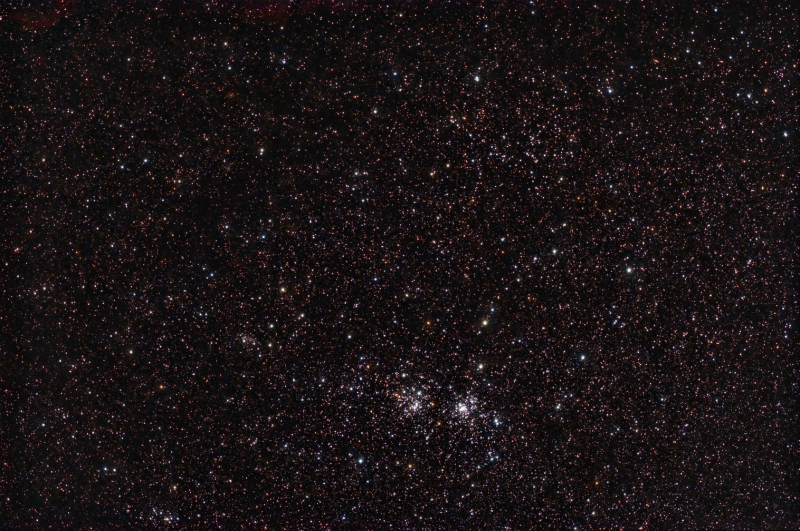
I am in the final stages of setting up a new imaging system based on a Canon 200mm prime lens with M25C OSC imager and a 52 mm IDAS filter on the front of the lens giving me f#3.85 and spikeless images 🙂 As it is that time of the year an obvious target for testing out the star imaging qualities of the rig is the Double Cluster. With a horrendous sampling of 7.97 arcseconds per pixel it makes you wonder how it can even resolve stars – but clearly it does 🙂 Above the Double Cluster we see the rarely images Stock 2 open cluster, which looks like a stick man on his side. And at the very top/left you can just see the edges of the Heart & Soul nebulae.
Only 16 x 5-minute subs for this one, and very misty conditions too, a LOT of water vapour in the air – however, as a bonus, there was no Moon.
I think this is going to make a good rig for those BIG winter nebulae. It is NOT a good rig for those single bright star shots as there are terrible ghost flares from very bright stars, probably resulting from all that glass in the 200mm lens. Well you can’t have it all I guess.
I have now removed the Canon 5D MkII from the 200mm lens in the south dome and replaced it with the M25C that used to be on the Hyperstar.
The massive field of view afforded by the 5D MkII on the 200mm lens is truly addictive – but the lack of red sensitivity of an un-modified DSLR and the lack of Peltier cooling drove me to put the M25C back on.
So – a whole Cassiopeia mosaic instead of being a 4-framer with the 5D MkII is now a 6-framer, or very comfortable 9-framer. The price you pay I guess.