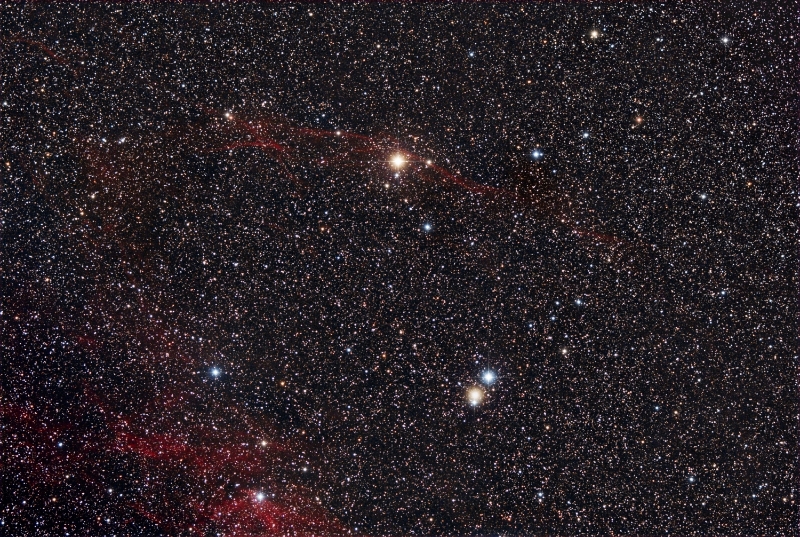
2 Carbon stars and nebulosity in Cygnus

Not having the day job has given me a new imaging experience – the ability to image during June 🙂  With the day job I used to give up imaging half way through May (if not earlier) due to the shortening evenings.  Last night I started setting up at 11:30 p.m. and finished imaging this region in Cygnus at 2:00 a.m. just as the clouds started to roll in from the SW.  Also had a good view of the ISS and ATV4 earlier on in the evening – so a pretty good night all round.

This image shows a region in Cygnus with a nice pair of Carbon stars, some nice faint nebulosity (hard not to find some emission nebulosity in Cygnus) and the stars 30, 31 & 32 Cygni in the centre of the frame.  I took 13 x 10-minute subs using all 3 scopes and M26C cameras, but this is just the Sky 90 data.  Excellent seeing conditions last night.

Posted in mini-WASP Array | Leave a comment

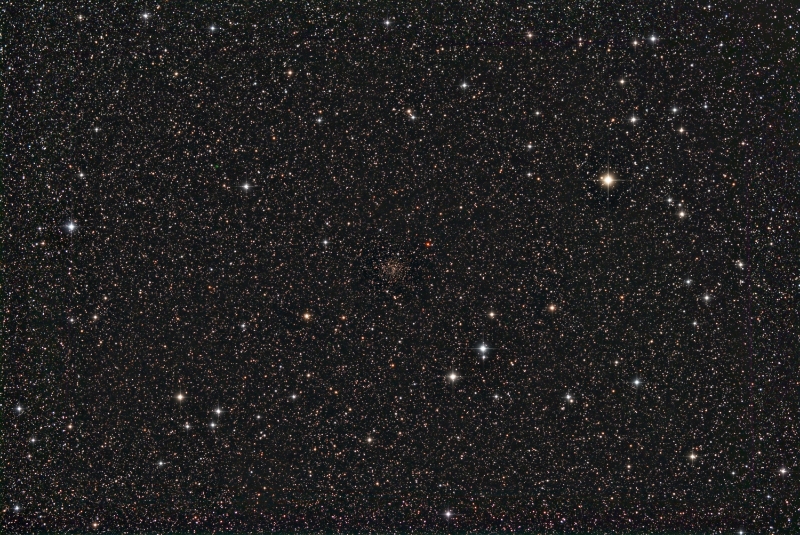
NGC 6791 and Carbon star U Lyrae in the constellation Lyra

Managed to grab 7 x 10 minute subs on all 3 mini-WASP cameras before the cloud I had been watching finally arrived from France.  Glad really as it meant I could have an early 12:30 a.m. night.

This is open cluster NGC 6971 in Lyra – very faint as you can see.  Why bother imaging such a faint cluster?  See the nice bright red star at the 1 O’Clock position?  Yep – another Carbon star, U Lyrae 🙂


Posted in mini-WASP Array | Leave a comment

A beautiful pair of Carbon stars in Lyra

Last night it was beautifully clear and Moonless and was probably one of the best imaging runs I’ve ever had.  Apart from the highly anti-social hours of course as I couldn’t start imaging much before 11:00 p.m. which meant shutting up shop around 2:00 a.m. more from tiredness than practical necessity.  Anyway, grumbling aside, I decided to go for a pair of Carbon stars which lie just to the west of the recently imaged Stephenson 1 open cluster.  Incredibly the Carbon star on the right in this image  has a B-V index of 5.16 – absolutely incredible!

I have now fitted the Canon 5D MkII to the top of the array so if we get yet another clear night tonight (that will be something like 5 or 6 in a row) then I’ll go for another ultra-wide-field with the 100mm macro lens.

The best laid plans of mice and men 🙂


Posted in mini-WASP Array | Leave a comment

Image of the Month – June 2013

Yes – another single star picture for this month’s Image of the Month.  Polaris, the Pole star, the North star, Alpha Ursa Minor – the Navigator’s friend.  I like this region of space because 1)  It is rarely imaged and 2)  It is difficult to take deep images in this region due to the vagaries of the good old GEM.  Quite a few faint fuzzies in the background of this one, and many of them are closer to the Pole than well-known Polarissima Borealis.  The green cross-hairs at the 2 O’clock position from Polaris indicate the position of the North Celestial Pole, as you can see, it’s actually quite some way from Polaris.  Finally, yes, if you think you can see some “cloud” in there – this is a touch of the Integrated Flux Nebula (IFN).

Posted in IOM | Leave a comment

Earth Science Picture of the Day number 47 on May 25th

I have just seen that I got Earth Science Picture of the Day (EPOD) number 47 on May 25th for “Imaging Diatoms”.

I can only imagine that I missed this because I had been working over the allotment all day and got back too shattered to even bother turning the computer on.  Still at least over 100 runner bean plants and over 300 spuds went in ready for this year 🙂

Thank you Jim at EPOD for continuing to publish my work and my apologies for not acknowledging sooner 🙂


Posted in EPOD, News | Leave a comment

Sometimes rainy days are useful for getting jobs done

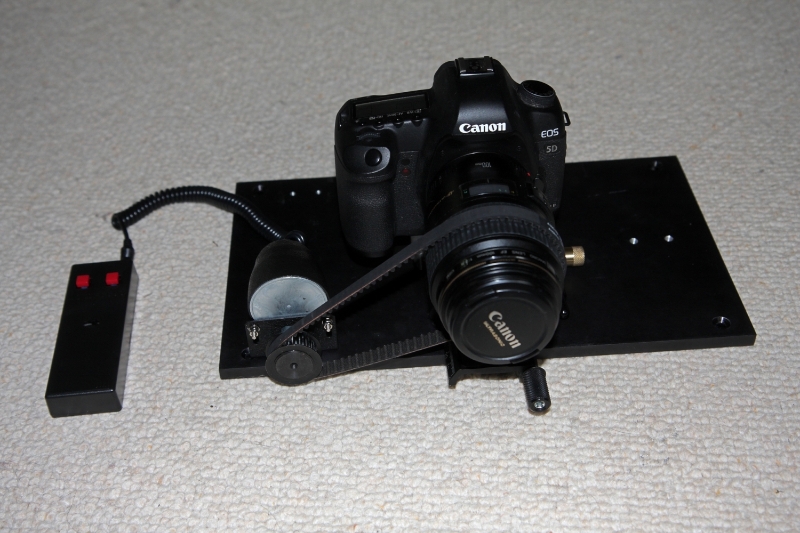
I had an electric focuser lying around so with a pulley and timing belt from Radiospares I put together an electric focuser rig for the Canon 5D MkII and the 100mm macro lens that took the mega-wide-field Virgo/Coma galaxies shot.  If I find there’s mileage in this approach I will invest in a prime 200mm Canon lens which has a 72mm diameter lens (and I have an IDAS filter for this lens size).

Posted in Equipment, Projects | Leave a comment

Hyperstar III test-shot #2

For the second test of the newly aligned M25C camera on the Hyperstar III I chose the Stephenson 1 region of Lyra.  Although I didn’t have the optics spot-on they were pretty close and I’m quite pleased with the resulting image.  When I spend a little more time getting the collimation just right we’ll be back to the earlier high-quality Hyperstar III imagery we’re used to seeing 🙂


Posted in Hyperstar and SXVF-M25C | Leave a comment

Hyperstar III test-shot

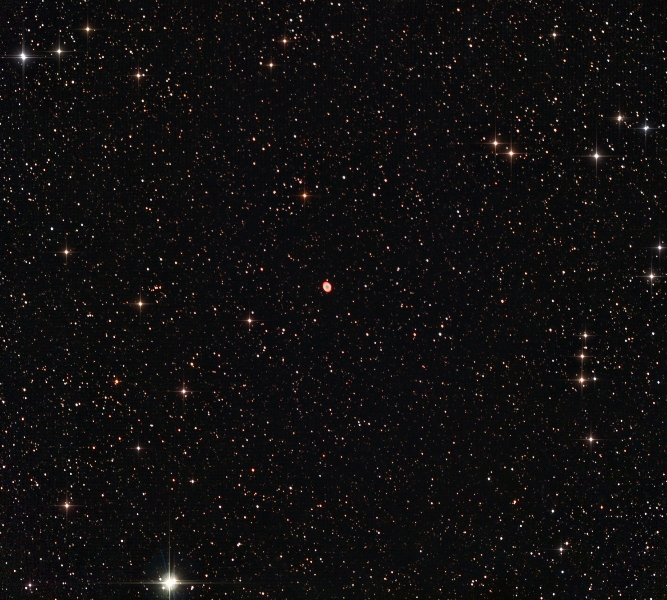
Recently imaged M57 as a test-shot for the recently flattened M25C chip.  This is 14 x 5-minute subs with a blazing nearly full Moon overhead.  Looks pretty reasonable considering 🙂


Posted in Hyperstar and SXVF-M25C | Leave a comment

The Hyperstar III

The Hyperstar III is so fast that all other amateur imaging systems are extremely slow and have very disappointing performance in comparison – and that includes the mini-WASP array as currently configured.


Posted in Hyperstar and SXVF-M25C | 2 Comments

Feynman’s Legacy

Feynman left us many interesting facts/tools and one of the most powerful I have ever come across was his observation that “The same equations have the same solutions”.  By this he means that equations of the same form have similar solutions.  Now this may sound like it is stating the obvious, which I guess it is, but it is an incredibly powerful tool in the right hands.

Maybe around 30 years ago I found two areas where this statement had some very interesting outcomes, but I have not been able to push the results to a final conclusion.  As I am now getting too old for this sort of young man’s thinking it is time for me to put this out for general consumption so that someone with a more agile mind/imagination can finish off this work.

The first subject area is mechanics and the derivation of a set of “Mechanical Maxwell Equations”.  I shall give you the outline of the ideas and it’s up to you to finish it off 🙂  The starting point for equations of the same form are the Newtonian gravitational force equation and the equation for the force between two charges.  Using the similarity in form you can “equate” 1/4 Pi Epsilon nought with G – I call this the equivalence of the constants.  Charge then equates to mass and distance is the same in both equations.  We have two more quantities in electromagnetism that we need an equivalent mechanical quantity for, namely B and E.  By looking for similar equations in electromagnetism and mechanics it isn’t too difficult to find that E’s equivalent is a, the linear acceleration, and that B’s equivalent is omega or angular velocity (very interesting that B should equate to omega!!).  You now have all the necessary information to create your own set of four “Mechanical Maxwell” equations.  I have done this, and luckily they turn out to be dimensionally correct – but I have no idea what they mean or what they are saying.  I will leave it up to you to tell me 🙂

The second area where “The same equations have the same solution” shows us an interesting route for new thoughts and ideas is in the area of Quantum Mechanics, specifically Hidden-Variable theory.  The form of the de-Broglie/ Bohm equation for a hidden-variable form of wave equation has the same form as the condensate wave function in superfluid physics.  So the Quantum Potential which is the source of all the trouble in de-Broglie/Bohm Hidden-Variable theory is related to a term in superfluid physics which is only important when the superfluid density varies rapidly with position, for instance near a wall or inside a vortex.  When we are dealing with the bulk fluid we can omit the term – which is extremely interesting.

So there you have it.  Two interesting areas of research.  The first might lead to a nice paper, and the second might lead to a Nobel Prize.  Over to you.
 

Posted in News, Writing | Leave a comment