Still learning how to use the Hyperstar III

Bit embarrassed to say that I am still learning how to use the Hyperstar III.  Rather humbling when I thought I knew all there was to know about getting the best out of the Hyperstar.  I had done a few camera swaps on the HSIII and I was having difficulty getting good stars across the whole of the M25C, something I had not had a problem with before.  Now here is where I was going wrong.  I thought that I could have the M25C adjusters set so that the face plate was perpendicular to the camera body (this means the chip would almost certainly not be flat to the optical axis) and that I could sort out all the chip flatness/collimation with the Hyperstar III adjusters alone.  THIS IS WRONG!!  I slowly caught on that I was not going to get good stars across the chip using the HSIII adjusters alone after spending around 3 hours playing about chasing my own tail – it was clear that the HSIII adjustments were not enough – YOU NEED THE CAMERA TO BE FLAT TO THE OPTICAL AXIS BEFORE IT GOES ONTO THE HYPERSTAR III.  Oh well – live and learn.  So I used Terry Platt’s method as given on his website to flatten the M25C APS-size chip to the optical axis, and I put the camera back on the Hyperstar III last night.

I ran the FocusMax autofocuser on Sulafat (Lyra) and the first 20-second sub looked pretty good without touching the Hyperstar collimation adjusters.  A CCDInspector look at the sub gave me the magic x = 0, y = 0 for the chip flatness (can’t do much better than that), and it gave me 2.7″ for the collimation.  I have never seen a set of CCDInspector numbers this good before for the Hyperstar III/M25C combo.

Hopefully I’ll be turning out some interesting Hyperstar images once again in the not too far distant 🙂

Posted in Hyperstar and SXVF-M25C | Leave a comment

Greg’s Enigma

Does the EPR “paradox” tell us anything about Physics?

Well the trite answer is yes of course it does – but can we be a bit more specific?

Physics is an “after the fact” science relying on experiments and the observations on the results of those experiments.  What do I mean by “after the fact”?  I mean you set up an experiment to measure some property or event and the experiment, if successful, will give you a numerical value for that property or event, so far you have learnt absolutely nothing new – but please keep with it 🙂  By setting up various different experiments and conditions we can measure the mass, “apparent” size and the charge on an electron.  But we cannot say WHAT an electron actually is.  Why not?  Well one reason is we don’t know how to set up the experiment to do that.  The experiments we set up measure the PROPERTIES of an electron – that is all.  We can smash things together in high energy particle accelerators and see how various particles are created (or annihilated) and what the energies involved are – but these experiments say nothing about what the particles themselves are.  How can they?  They are only measuring the EFFECTS that the particles themselves create.

Mathematical Physics is great at providing predictions.  It still requires the experiment to be performed to give the mathematical predictions any substance – any “reality”.

This situation is rather like the 4-year old kid who keeps asking why? to an initial answer to a question.  Eventually we come to a stopping point.

The EPR “paradox” was thought up as a hard test for the theory of Quantum Mechanics.  Quantum Mechanics gave its answer, a nasty answer that goes (like most things in Quantum Mechanics) against common sense.  Aspect and some other brilliant experimentalists created beautiful experiments to measure the results of an EPR-type problem, and yes, Quantum Mechanics gives  us the same answer as the experiments and common sense doesn’t.  But can  you take things further than this?  Can you, with the information provided, say anything about the MECHANISMS involved?  I don’t see how this is possible.  You created the experiment given the parameters you wished to measure to confirm (or otherwise) the EPR “paradox”.  You did not set up the experiment to look at the MECHANISMS involved (and basically you wouldn’t know how to do this anyway) so why would you expect an EPR-type MEASUREMENT to give you an insight into the underlying mechanisms?  This is very much the situation of the 4-year old kid asking “Why?” one time too many.

But if this is the case, doesn’t every experiment and every part of Physics run into this very same problem?  Even the simplest Physics that we think we know EVERYTHING about?  I think it has to  – doesn’t it?

Let’s take a very quick look at Newtonian Mechanics – not much there we don’t know everything about is there?  Masses flying about, velocities, energy (potential and kinetic), acceleration, inertia – oops what’s that one?  Inertia?  What’s that then?  Well it’s the resistance to an applied force exhibited by any body possessing mass.  Yes but what IS it?  Well it’s possibly caused by the interaction of the body with all the other mass in the Universe – but actually we really don’t know.  And what is mass anyway?  I don’t think the Higgs Boson goes very far in telling us what “mass” actually is.  So even in a science that we think we know quite well and that was dealt with a couple of hundred years ago sufficiently well for us to send space probes on Grand Tours – we don’t have to go very far back with the Why? question to hit our stopping point.

A lot of these Physics problems come down to “fields” as their ultimate answer, where “fields” is a great euphemism for “I don’t know”.  When Maxwell came out with his 4 equations for electromagnetism he hit similar issues with the scientists of his day.  What were these “fields” where are the “springs” and the ether that carry these waves?  What are the mechanisms?  I guess I am also asking what the “springs” are in all our theories – and my contention is that we simply don’t know.

If we’re stuck in asking the basics of such “very simple” questions – then where do we stand in asking the biggies?  What happened before the Big Bang for instance?

The Scientific Method is a very powerful tool for explaining what we can observe, it should be, after all the experimental method has proven to be a great way to provide the hard numbers to our observations.  But for the underlying mechanisms?  What do we do for those?

I have a very strong feeling (shouldn’t really allow “feelings” to come into it – that’s getting into Metaphysics 🙂 ) that we are seeing EXACTLY the same problem rearing its head that we have already seen in mathematics.  Godel’s Theorem didn’t help us much there – but at least mathematics has a name for the issue – Physics doesn’t.  How about Greg’s Enigma??


Posted in News, Writing | Leave a comment

Talk at the Webb Deep-Sky Society 2013 AGM

I will presenting “Deep-Sky Imaging from the New Forest Observatory” at the Webb Deep-Sky Society AGM meeting on Saturday 15th June 2013.

The venue is the Institute of Astronomy, University of Cambridge, Madingley Road, Cambridge CB3 0HA.

Images taken using the original Hyperstar/H9C,  Sky 90/M25C, Hyperstar III/M25C and the mini-WASP array will be shown during the talk.


Posted in Talks and Presentations | Leave a comment

The Dream of the Cosmos

Anne Baring’s new book “The Dream of the Cosmos:  A Quest for the Soul” has a Pleiades image from the New Forest Observatory on the cover.  The Publisher has done an excellent job in putting the book together.

Posted in News, Writing | Leave a comment

Let’s all dumb down together – or maybe not

As I’ve mentioned before – this is MY blog, so I can write what the hell I like.  My cage has just been rattled by a piece written about Harvard and it mentions teaching in Universities.

You have teachers at a school and you have Lecturers at a University.  Ever wondered why they are given different names?  It’s because at school you are spoon fed, and that is the job of a teacher.  For that age group it is a vital and necessary job, and it needs to be done extremely well.  At University the aim is to get you to start learning on your own, hence a Lecturer who basically tells you what to go away and learn.  Well that’s how it used to be at one time anyway.  In the grand dumbing down which is so fashionable today it is becoming hard to differentiate Lecturers from teachers.  Even harder because the Administrators at University will call it “teaching” and it is your “teaching load” not Lecturing or Lecturing load.  The insidious incursion of the dumb downers is even seen and felt in our institutions of higher education.  Well, why shouldn’t it be?  When those running our Universities are quite often no more than (unqualified)  accountants and honorary pen pushers who would look at you like you were a lunatic if you asked them what their philosophy of higher education was – what the hell do you expect?

And the terrorist outrages against schools we have seen recently?  Terrorism?  Religion?  Some fanatical adherence to some arcane cause??  No.  They just want you to be as thick as they are – they can’t deal with educated people with a mind of their own – such people are dangerous (to morons anyway).

If you really want to rebel – get educated – it will create a great deal more upheaval for society long-term, than carrying out some petty crime.

Rant over.


Posted in Writing | Leave a comment

Image of the Month – May 2013

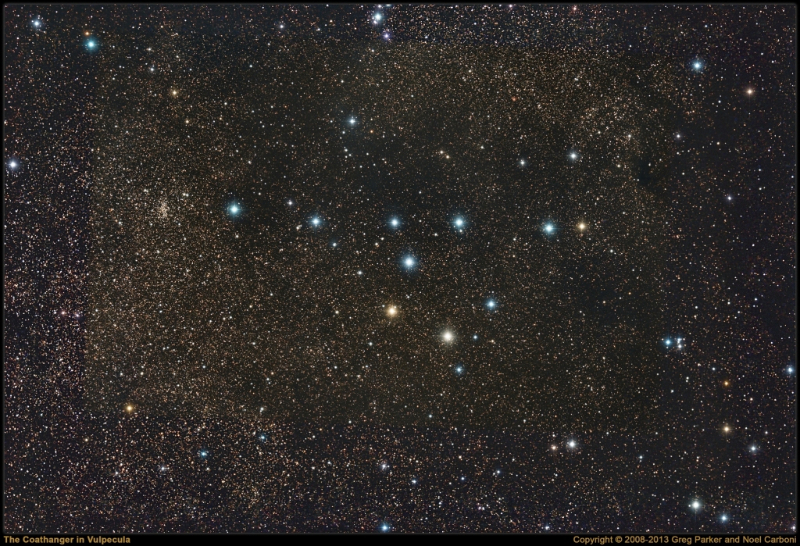
The Image of the Month for May 2013 is the recent reprocess of the Coathanger Cluster (Al Sufi’s cluster, Collinder 399) in the constellation Vulpecula.  This reprocess by Noel Carboni included data from the mini-WASP array plus deep data from the Hyperstar III.  To the left of the cluster we see the sparkling little open cluster NGC 6802, which reminds me a lot of little NGC 1502 sitting at the end of Kemble’s cascade.  This image of the Coathanger represents around 8-hours of total imaging time using OSC cameras M25C and M26C.  I like the Milky Way background and the prominent dark patches in this image.

Posted in IOM | Leave a comment

The Navigator’s companion

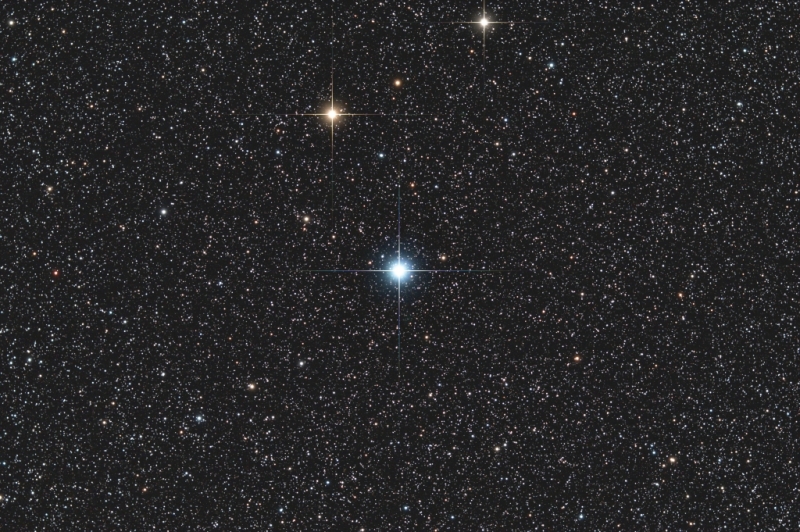
A recent Noel Carboni process of mostly mini-WASP test data (I used one scope for imaging whilst trying to set up the other two scopes).  This is Polaris the alpha star in Ursa Minor.  Although it looks like a single bright star it has two close companions and two more distant companions – it is also a Cepheid variable!  The green cross hairs at the 2 O’clock position from Polaris show the position of the celestial pole, the point which all the stars appear to rotate around.

Posted in mini-WASP Array | Leave a comment

Carl Sagan

In 1973 when I was 19 I left home to start work at Harwell and also to take an HNC at Oxford Polytechnic (as it was then).  This was a time of great awakening for me, I had found the whole school experience to be a complete and utter waste of time and couldn’t wait for the day when I could leave.  Starting at Harwell was that day and was also the time when I discovered (for myself, no prompting from teachers) that learning could actually be a rewarding experience.  So it was in 1973 that I bought one of the many books that would transform my world-view, in a very positive way, forever.  1973 was the first publication of Carl Sagan’s “Cosmic Connection”.  Some 40 years later I have totally forgotten its contents and the original book is long gone – but I have on my desk an Anniversary issue which I am slowly re-reading, and I understand why it gave me such a buzz such a long time ago.

Today I finished reading “The Varieties of Scientific Experience” also by Carl Sagan, and Carl has done it yet again – I got the same buzz from reading this book that I got from reading the “Cosmic Connection” 40 years ago – thank you Carl 🙂

What can I say about “The Varieties of Scientific Experience”?  Firstly, I think this should be compulsory reading for GCSE schoolkids, those that have sufficient intelligence to follow the plot could go on to do good things.  Secondly, it should make an educational read for politicians and theologians alike – so maybe they wouldn’t like it very much.  Logical argument, beautifully written, and very humanistic with none of that highly annoying zealotry that we have come to associate with Richard Dawkins.  Carl – you are very sorely missed!

Posted in News | Leave a comment

I have this really huge problem with DNA

Well this site is about Life, the Universe and Everything, so where better to bring this up?

I am just starting to read Carl Sagan’s “The varieties of scientific experience” and just in the first few pages it had me revisiting this old problem of mine.

Life as we know it, in all its forms is based on DNA – on this planet at least.  Life as we see it all around us has been undergoing evolution ever since it kicked off – I’m very happy with that.  What I was (and still am) very unhappy about is the apparent lack of DNA precursors.  DNA is a pretty complex molecule, are we meant to believe it just suddenly arrived, completely built and ready to go?  There is an analogy often made about this regarding a hurricane going through a metal scrap yard and creating a pocket watch – but the probabilities of course are much lower than this.  So, my initial naive way of thinking went like this, there must have been simpler DNA precursors which themselves underwent evolution to give us the DNA we see today.  Problem is, we don’t see any evidence of these precursors and we don’t see any life on this planet based on anything other than DNA.  I actually knew the answer to this one but still came up with the stupid idea anyway.  What is the answer?  The answer is, it’s DNA all the way back, right back to the beginning – the first forms of life on Earth were based on the same DNA structure, so there were no precursors, like turtles, it’s DNA all the way down.

Now I really do have a problem, but I also have a solution to the Fermi problem.  My problem is this.  What is the likelihood/probability of the DNA molecule coming together like that something like 4 billion years ago?  The observer’s answer is that is must be finite ‘cos here we are.  Finite yes, but how small a finite are we talking here?  10^-20?  10^-100?  10^ -Googol??

I have been heard to say on television (Chris Packham’s Inside Out BBC programme) that there is “life out there” – that the Universe is teeming with life.  I would like to change that one slightly in the view of this DNA business.  I don’t think there’s any life out there beyond this planet, none at all.  Nothing based on elements other than Carbon or molecules other than DNA – nothing.  There’s your answer to the Fermi problem.  We haven’t heard from them yet because there’s nobody out there calling.

This does create a rather important corollary.  We should be just a little more considerate and caring not only of each other, but all the creatures on this planet – and of course the planet itself.  Stupid boys with idiot haircuts spouting nonsense intended to upset the other people on this planet are not helping things along much.  It really is time to grow up – fast.


Posted in Writing | 17 Comments

Greg’s “3” asterism in Leo

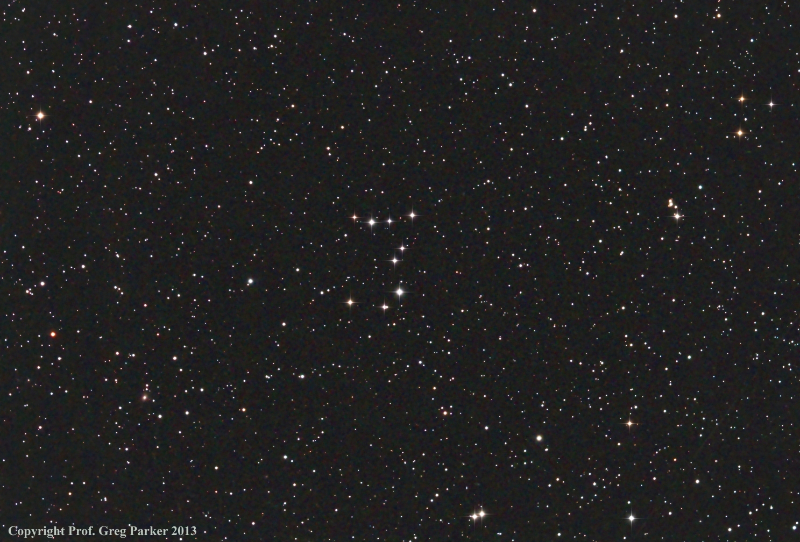
A few weeks ago I was scrolling through the constellation Leo using “the Sky 6” planetarium program when an amazing numerical asterism flashed into view.  It looked quite unreal and I wondered if it would look as impressive in the flesh.  We haven’t exactly been blessed with much in the way of decent imaging weather lately, so impatient to see what this region of Leo looked like I downloaded the DSS data for the area.  Yep – it was every bit as impressive as it looked on the Sky 6.  So now it’s playing the waiting game, waiting for some clear sky.  Unbelievably, last night there was a 1-hour break in the clouds.  I have never moved so fast, nor been so excited about taking a deep-sky image before – I really wanted this one.  And I got it 🙂 🙂  O.K. so it’s not deep enough to show the faint fuzzies in the background, and there’s not enough subs to really clean up the background noise either – but it’s still one of my favourite images of all time 🙂 🙂

Posted in mini-WASP Array | Leave a comment