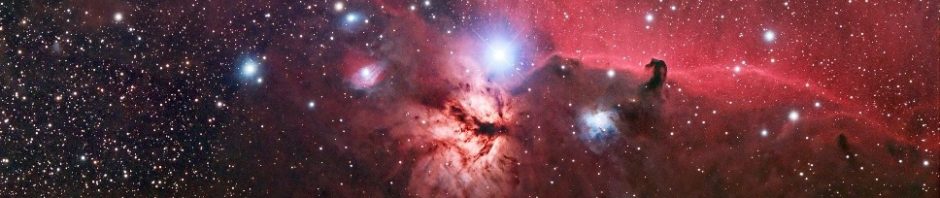

The system was set up absolutely spot on last night, so rather than just go for a Carbon star, I went for a Carbon star (SAO 69636 – indicated by the yellow arrow) and a bit of interesting nebulosity 🙂
The system was set up absolutely spot on last night, so rather than just go for a Carbon star, I went for a Carbon star (SAO 69636 – indicated by the yellow arrow) and a bit of interesting nebulosity 🙂
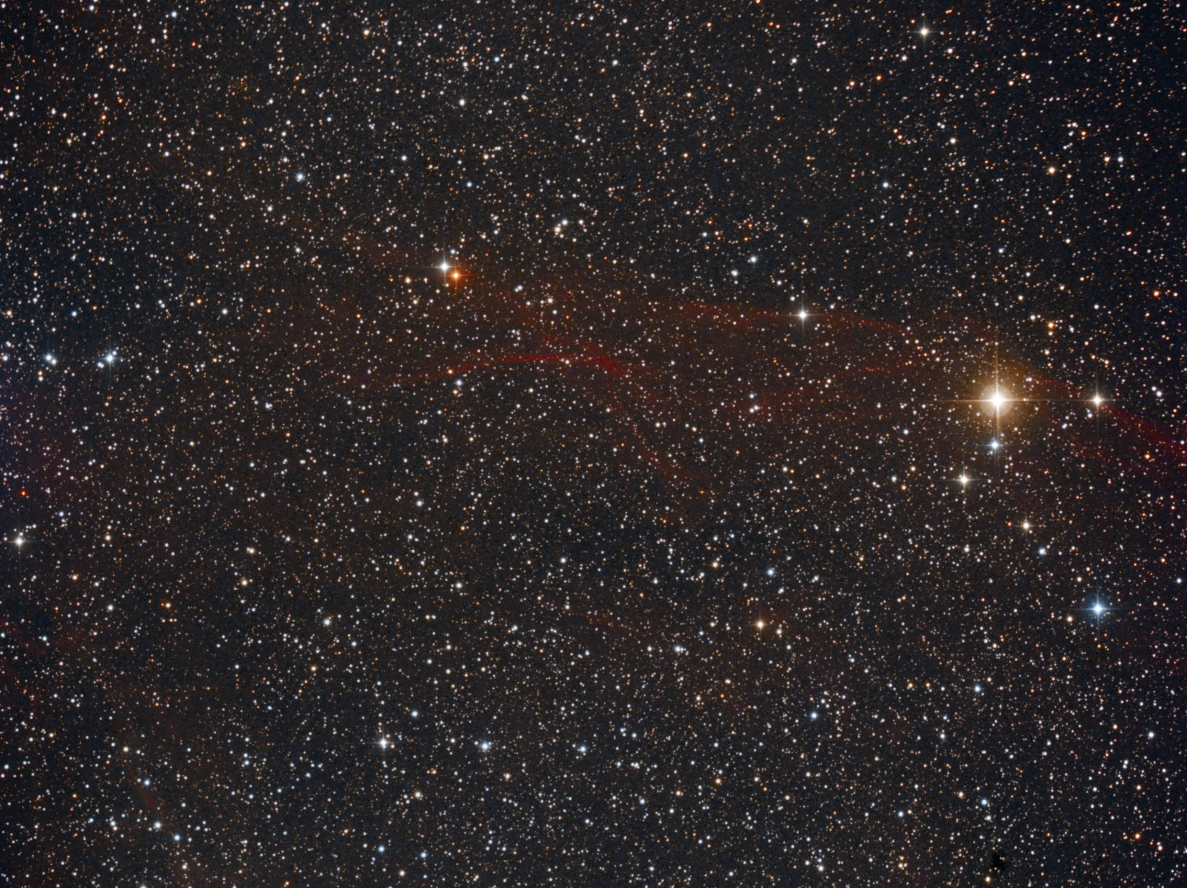
And yet again another beautiful clear Moonless night last night – that’s 5 in a row now, almost makes up for 6 weeks of cloud and rain. Went for another Carbon star in Cygnus, this time it is U Cygni, this is the small bright red star just left and above centre with a similar sized blue star lying close by at the 11 O’Clock position.
This time I managed 20 x 200 second subs with the Hyperstar III and M26C one-shot colour CCD, dithered data.
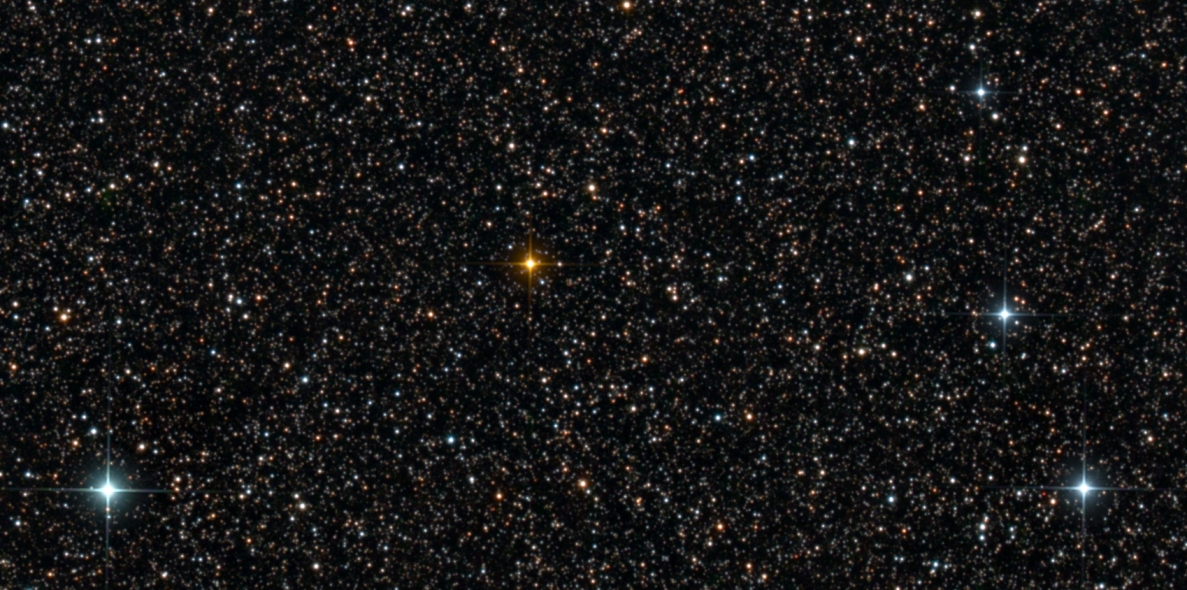
Grabbed this one from the clear night last night. Hyperstar III and M26C one-shot 10-megapixel camera. 22 subs at 200 seconds per sub with dither. Carbon star TT Cygni. If the clear skies continue I will add to the Carbon star tally with more Carbon stars in Cygnus.
I was just about to post up last night’s imaging session when I saw the counter has just gone over the 300,000 mark 🙂 Thank you all for visiting, and keep the visits coming, the mini-WASP array will be imaging soon and you’ll be able to see some really BIG Star Vistas.
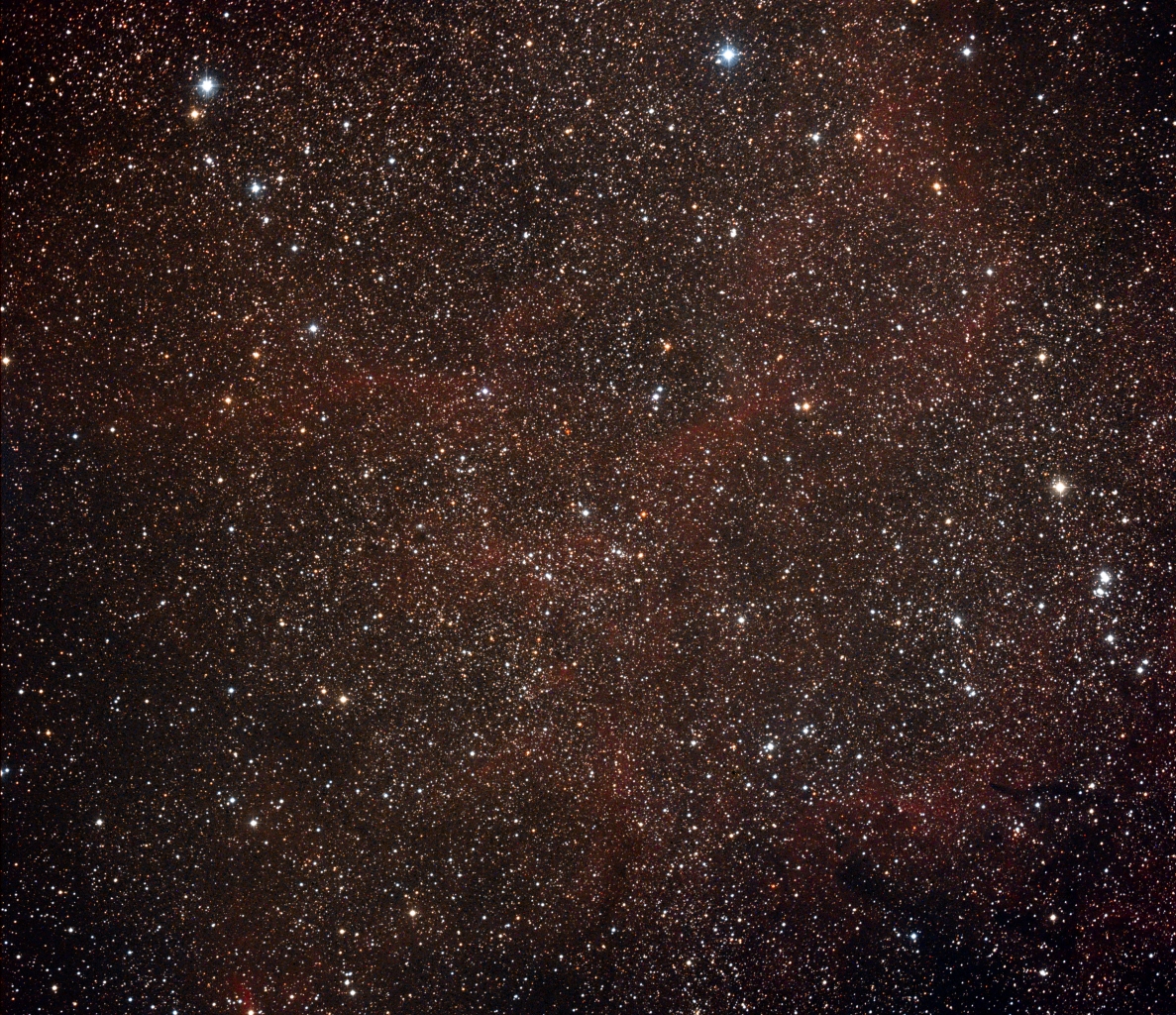
Stayed up until 2:00 a.m. last night taking a Hyperstar III/M26C 2-framer of the NGC 6883 and NGC 6871 regions in Cygnus. This is just one sub from each region quickly stitched together with virtually no processing just to get an idea what it will look like. Being Cygnus of course the whole area is full of emission nebulosity. Vignetting, hot pixels – I’ve left the lot in here – but it looks like the full data set might be quite nice 🙂

Last night was the third night of trying to set up the Hyperstar III and the M26C 10-megapixel one-shot colour CCD. It’s been a bit of a battle and I still haven’t got very good chip flatness and collimation, but it was certainly good enough to do some test shots in Cygnus. Focusing was very good and tracking was excellent – chip flatness and collimation only mediocre – I think it is much harder to get the chip accurately flattened with the smaller pixels of the M26C compared to the larger M25C pixels – this also seems to be a fine tuning problem on the mini-WASP array as well. Not too surprising I suppose, and not too difficult to sort out either – just takes quite a bit of time.
The 10-megapixels of the M26C versus the 6-megapixels of the M25C manifests itself in many ways. My little mini-ATX computer REALLY notices the much bigger file sizes, much longer to download the data files and CCDInspector takes a lot longer to analyse a sub-exposure. But neither of those things matter too much when your images have nearly doubled in resolution. As the Hyperstar III demands a one-shot colour camera, and the full frame sensors are just too big for the C11/Hyperstar III – then I reckon the M26C is just about the most ideal camera you can use with the system.
The accompanying image comprises 5 x 5-minute subs of the NGC6883 open cluster region (with nebulosity) in Cygnus. It lives right next door to NGC6871 another open cluster with nebulosity – and this region will make a really great 2-framer when I finally get the HSIII/M26C fully-tuned up.
I also got an hour’s worth of 15-minute subs on the Sadr region, which I will not show as there are lens flares all over the place (this is a problem with the Hyperstar III unfortunately, you can’t image very bright stars with the HSIII due to the lens flares), and I haven’t bothered correcting the vignetting with a flat (I didn’t bother correcting the vignetting in the NGC6883 image either). However, that said, it gave me the usual very deep result you’d expect with 15-minute HSIII subs (that’s equivalent to 75-minute subs on the mini-WASP array!!) and overall I am very happy with these first First-Light results with the HSIII and the M26C camera 🙂
Unbelievably there were a couple of hours of clear sky (and no Moon) last night 🙂 As both the mini-WASP and the new Hyperstar III setup need tuning it was a hard choice of which one to work on. Expecting to finish the Hyperstar III and maybe even grab an image too – I went for the Hyperstar. Needed to refocus-train the system as there is a new camera on board, and then it was the old collimation routine. Got to a point of pretty good collimation but poor star shapes around the edges. Think this needs another bit of optical hardware to get rid of that – so next outing I suppose. Three hours work done before the clouds rolled in – can’t complain – better than nothing.
If you’re into Science Fiction I can highly recommend “Slabscape: Reset” – the best thing I’ve picked (well Kindled anyway) since William Gibson’s Neuromancer – and that’s going back a LONG time 🙂
Spica
Star name: Spica
Other names: Alpha Virginis, Azimech, Alaraph, Dana
Constellation: Virgo
Other ID: 67 Virginis, HR5056, HD116658, SAO157923, HIP65474
Magnitude: +1.04
Absolute magnitude: -3.55
Luminosity, Sun = 1: 12,100
R.A. 2000: 13hr 25min 11.5793sec
Dec 2000: -11deg 09min 40.759sec
Spectral type: B1 III-IV/B2 V (Beta Cephei type variable, rotating ellipsoid)
B – V colour index -0.24
Temperature: 22.400 K
Mass, solar masses: 10.25 +/- 0.68
Radius, solar radii: 7.4 +/- 0.57
Distance in light-years: 260 +/- 20
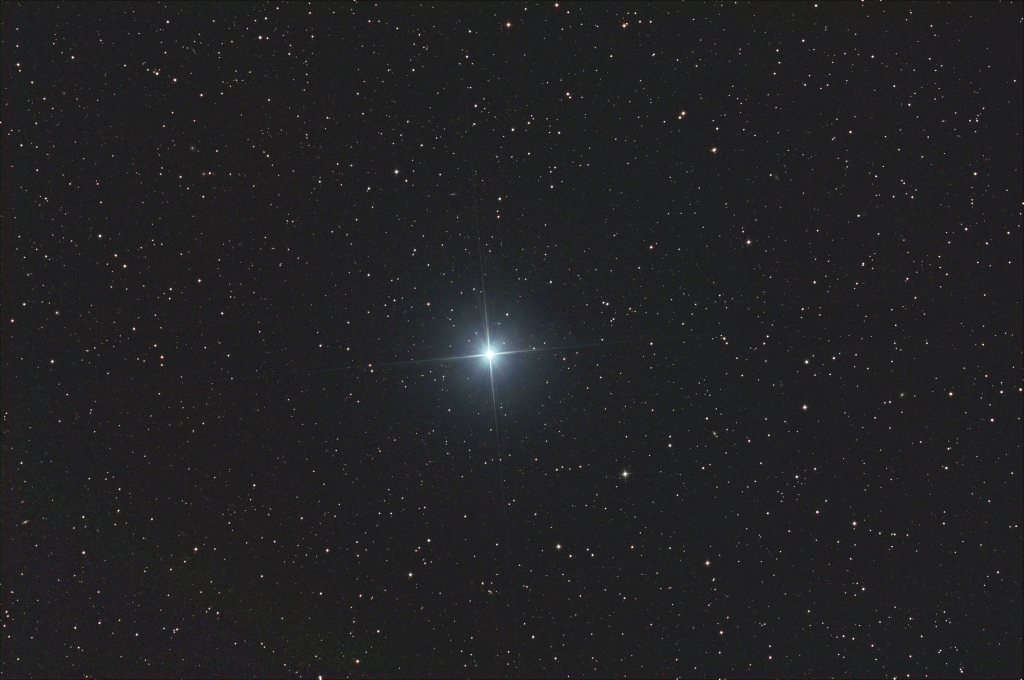
Spica is the brightest very blue star in the night sky, the brightest star in Virgo, and the 15th brightest star in the whole (north and south) sky. Spica is a close binary with an orbital period of about 4 days. Spica is a Beta Cephei type variable which has a brightness variability over a 0.1738 day period, in addition, due to the presence of its companion star, Spica is also a rotating ellipsoidal variable leading to an apparent magnitude change of 0.03 over the binary orbital period. Note that this is not an eclipsing binary, but an effect of gravitational distortion due to the close companion star. As Spica is close to the ecliptic it can be occulted by the Moon and sometimes by the planets as well. From my 51 degree north location Spica can be seen close to my southern horizon during the spring. In 2012 as Spica crossed my southern horizon it was accompanied by Saturn which travelled almost directly above it creating a nice photo-opportunity for a wide field setup.
Well I don’t think there is going to be much let up in the rain for a good few months now – I have just received a new camera for the Hyperstar III. For quite a while now I have used the faithful Starlight Xpress M25C one-shot colour CCD on the HSIII – 6-Megapixels and 2.85 arc seconds per pixel sampling – it has performed flawlessly and provided some superb images. BUT – there’s always developmental improvements at Starlight Xpress and as I now have quite a bit of experience using the new M26C cameras on the mini-WASP array, it became clear that this should be the new camera for the HSIII. So I’ve leapt up from 6-Megapixels to 10-Megapixels and my sampling has gone up from 2.85 arc seconds per pixel to 2.1 arc seconds per pixel. The Hyperstar III and the M26C are going to be a formidable combination. Last night I managed to get all the software working with the new camera and the next job is to focus train the new system using Starizona’s Microfocuser system and FocusMax. With the system focus trained for the new camera it’s then a matter of flattening and collimating the camera using CCDInspector (and FocusMax) – and then I’ll be all set for imaging again. Really looking forward to putting the new combo through its paces 🙂 Guess I also now need to create a new Category for this web site – Hyperstar III and M26C CCD images.