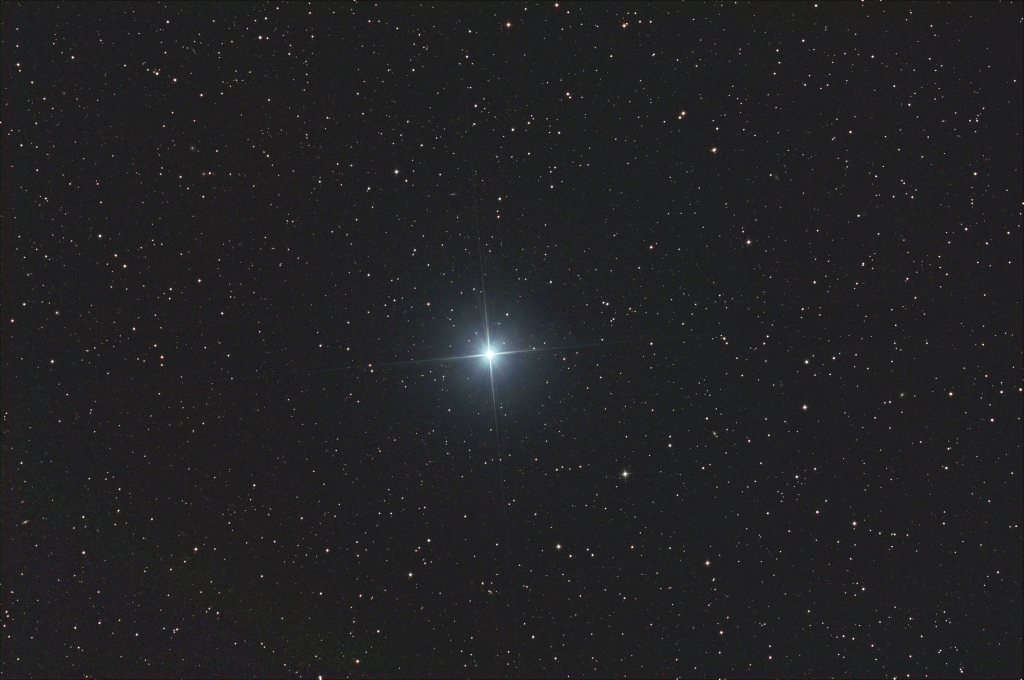
Spica – the brightest of the very blue stars in the night sky

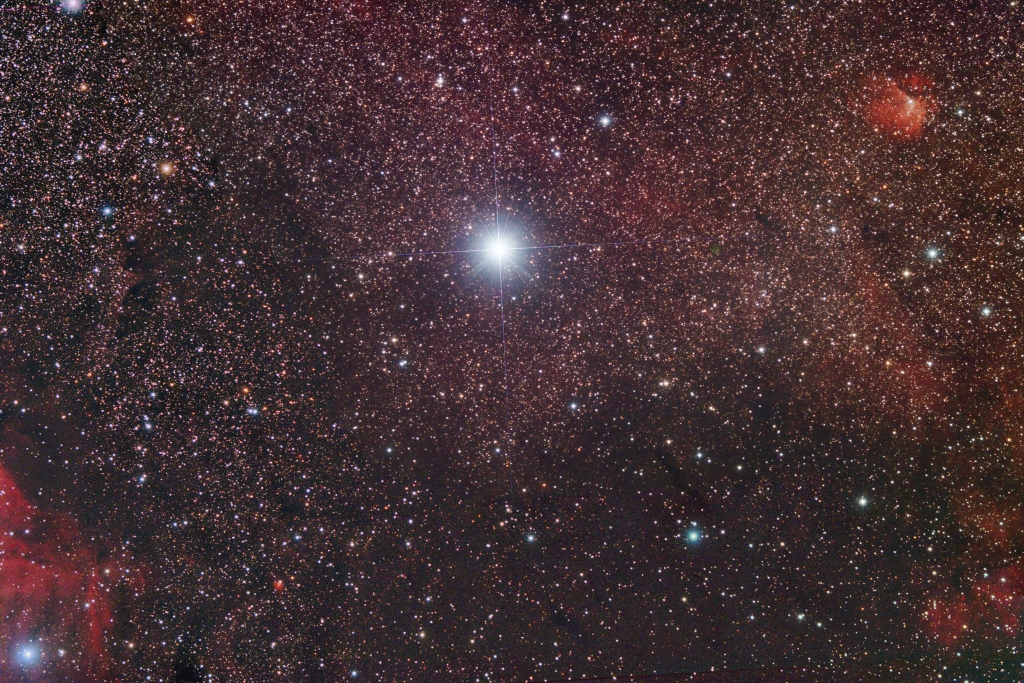
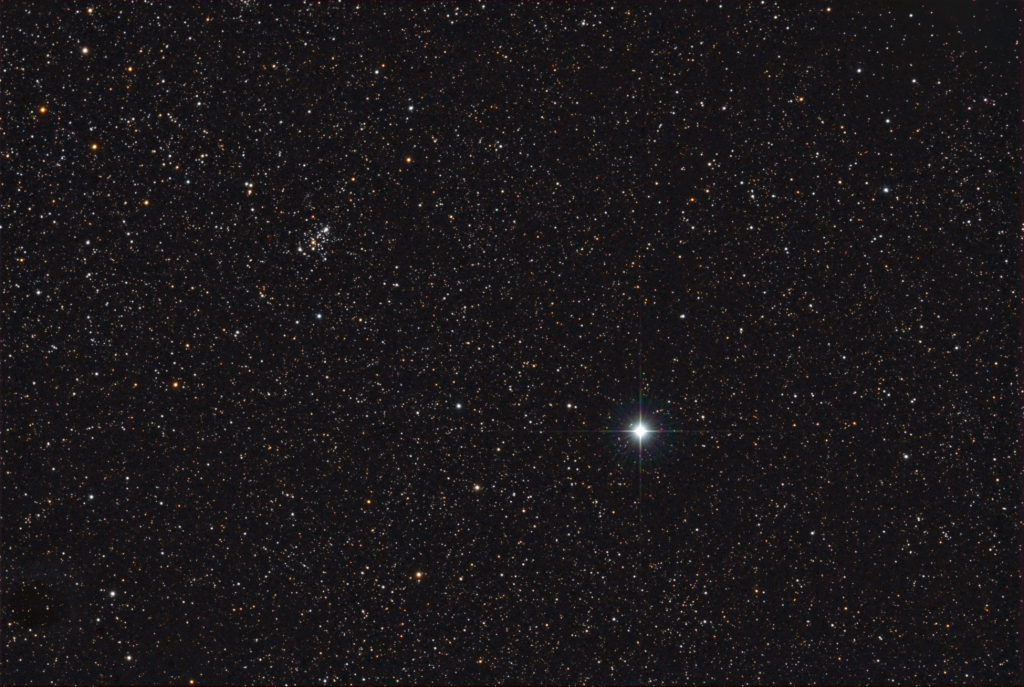
Whereas there are lots of very red stars in the night sky (not many bright ones though) there are fewer very blue stars, that is stars with a big negative B-V index.  The brightest very blue star in the night sky happens to be Spica, which I was only really aware of this year, very low down on my southern horizon, travelling along with Saturn, during this Spring.  As I am interested in imaging the brightest very red and very blue stars in the night sky I imaged Spica with the Hyperstar III and the M25C camera, but being bright meant that I got an enormous unwanted lens flare from the Hyperstar III.  I can’t deal with bad lens flares in the processing, so Noel Carboni came to the rescue and processed this one for me.  Great job Noel!!

Posted in Hyperstar and SXVF-M25C | Leave a comment

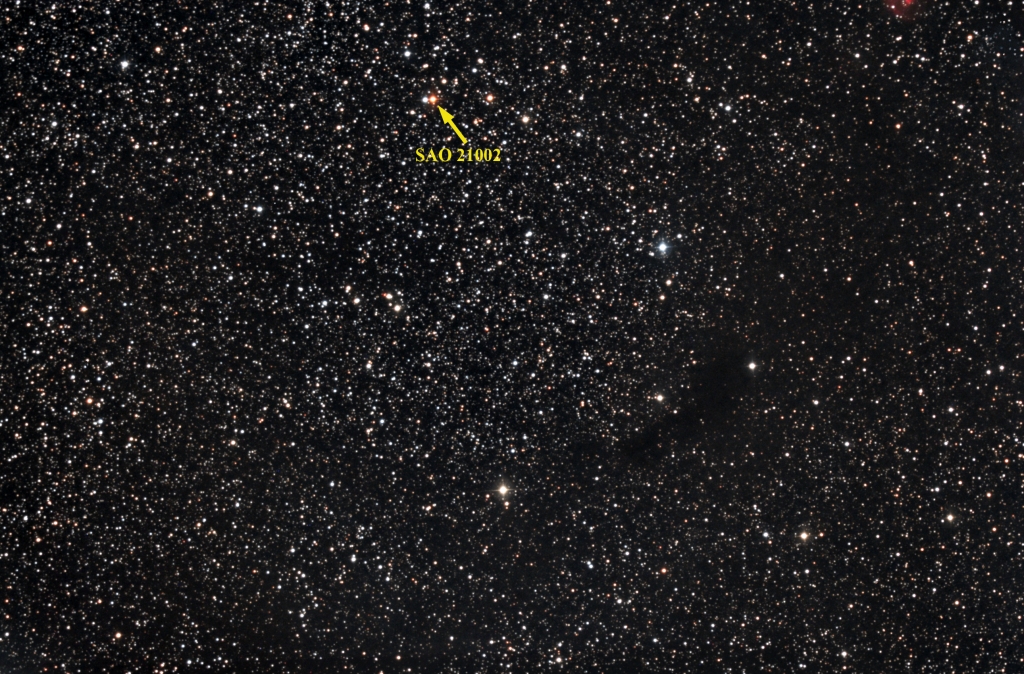
WZ Cassiopeiae – a Carbon star near Caph in the constellation Cassiopeia

WZ Cassiopeiae

Star name:                                           WZ Cassiopeiae

Other names:

Constellation:                                      Cassiopeia

Other ID:                                             SAO 21002, HIP 99, HD 224855, B+59 2810, PPM 11856

Magnitude:                                          6.772 to 7.215

Absolute magnitude:                            -2.7 +/- 1.0

Luminosity, Sun = 1:                           980 +/- 910

R.A. 2000:                                          00hr 01min 15.855sec

Dec 2000:                                           +60deg 21min 19.016sec

Spectral type:                                      C5p

Temperature:                                       3,450 K

Mass, solar masses:

Radius, solar radii:

Distance in light-years:                       2900 +/- 1300


WZ Cassiopeiae is a Carbon star in the constellation Cassiopeia.


Posted in News, Sky 90 and SXVF-M25C | Leave a comment

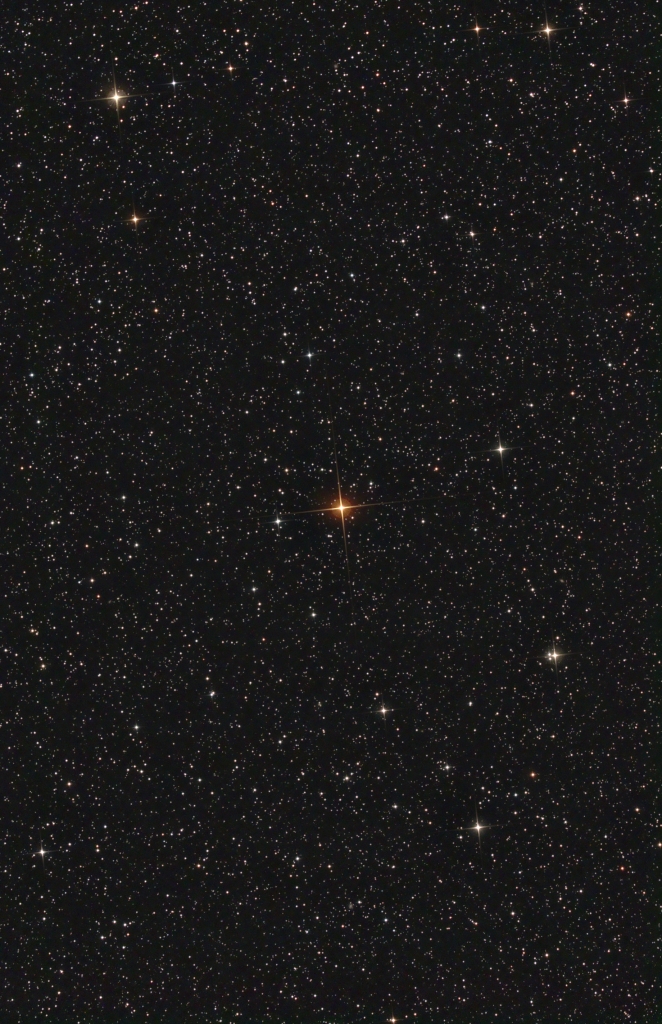
UU Aurigae – a Carbon star in the constellation Auriga

UU Aurigae

Star name:                                           UU Aurigae

Other names:

Constellation:                                      Auriga

Other ID:                                             SAO 59280, HD 46687, HIP 31579, HR 2405, BD+38 1539

Magnitude:                                          5.446

Absolute magnitude:                            -3.1 +/- 1.1

Luminosity, Sun = 1:                           1400 +/- 1400

R.A. 2000:                                          06hr 36min 32.8364sec

Dec 2000:                                           +38deg 26min 43.8sec

Spectral type:                                      C5II semiregular variable

Temperature:                                       3,450 K

Mass, solar masses:

Radius, solar radii:

Distance in light-years:                       1,630 +/- 820


UU Aurigae is a binary Carbon star in the constellation Auriga.  Period of variation 441 days.


Posted in Hyperstar and SXVF-M25C, News | Leave a comment

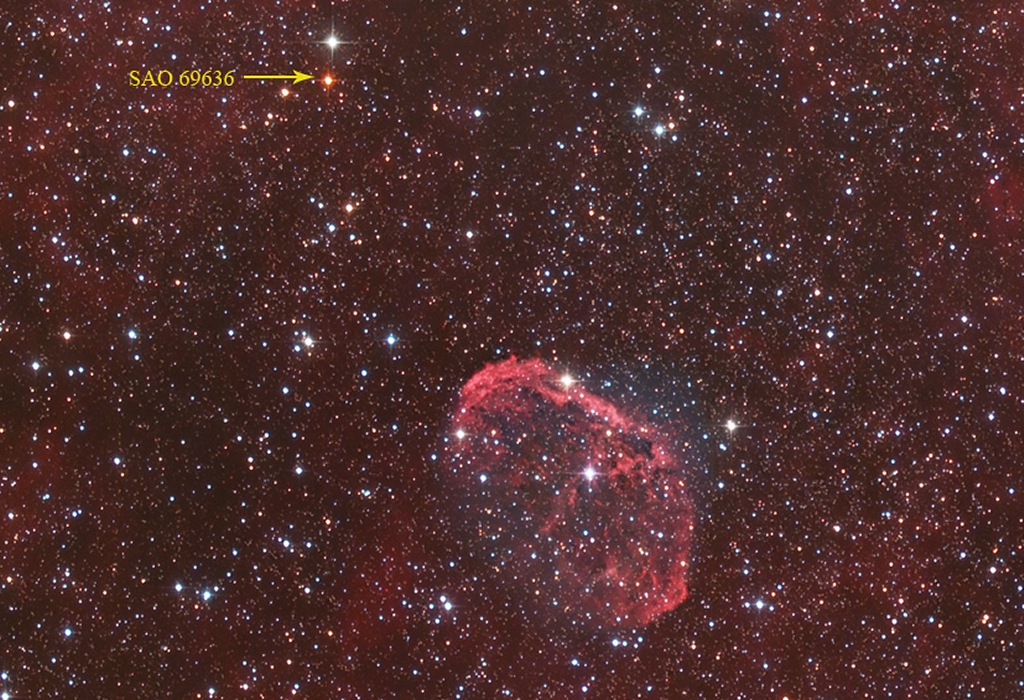
RS Cygni – a Carbon star lying close to the Crescent nebula in Cygnus

RS Cygni

Star name:                                           RS Cygni

Other names:

Constellation:                                      Cygnus

Other ID:                                             SAO 69636, HIP 99653, PPM 84477, HD 192443, B+38 3957

Magnitude:                                          7.1 to 8.5

Absolute magnitude:                            -0.77
+/- 0.92

Luminosity, Sun = 1:                           170 +/- 140

R.A. 2000:                                          20hr 13min 23.662sec

Dec 2000:                                           38deg 43min 44.47sec

Spectral type:                                      C5II

Temperature:

Mass, solar masses:

Radius, solar radii:

Distance in light-years:                       1550 +/- 650


This Carbon star lies very close to the Crescent nebula (NGC6888, an emission nebula formed from the Wolf-Rayet star HD 192163) in the constellation Cygnus.  The mean period of the variability of RS Cygni is 434.1 days.

Posted in Hyperstar and SXVF-M25C, News | 2 Comments

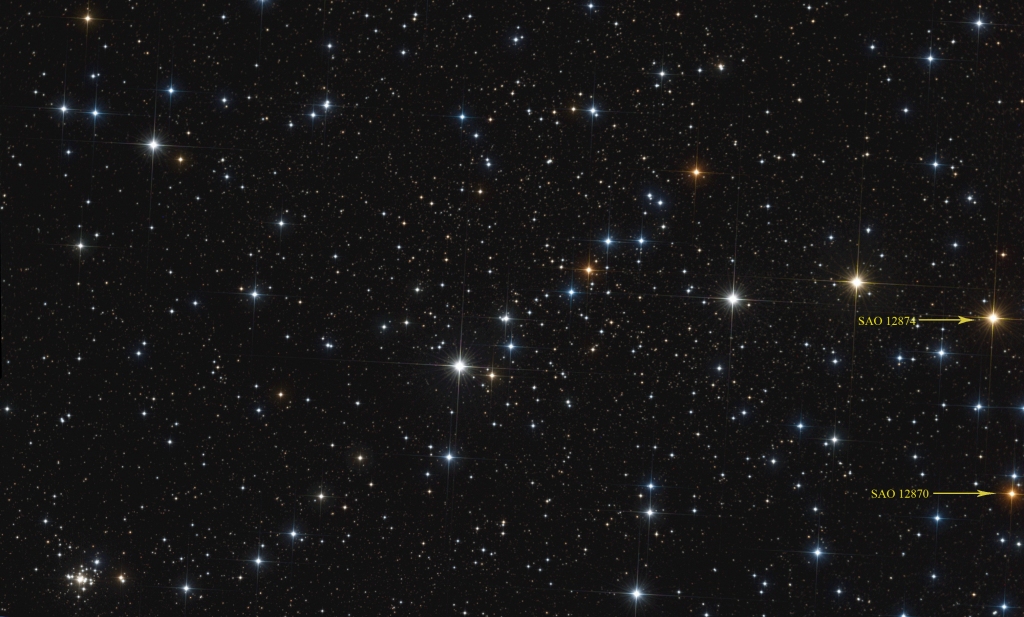
SAO 12870 Carbon star next to Kemble’s Cascade in Camelopardalis

SAO 12874 and SAO 12870

Star name:

Other names:

Constellation:                                      Camelopardalis

Other ID:                                             SAO 12874, HIP 17296, HD 22649, B+62 597, PPM 14446

Magnitude:                                          5.05

Absolute magnitude:

Luminosity, Sun = 1:

R.A. 2000:                                          03hr 42min 09.325sec

Dec 2000:                                           +63deg 13min 00.501sec

Spectral type:                                      S5.3 SB

Temperature:

Mass, solar masses:

Radius, solar radii:

Distance in light-years:                       520.19


Star name:                                           U Camelopardalis

Other names:

Constellation:                                      Camelopardalis

Other ID:                                             SAO 12870, HIP 17257, HD 22611, B+62 596

Magnitude:                                          6.99 (6.9 – 7.6)

Absolute magnitude:

Luminosity, Sun = 1:

R.A. 2000:                                          03hr 41min 48.172sec

Dec 2000:                                           +62deg 38min 54.382sec

Spectral type:                                      C3
– C6(N5)  Carbon star

Temperature:

Mass, solar masses:

Radius, solar radii:

Distance in light-years:


SAO 12874 and SAO 12870 are a pair of red stars lying just to the right of the famous “Kemble’s Cascade” asterism.  SAO 12874 has B-V 1.97 and SAO 12870 or U Camelopardalis has B-V 4.91 so it is a very red Carbon star.


Posted in News, Sky 90 and SXVF-M25C | Leave a comment

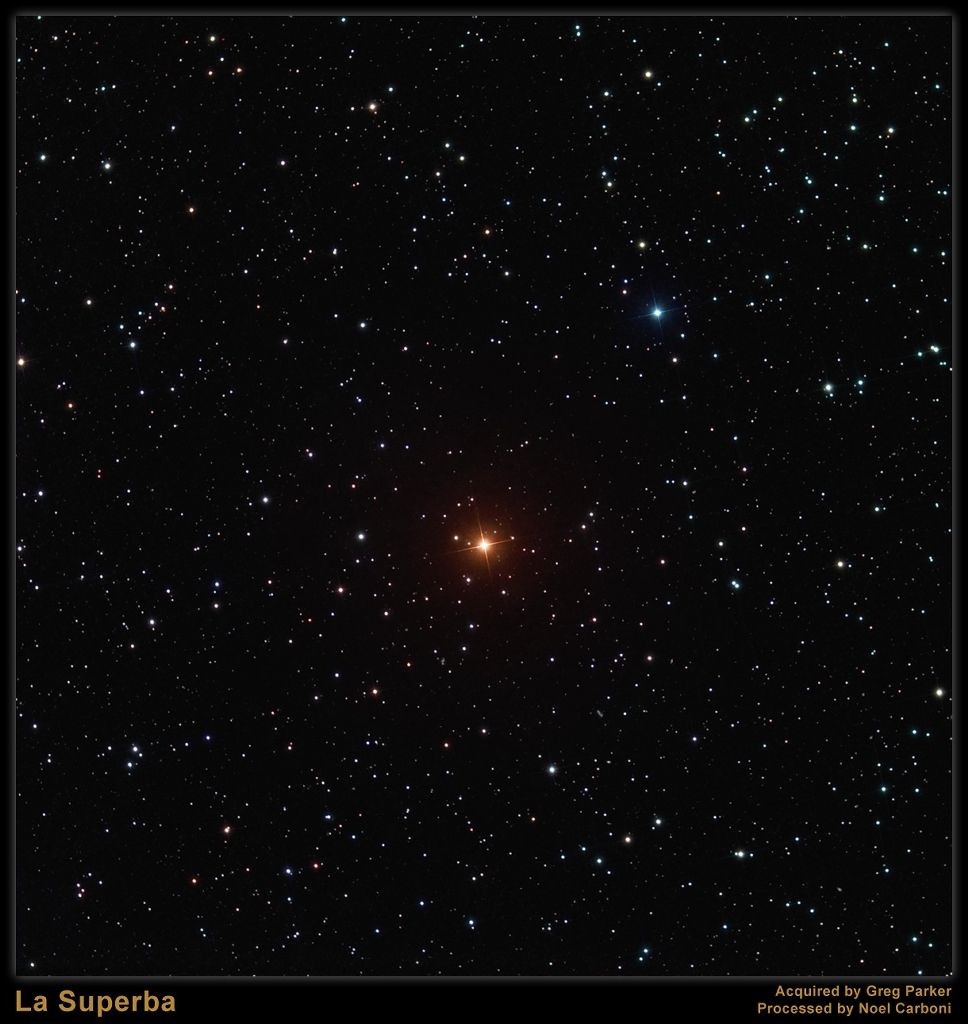
La Superba – Carbon star in Canes Venatici

La Superba

Star name:                                          La Superba

Other names:                                      Y Canum Venaticorum

Constellation:                                     Canes Venatici

Other ID:                                             SAO 44317, HIP 62223, HD110914, HR4846, GC17342

Magnitude:                                         4.8 to 6.3 (variable over 160 days)

Absolute magnitude:                          -7.63

Luminosity, Sun = 1:                          4,400

R.A. 2000:                                          12hr 45min 07.827sec

Dec 2000:                                           +45deg 26min 24.922sec

Spectral type:                                     C7 (CN5) supergiant

Temperature:                                      2,200 (2,800) K

Mass, solar masses:                            3

Radius, solar radii:                             215

Distance in light-years:                      711 +/- 113


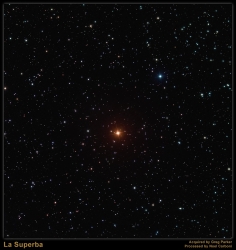
La Superba in the constellation Canes Venaticorum is one of the brightest Carbon stars in the sky but it is not a naked-eye object as most of its output is in the infrared part of the spectrum.  It was named “La Superba” by Father Angelo Secchi who was amazed at the beauty of its spectrum, and as you can see in the accompanying (north up) image, it is a strikingly brilliant red star.  La Superba is a very special type of Carbon star, it is in fact the brightest “J-star” in the sky, where a J-star is a very rare group of Carbon stars that has an abundance of Carbon-13 (heavy Carbon).  At between 2,200 and 2,800 K La Superba is one of the coolest true stars known.  In the accompanying image, which was the Astronomy Picture of the Day (APOD) for December 18th 2008, we once again see the obligatory brilliant blue star (SAO 44292) lying at the 1 O’clock position from La Superba.  There are also a number of faint background galaxies in this image, the most obvious lying at the 7 O’clock position which is magnitude 15.7 PGC 43044.
 

Posted in Hyperstar and SXVF-M25C, News | Leave a comment

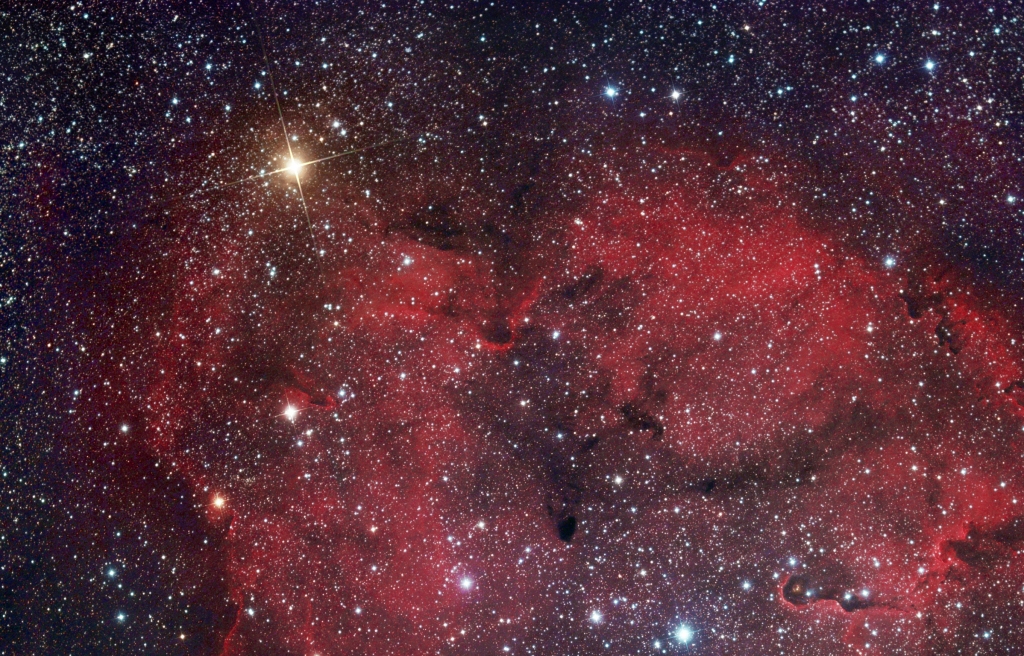
The reddest star in the sky – Mu Cephei, Herschel’s Garnet Star

Mu Cephei

Name:                                                  The Garnet star

Other names:                                      Herschel’s Garnet star

Constellation:                                     Cepheus

Other ID:                                             Erakis, HD206936, HR8316, SAO33693, HIP107259

Magnitude:                                         4.08 (variable)

Absolute magnitude:                          -7.63

Luminosity, Sun = 1:                          370,000 (possibly as much as 600,000, uncertain figure)

R.A. 2000:                                          21hr 43min 30.4609sec

Dec 2000:                                           +58deg 46min 48.166sec

Spectral type:                                     M2Ia supergiant

Temperature:                                      3,690 +/- 50 K

Mass, solar masses:                            15

Radius, solar radii:                             1650

Distance in light-years:                      2,400 (Kaler – uncertain)


This is the reddest star in the entire night sky and at magnitude 4.08 it is naked-eye from reasonably dark sites too.   The incredible output power of the Garnet Star (check that Luminosity figure!) makes it one of the most luminous stars in the whole of our Milky Way.  Mu Cephei varies by almost a full magnitude with a semiregular period between 800 and 1,000 days. In the accompanying image, north is up and Mu Cephei is the bright star towards top left.  As you can see it sits on the outer edge of the massive IC1396 emission nebula.  At bottom far right you can see the famous “Elephant’s Trunk” nebula.  The constellation Cepheus is a very rich region for imaging interesting deep-sky objects.


Posted in News, Sky 90 and SXVF-M25C | Leave a comment

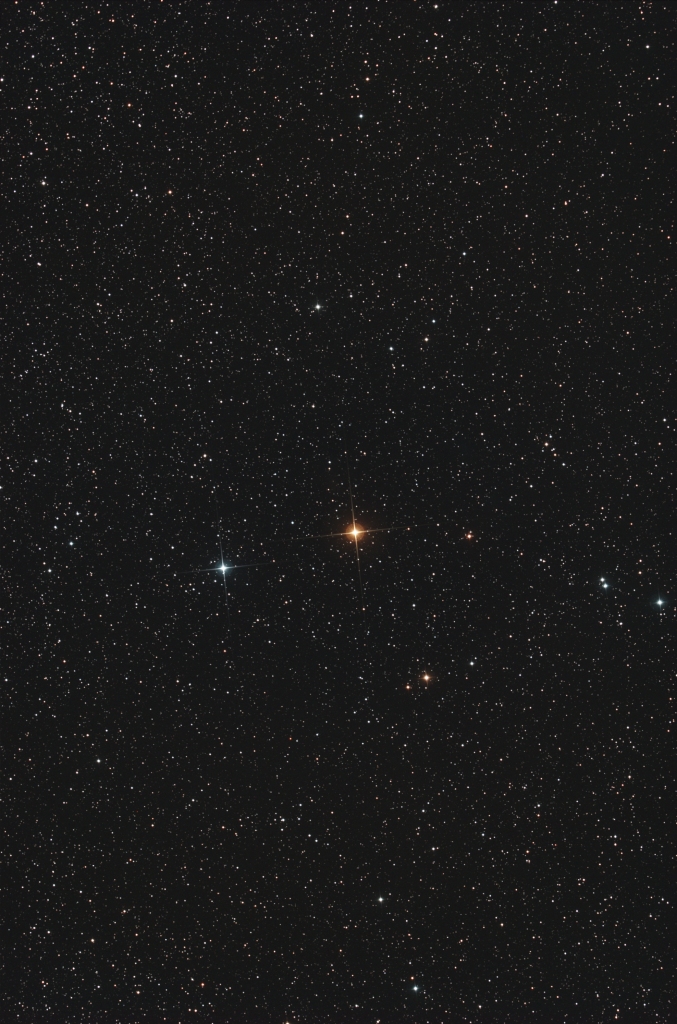
The second reddest star in the sky – 119 Tauri, CE Tauri

119 Tauri/CE Tauri

Star name:                                          CE Tauri

Constellation:                                     Taurus

Other ID:                                             119 Tauri, SAO 94628, HIP25945, HD36389, B+18 875, HR1845, GC 6841

Magnitude:                                         4.32

Absolute magnitude:                          -4.38+/-0.31

Luminosity, Sun = 1:                          44,000 (variable)

R.A. 2000:                                          05hr 32min 56.552sec

Dec 2000:                                           +18deg 35min 39.243sec

Spectral type:                                     M2Ib

Temperature:                                      3,500K (variable)

Mass, solar masses:                            14

Radius, solar radii:                             608 (variable)

Distance in light-years:                      1918.57

This is the second reddest star in the entire night sky after Mu Cephei (the Garnet Star in Cepheus right next to the huge emission nebula IC1396).  CE Tauri is an M-type pulsating red supergiant (semiregular variable) first recognised by A. Ahad as the second reddest star in the sky.  In the accompanying image (north up) we note a nice blue star just to the left of CE Tauri, this is SAO 94649 (120 Tauri), and it is surprising just how many bright red stars seem to have a bright blue close-by companion.  This semiregular variable changes magnitude by approximately 0.3 over a period of around 165 days.  CE Tauri is metal-rich and is likely to be fusing its Helium into Carbon, although Carbon fusion itself cannot be ruled out.  As 119 Tauri is only 4.6 degrees off the ecliptic it affords accurate measurements of its size by lunar occultation measurements.  Look at the Luminosity and Radius of this star – it is a giant in every way.

Posted in Hyperstar and SXVF-M25C, News | Leave a comment

IOM July 2012 – the whole of the constellation Leo

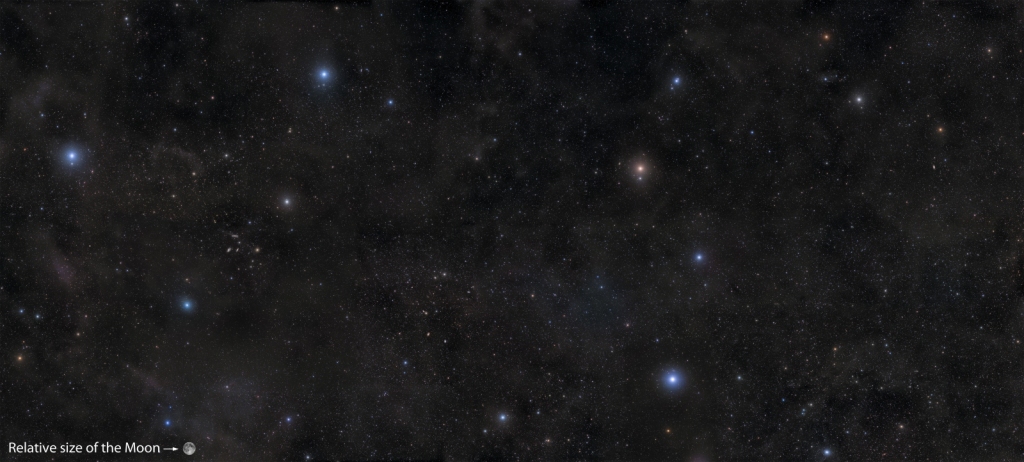
Rogelio Bernal Andreo is completely redefining amateur deep-sky imaging.  I have shown Rogelio’s work before in the NFO prequel “Image of the Week” and I continue to be completely blown away by the beauty and extreme high quality of his work.  Here we have a 54-frame mosaic, stitching together such a beast is no mean task in itself, I’m not sure if my computer could actually handle the file size!  The image covers an absolutely massive 41 x 19 degrees where the diameter of a full Moon is a mere half a degree.  Everything about this image shouts “quality”, “hard work” and “extreme dedication” to the hobby, congratulations Rogelio on creating yet another groundbreaking masterpiece.

You must see this image at much higher resolution on Rogelio’s site here.  Be prepared for a mind-blowing experience, better be sitting down 🙂


Posted in IOM | Leave a comment

More data added to the Deneb region image

While I have been trying to tune up scope 1 and camera 1 on the mini-WASP array, I have not wasted good imaging time 🙂  During the tuning periods I was imaging the same region with the well-tuned scope 2 and camera 2, a Sky 90 and an M26C one-shot colour camera.  So I have added around 3 and a half hours to the earlier 1 and a half hours worth of data taken in the same area.  Looks quite nice with a Milky Way backdrop and a ton of faint emission nebulosity coming through.

Posted in Sky 90 and SXVF-M26C | Leave a comment