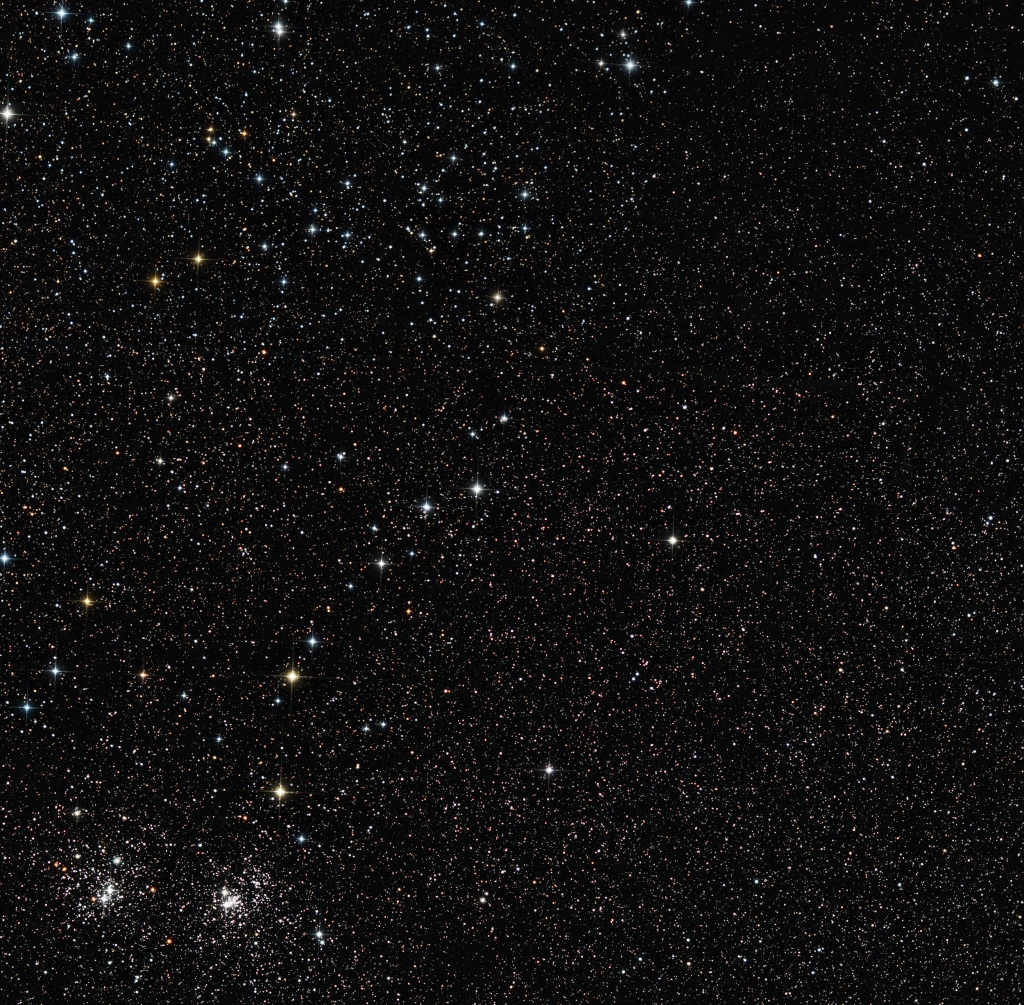
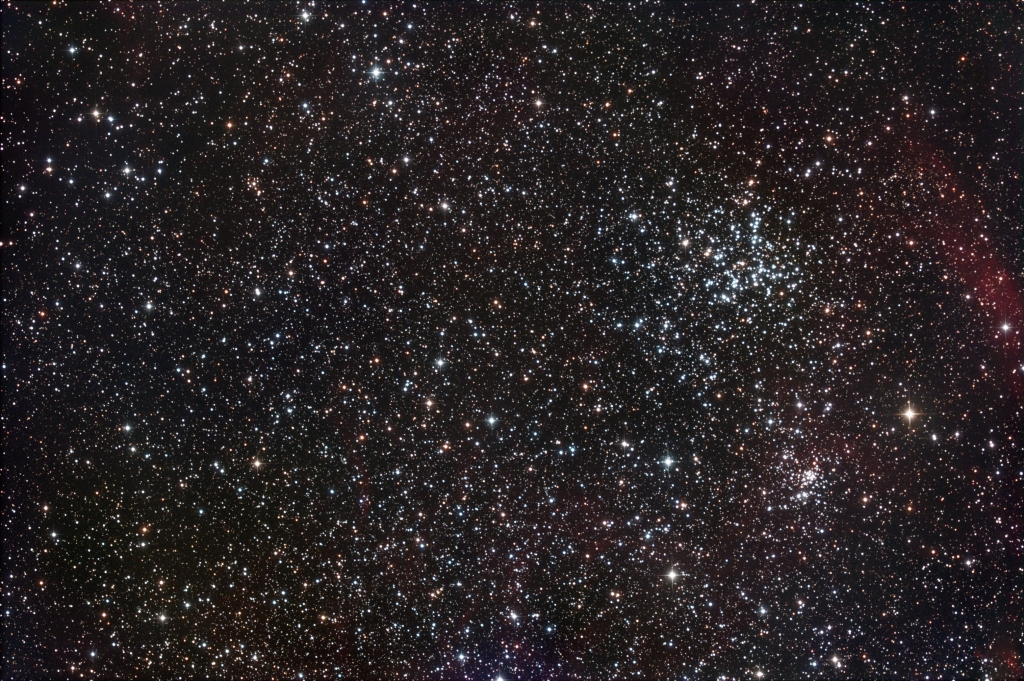
The Double Cluster and Stock 2 region in Perseus. Grabbed the last bit of this data last night. Also managed to get rain into the observatory as a solitary rain cloud passed over and chucked it down 🙁 All dried out this morning 🙂
The Double Cluster and Stock 2 region in Perseus. Grabbed the last bit of this data last night. Also managed to get rain into the observatory as a solitary rain cloud passed over and chucked it down 🙁 All dried out this morning 🙂
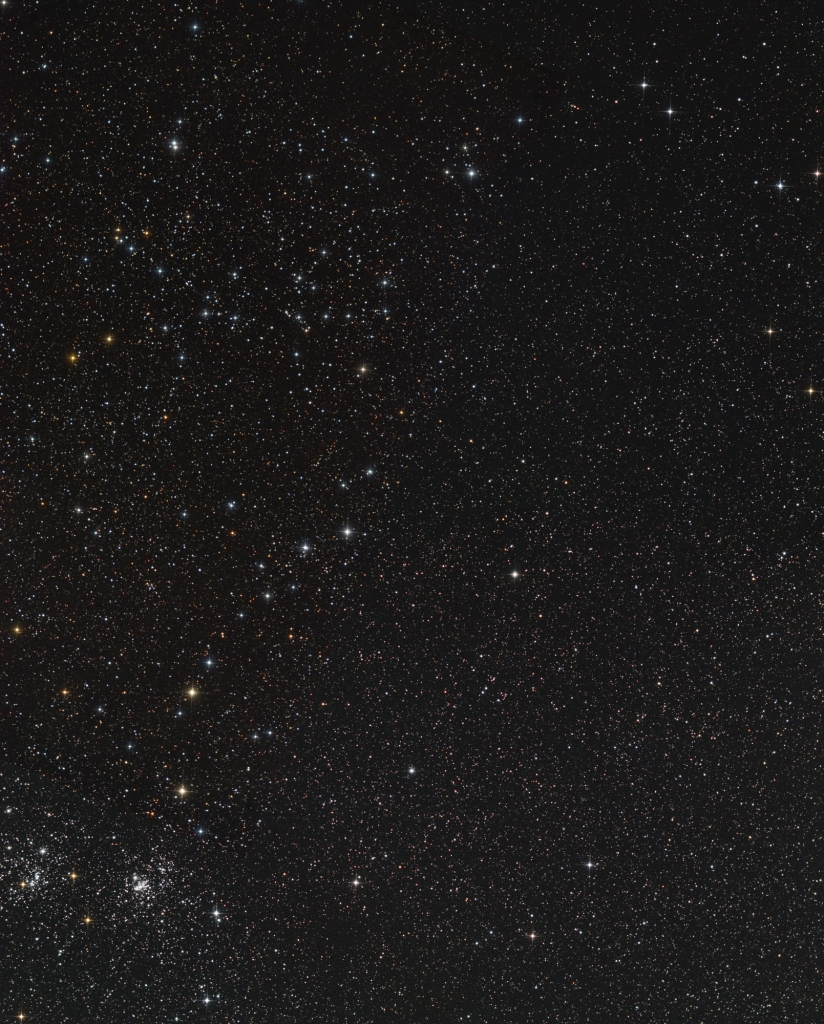
When this is framed properly, and at least 3 hours worth of data taken, then this is going to look good 🙂
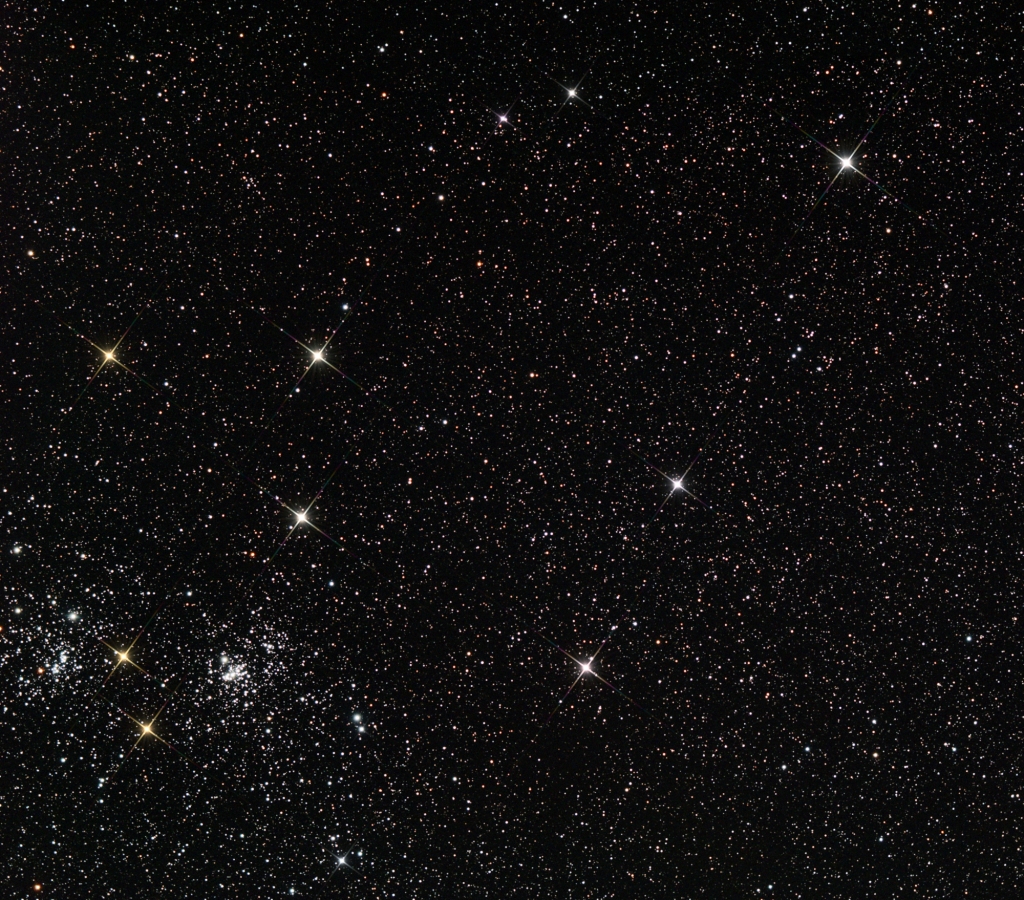
Managed to get half an hour on the Double Cluster with one camera before it all went pear-shaped with the weather last night. The Double Cluster and Stock 2 is one image that the mini-WASP array was actually designed for 🙂 Just as well I did this “test shot” as it shows my framing is out and now I know where to place the clusters in the FOV for a much better image. The second camera (with the Stock 2 image) didn’t have the same number of sub-exposures as camera 1 so the complete image doesn’t look so good. Never mind – I am at least prepared now to do the thing properly next clear evening. One thing is for sure – the mini-WASP array is going to be perfect for those BIG star fields 🙂

Took this image with the Canon 5D MkII around 7:20 p.m. on Monday 2nd January 2012. Here we have a very nice lunar halo and close to the Moon at around 7 O’clock we have Jupiter too. But there’s a lot more! Just outside the halo at 10:30 there are the Pleiades and a little further out again at 9:30 there is Aldebaran and the Pleiades. Over to the far left (East) rising above the trees is the familiar Winter constellation Orion. Bottom left you can see the North dome, and a little further to the right at the bottom you can just make out the top of the South dome. Pretty busy image 🙂

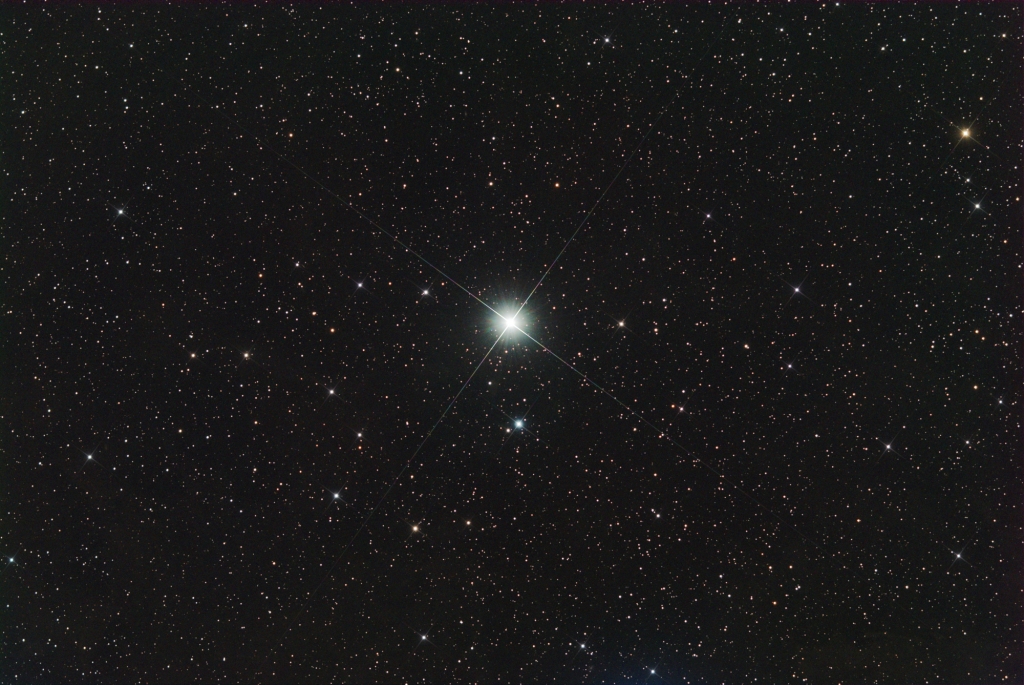

The earlier images of Bellatrix, Polaris and Pollux re-processed using a new process step.
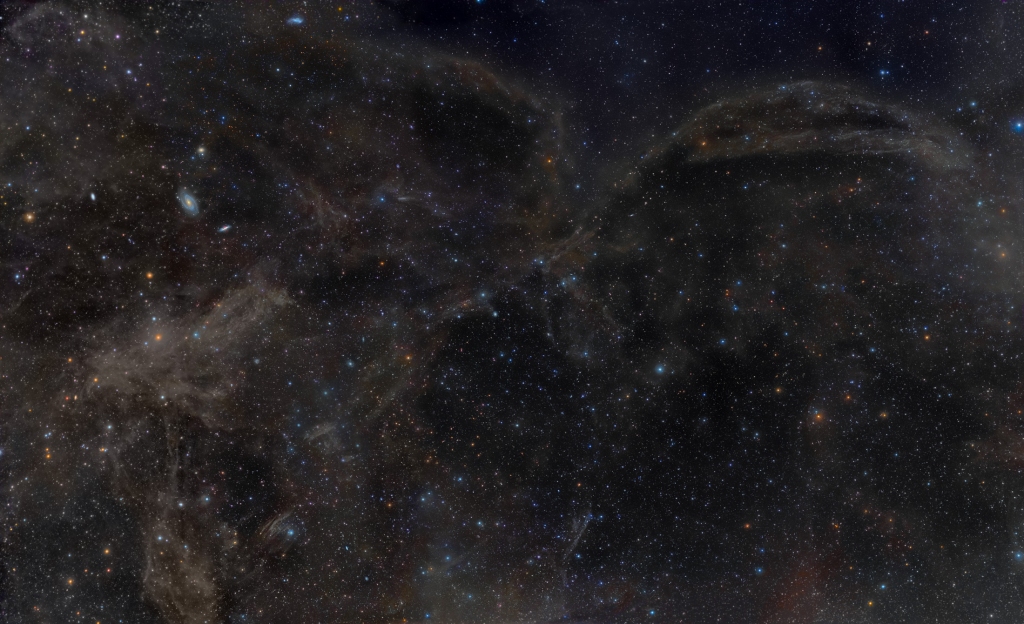
Happy New Year! And the first “Deep-Sky Image of the Week” for the New Year is another belter from Rogelio!!!!! O.K. for your average Joe Public this may look pretty grey and unimpressive – where are all the pretty colours? But for us astroimagers, we know what skill (and ultra dark skies) are necessary to create a panorama such as this. In my opinion this is the most incredible amateur deep-sky image to have ever been produced – period. Under U.K. skies we struggle to pull out a little of the IFN in the M81/M82 region (I even struggled with long exposure times using the Hyperstar!) – so what do you make of this enormous ultra widefield showing the full extent of the Integrated Flux nebula around the Pole? Nothing short of outstanding. I’ll now leave it to Rogelio to discuss his incredible image and the effort it took to acquire it.
“I’ve ended up calling this the 1,200 miles image, because that’s the total number of miles I ended up driving in order to capture the data for this image. By the way, that is a record for me! We do crazy things sometimes just to capture a bunch of photons!
The Object
The above wide field image features a large area of the IFN (integrated flux nebula) of the polar spur – probably the largest IFN image captured by an amateur so far. The field of view is approximately 15×9 degrees. The IFN is extremely faint, so much that almost every image taken of this area would either show no IFN at all of at most, a barely perceptible hint of it.
In simple terms, the IFN is dust clouds. However, unlike most known nebulae, they do not reflect, scatter or fluoresce due to the radiation of any individual star or cluster of stars, but do so from the integrated flux of all the stars in the Milky Way Galaxy. In other words, the IFN is illuminated by the glow of our own galaxy.
Steve Mandel once said that the IFN was like photographing something through a dirty window, the IFN being the dirt on that window, except that the “dirt” itself is beautiful to behold.
The Challenge
Because the IFN is so faint, capturing it is a challenge, as even under good skies it will sit barely above the noise. This means that once you’ve captured the data and try to bring the signal from the IFN, you will bring it along with the noise in the image, making it almost impossible to discern between noise and nebulae. This is the main reason most images won’t show any or almost any IFN – as astrophotographers deal with the noise – trying to make it dissapear – the IFN will dissapear with it.
For that reason it is important to image this area from as dark skies as you can get. Otherwise, the sky glow will completely bury the signal from the IFN.
How to understand this image
From a scientific point of view, the mind establishes an order regarding what’s being seen, because the IFN is the main structure and it appears well defined, but from other perspectives, the image may look simply weird.
Also, one may feel this image has a dirty look, perhaps even artificial, not only because of us looking at the sky through a “dirty window” but also because it would be impossible to preserve a “natural” balance when attempting to reveal the extremely faint IFN structures with so little data and without blowing up the brighter structures. The purpose of this image is to reveal those structures, not to create a natural and silk-smooth “pretty” composition. Beauty in this case is in the eye of the beholder.
Capturing the data
I captured this 2×5 mosaic (10 frames) first three days in a row, on Tuesday April 6th thru Thursday the 8th, and then during one more session on April 16th, 2010, taking advantage of an unusual break in the cloudy weather we’ve been having this year so far.
The first night I traveled to Dinosaur point to take the data for three frames but I wasn’t very happy (too much skyglow), so I decided that the next two days I would travel to Lake San Antonio (about 170 miles from home) which would give me better skies (6.5 ~ 6.6 NELM approx). After all that was done, I went back to Lake San Antonio one third night on April 16th to take the last two frames.
In the end, I drove over 1120 miles during the four days to acquire the data. I believe on Friday 9th I was near a coma after the effort (ok not exactly, just BRUTALLY tired). Picture yourself leaving Lake San Antonio on Friday morning at 4am after three restless nights and already 620 miles driven, for another 160 miles drive back home, and around 6:30am as you get near your home, you run into the morning rush hour traffic… We are… a very nut crowd!
Acquisition details
Each frame of the mosaic is only 90 minutes of luminance (6×15′) and 27 minutes of RGB color (3x3x3′). I had to limit the exposure to such short times because I knew I would only have just enough clear nights this time around and even with that, I knew I could barely make it. If one thing went wrong, I wouldn’t be able to finish it. This also meant that for the most part I would stay put checking the images during the capture at least every hour or so.
Every 2+ hours I’d shift to the next frame. Besides slewing to the next area, this involved taking flat images, rotating the camera,and doing my “manual” plate solving (I don’t do plate solves, so the realigmnent – including camera rotation – is done manually, and taking test shots to make sure the camera is well positioned to cover the field for the next frame.
Processing
The small image in this page is downsampled so that it fits well in the page. The large image (the one you see when you click on the image) is downsampled from a larger version. Since the IFN is, as I mentioned earlier, just above the noise, I had to chose between leaving the image at its original size but with the obvious degradation in quality, or take advantage of the benefits of downsampling when “fighting the noise”. Even with that you can still see the image is noisy but at this point my goal wasn’t to produce a clean image as much as being able to capture all that is going on up there even if that meant producing a less than average quality image from an aesthetic point of view. As with most of my images however, the aesthetics still played a role, and that’s why care was put in preserving details, avoiding blown up stars and galaxies, etc.
A big challenge was to join the different frames of the mosaic, where none of them had similar background and signal values, each had its own gradient issues, and even at times the SNR wasn’t similar. This forced me to do some very careful but strong adjustments on each frame (using formulas suggested by PixInsight’s Juan Conejero), applying synthetic background models, etc.
How to bring out all this faint detail that sits just above the noise, without making the image look like, well, crap? While several conventional techniques were used at different stages, it was probably the multi-scale techniques the ones that helped me bringing out the fainter details while preserving the integrity of the already bright areas. No “selective stretching” was ever done in the image to bring out the significant IFN signal – that is, I did not manually select areas that I later stretched, nor created masks to increase brightness selectively. While lightness-based masks were used at different stages in the processing of the image, none was used to “push” the signal of the IFN over the background. The reason for this is actually quite simple: if I did a “selective stretching” I would be dictating where there is IFN and where there isn’t. By avoiding selective stretching, I let the data be the one defining where the IFN is and how much of it.
As for the color, obviously I didn’t have enough data to get an accurate rendition of the color in the IFN, and what I’ve got wasn’t deep at all. I knew beforehand I wouldn’t have enough time to get deep and detailed color data, so I compromised with at least getting enough color for the stars and the field, hoping that the IFN would at least inherit some color from the background signal, which is most definitely the case here, and that’s why the IFN has a brownish hue versus the more expected blueish cast – regardless, the IFN not only scatters blue light but is also fluorescing a broad red spectrum of light known as the Extended Red Emission (ERE), so the brownish hue acquired from my poor color data isn’t completely off track.”
Many, many thanks for sharing this magnificent image with us Rogelio – and for kicking off 2012 with one of the most astonishing (amateur OR professional!!) deep-sky images out there 🙂
Check out the high resolution version on Rogelio’s web site: http://blog.deepskycolors.com/archive/2010/04/08/integrated-Flux-Nebula-Ifn-really-wide.html
First off, a very Happy New Year to you all. Well – 2011 can’t be said to have been the best imaging year on record, in fact I think it is fair to say that it is the worst imaging year overall I have recorded in my log book – and that goes back to September 2004. Let us at least hope for a better year, weather-wise, this year.
So what is this month’s Imaging Object of the Month? I have decided again to steer clear of the Orion goodies and move to nearby Auriga. Now Auriga usually means IC410/IC405 the Flaming Star nebula – but lying very close by there are a bunch of very nice open clusters and some smaller regions of emission nebulosity. So my Imaging Object for this month is the M38 open cluster region in the constellation Auriga. M38 (NGC1912) is quite a sizeable open cluster at 15 minutes in diameter and pretty bright at magnitude 6.4. Lying just underneath M38 you can see another little open cluster – NGC1907 – which very nicely offsets the subject of the image, M38. I have both clusters offset from the centre of the image as this is part of a much larger mosaic which will eventually include M36, IC417, IC410 and IC405.
As per usual with any open cluster you don’t need to use particularly long subs but as I wanted to catch the outer fringes of all the emission nebulosity surrounding IC410 and IC405 (which you can see towards the top right of the image) I used 5-minute subs with the fast f#2 Hyperstar III system – so this image goes pretty deep. As usual, you need at least 4 hours worth of data to start getting on top of the noise in the faint regions. Plenty of stars, plenty of faint nebulosity, the M38 region is certainly worthy of your valuable imaging time.
Until next month – clear skies 🙂
Happy New Year to you all 🙂
My log book confirms that 2011 was the worst year, weather-wise, for imaging since I started this lark. Not too surprising I guess with the groundbreaking mini-WASP array being this year’s mega-project. I hope the weather Gods are now satisfied that they have effectively ruined the mini-WASP’s arrival in this world and will now leave off to give us a half-decent 2012. Here’s hoping for clear dark skies, and plenty of them for 2012.
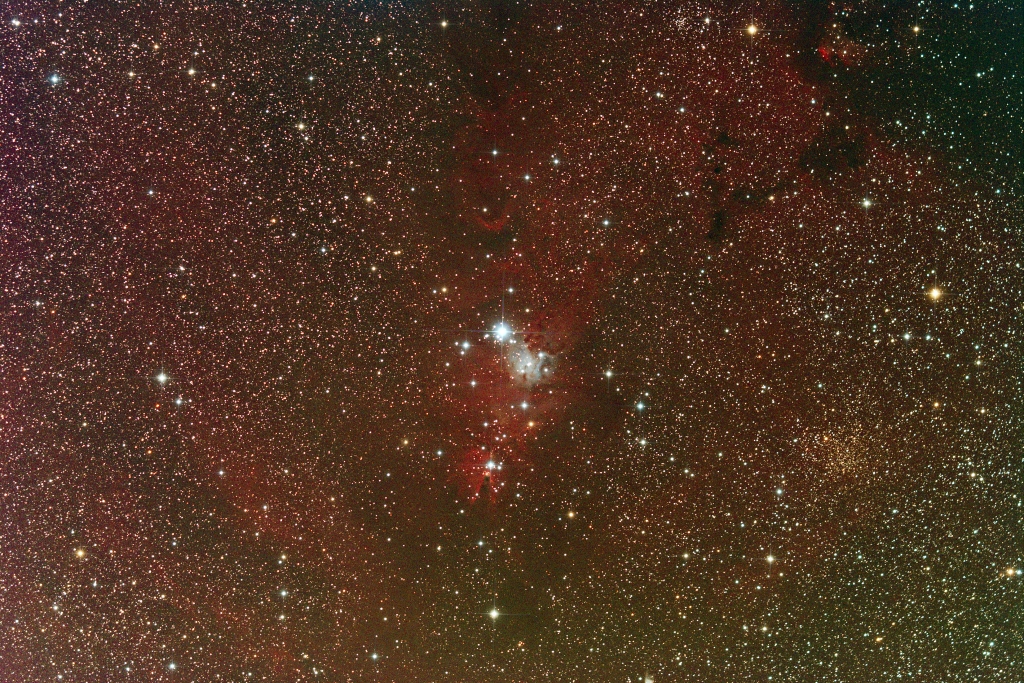
This image is a single frame from the mini-WASP and comprises 12 subs at 10-minutes per sub, so a 2-hour total exposure time (again well short of the 8 hours needed). The reason for only one frame is that due to hiccups I only got 5 subs for the upper frame and the data difference was just too big to match reasonably 🙁 Still, once again it shows me what is required for mini-WASP imaging, and I am now very glad that I resurrected the Hyperstar III as I may need to use this instrument to grab the faint data to paste into the mini-WASP bigger frame. I reckon composites are going to be the order of the day at the New Forest Observatory.