Deep-Sky Image of the Week – Astrophotographer Yours Truly

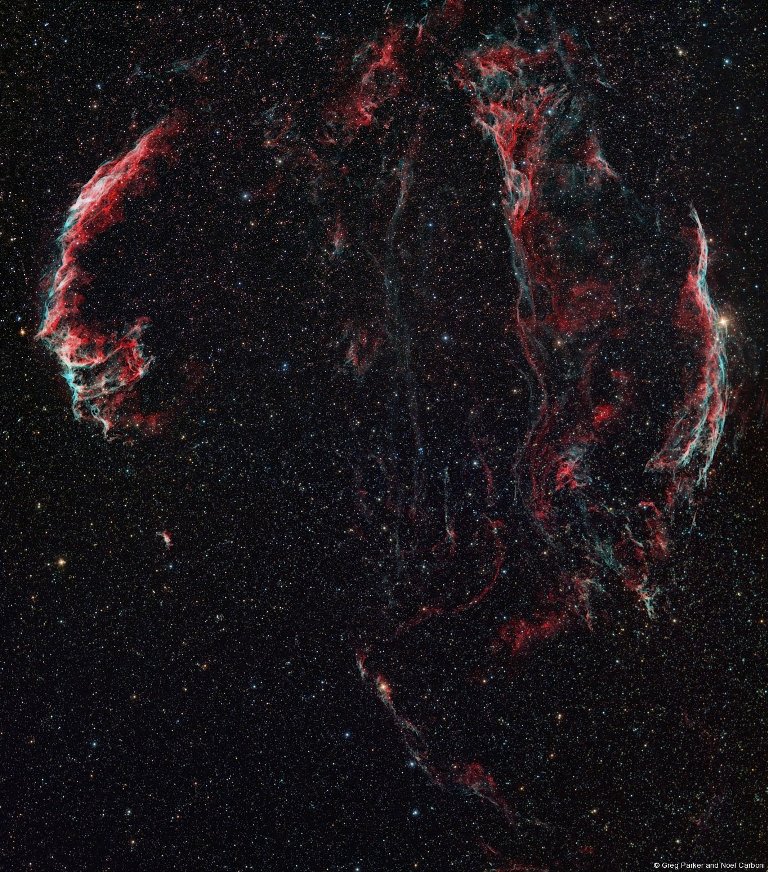
The deep-sky image for this week is one of mine 🙂  It is perhaps not one of the best-looking images that I have taken, but it is one of my favourites due to the amount of time I spent in getting the data.  This is still the most time (and data) intensive image I have produced to date (but it will be surpassed once the mini-WASP is let loose to do its thing in earnest).  This image of course shows the famous Veil Nebula in Cygnus, a supernova remnant, and a most beautiful object.  All imaging was undertaken using the Sky 90/M26C one-shot colour CCD combination.  I started on this marathon imaging run by just taking the Northern section of the Veil in RGB.  I spent a LONG time in getting this data (around 8 hours or so) and to be frank, when I saw the results I was less than impressed.  The filaments were a bit fuzzy and not very well defined at all, and the image just “looked wrong” with the bottom half missing.  As I didn’t have an OIII filter at the time I ordered one up and in the meantime I imaged the lower half of the Veil nebula in RGB, around another 6 hours or so.  The OIII filter arrived and I imaged both halves of the veil in OIII and then I did the same again thing for H-alpha.  We’re now talking about 30-40 hours of data on this one object alone.  After Noel Carboni put in around the same amount of image processing time – we arrived at this result.  As I said – not one of the best – but certainly the hardest earned 🙂

I have a couple of large deep-sky objects planned for the mini-WASP array that will make the Veil imaging marathon pale into insignificance by comparison, keep visiting the New Forest Observatory to see developments.  And to remind yourself of the power of the mini-WASP array, it would have imaged the whole of the Veil nebula in one go with its two Sky 90s and two M26C one-shot colour cameras.  And as the mini-WASP array also has filter wheels for each camera with H-alpha, H-beta, OIII and SII filters loaded – you can imagine what “the beast” will be turning out in the coming years.
 

Posted in Uncategorized | 6 Comments

Scientific Artist web site

Just a reminder that the New Forest Observatory site now only shows astronomical images and all those other images that I used to post here such as macros, micros, high-speed flash and mathematical objects, can now be found on my Scientific Artist site.

Posted in News | Leave a comment

Deep-Sky Image of the Week – Astrophotographer Pete Lawrence

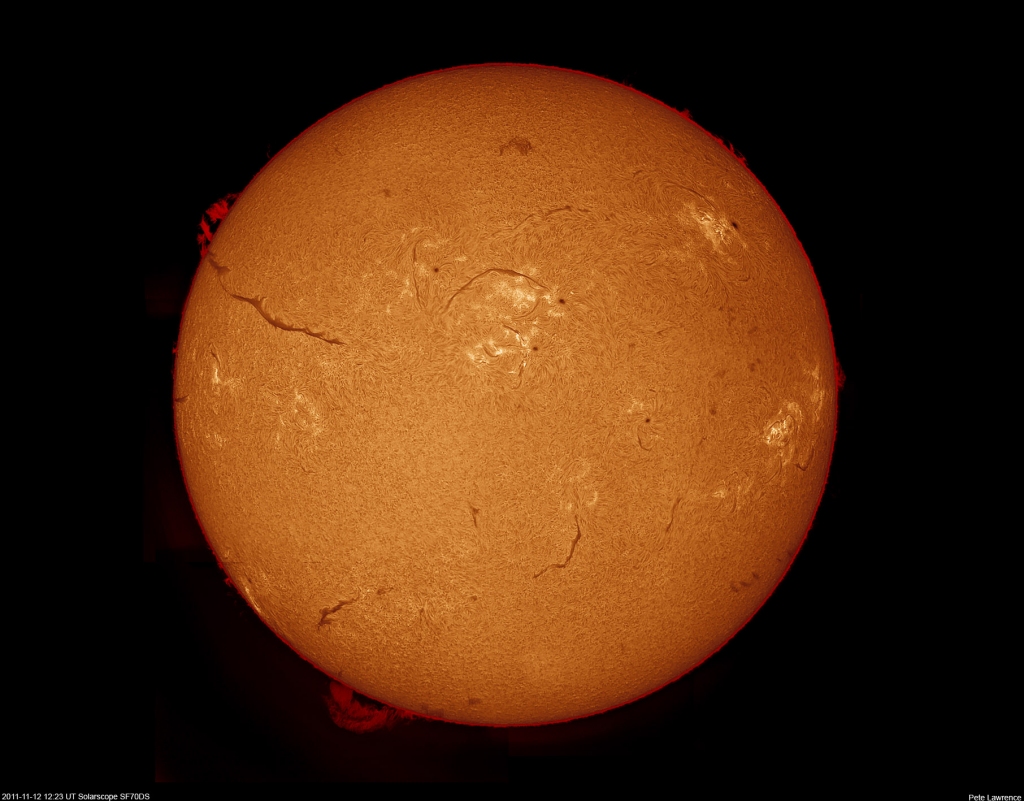
This week’s object is not deep-sky, it’s our closest star – the Sun.  And look at the beauty of our nearest star as captured by Selsey astronomer Pete Lawrence.  What a truly remarkable image – I would have that blown up to A0 and it would be framed on the wall over the fireplace, I would never grow tired of looking at it.  Marvellous image Pete, and the details for capturing this superb image are provided by Pete below:

“This image of Sol was taken through a Solarscope SF70 double-stacked h-alpha filter set fitted to a Vixen FL-102S refractor. The camera used was a Lumenera SKYnyx 2-0M high frame-rate planetary camera. This is a 9-pane mosaic, each pane being distilled out of a collection of around 500 still images, processed in Registax. The 9 processed panes were then manually stitched together to produce as smooth a full disk image as possible and flattened. The main disk was selected and copied as a separate layer allowing me to process the surface and prominence regions separately. False colours were applied to the original monochrome captures using a levels adjustment. Then following a few contrast and levels tweaks, both layers were merged together to produce the end result.”

All that hard after-acquisition processing sure paid off with this one Pete – a truly lovely, and awe-inspiring image 🙂

Posted in Uncategorized | 1 Comment

Blast from the past

Here is a 4-frame mosaic of the Pleiades taken with the original Hyperstar lens assembly (on a C11) with a tiny little H9C one-shot colour camera.  Also happens to be one of my all-time favourite images.

Posted in Hyperstar and SXV-H9C | Leave a comment

Emeritus Professor of Photonics at the University of Southampton

On December 1st 2011 Greg was made Emeritus Professor of Photonics at the University of Southampton 🙂

Posted in News | Leave a comment

Robofocus brackets completed

The new Robofocus mounts were completed and tested today, all looks fine.  Now I’m just waiting for a good friend to bring me his Sky 90 as the second imaging scope and I’ll be able to get on with the 2-framers.  I will then take my time collimating the other 2 Sky 90s which can be used either as a backup, or in the full 4-scope, 4-camera array.

Posted in mini-WASP Array | Leave a comment

New Robofocus brackets

Just making a couple of new Aluminium brackets to hold the Robofocus units to the Sky 90s.  At present I mount the motors on a plate off the rack and pinion screws which on reflection is probably not the best way to do it.  It will almost certainly make no difference to the way the Sky 90s operate but it takes one more unknown out of the equation (I’m not sure with the present set up if I am applying too much pressure to the focuser rack and pinion).

Posted in mini-WASP Array | Leave a comment

Deep-Sky Image of the Week – Astrophotographer Harry Page

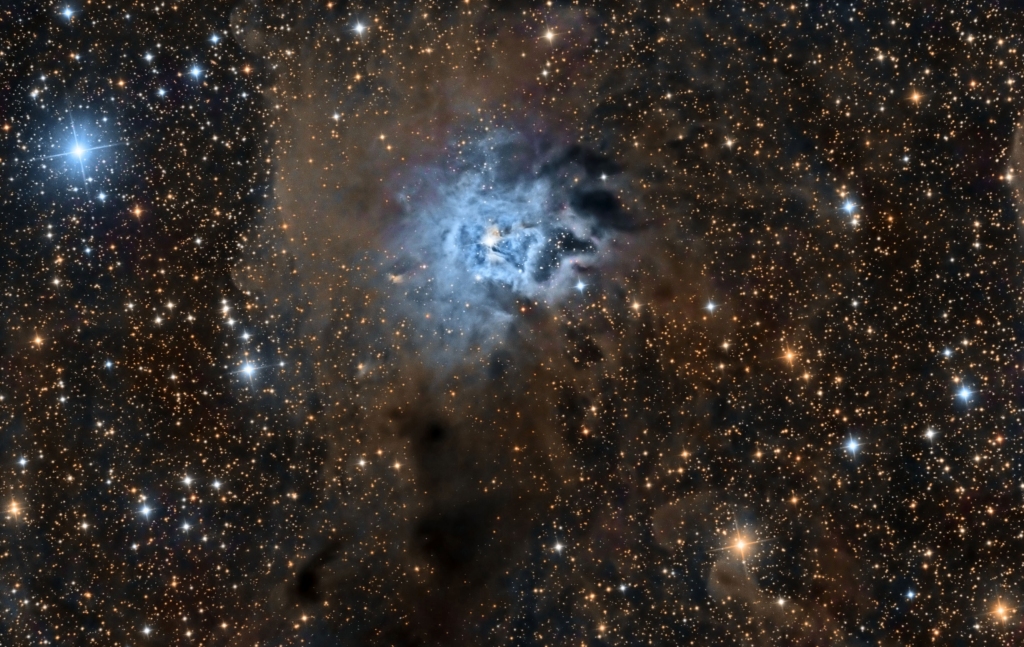
The image for this week comes from fellow PAIG forumite Harry Page – with yet another superb deep-sky offering – this time it’s the beautiful Iris nebula with its surrounding brown dusty clouds.  This region of Cepheus is another one of my happy hunting grounds and I clearly remember grabbing some early Iris images with the original Hyperstar and the little H9C camera – they were nowhere near as good as this image of course 🙂

Harry provided the following data for his image.

1 Luminance 610 minutes

2 RGB 80 minutes each

3) IDAS light-pollution filter

4) 14″ Newtonian at F#3.75 with an Orion Optics corrector

5) Processed in Pixinsight and captured in AA5

6) All subs 10 minutes unguided ( new TDM on scope )

7) Camera Starlight Xpress H35

The Pixinsight processing included  DBE to remove gradients , histogram stretch , hdr wavelets ,  some noise reduction and finally a bit of a saturation boost.

You can see a higher resolution version of Harry’s Iris nebula image at the address below, I strongly recommend you take a look, the higher resolution makes a huge difference!

http://www.harrysastroshed.com/Image%20html/Iris2011.html

Posted in Uncategorized | Leave a comment

IOM December 2011 – The eye of the Bull

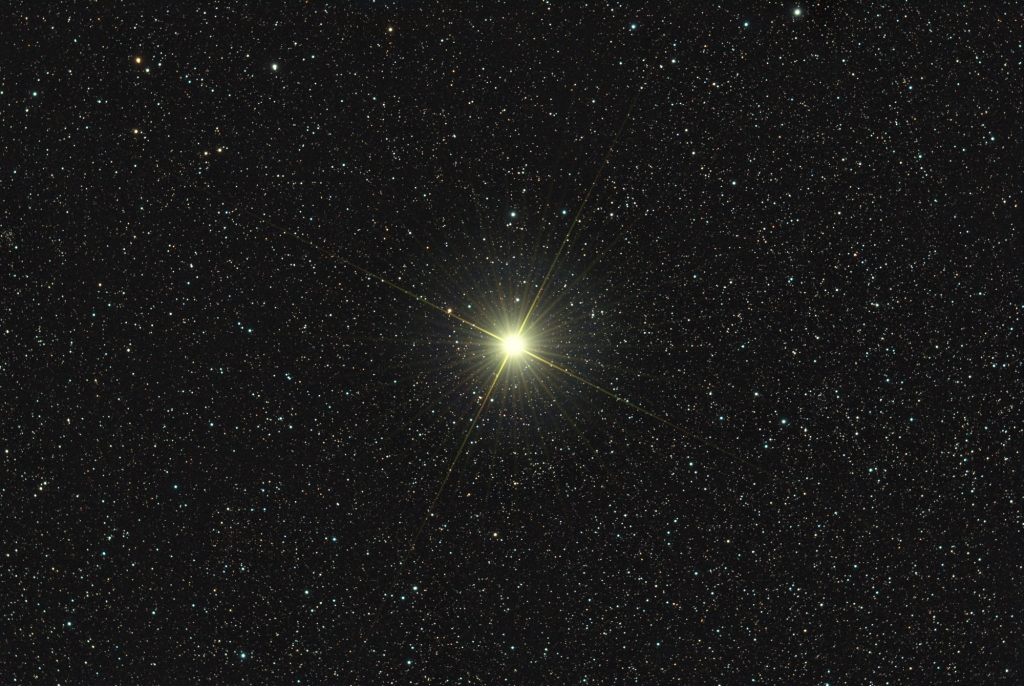
I thought I’d take a break from the usual Orion object this month and instead present just a single star image.  This month’s object is the star Aldebaran, the eye of the Bull in Taurus.  If you had a much bigger field of view you could capture Aldebaran and the whole of the Hyades star cluster as well – there aren’t too many good images of that lot about.  However, returning to Aldebaran, what makes it nice and interesting of course is that there is some colour associated with this star.  Aldebaran is a red giant lying just 68 light years away.  Aldebaran has a diameter 38 x that of our Sun and it shines with 150 x the Sun’s luminosity.  Being so bright means there is very little effort involved in imaging this one, and it’s more a matter of how your optics reproduce a bright point source.  This image was taken with the (highly) modified original Hyperstar and the little H9C one-shot colour camera.  The four cables coming out the back of the H9C lead to the diffraction spikes from the star (the splitting of the spikes is due to the cables not coming out at precisely 90 degrees to one another) – there has been no addition of software spikes to tidy this image up.  In addition there is an array of fine spikes close in to the star as well as an outer halo probably caused by the outer round aperture I used to use with this kit.  I made up an aperture to go around the edge of the C11 taking the aperture down from 11″ to 10.5″ (with the speed of the Hyperstar this loss of aperture made no real difference to my imaging times) – but what it did do was to considerably sharpen up the stars – I guess there might have been a little bit of “rounding” of the mirror edge?  The edges of the lenses of the Hyperstar were blackened with matt black paint – otherwise there would have been a terrible lens flare to deal with from such a bright source.

We are now well into the winter objects and we have the long dark evenings – even if very few of them are clear and Moonless 🙁  But we carry on regardless as it’s what we love to do.  So until the New Year of 2012 is upon us I just wish you a Merry Christmas and hopefully some clear dark skies as a bonus pressie 🙂

Posted in IOM | Leave a comment

The yellow is there – just need to process properly!

Having sat here for an hour or so not believing I could possibly have bleached all the colour out of Capella in the imaging I decided to reprocess the image from scratch and got this result.  O.K. so that’s a lot better now 🙂

Posted in CCD Images, News | Leave a comment