The New Forest Observatory “Deep-Sky Image of the Week”

I shall be posting deep-sky images sent in by dedicated amateur imagers (Worldwide) early on a Monday morning.  Well I won’t do it personally in real time, I’ll write it up beforehand and schedule it 🙂  The very first image has already been chosen and will make an appearance on Monday October 3rd 2011.  Send in your best images to greg@newforestobservatory.com I can assure you that there are no vested interests and no politics to get in the way of getting your work shown on this site – so why not give it a try?  The only requirement is that it is your work taken on your own equipment and that you are an amateur.  The images are only shown at 1024 pixels on the largest edge on the NFO site.  However, if you provide a larger image I can provide a link to it and host it on my Flickr site (but only if you state that you would like me to do this).  Please don’t send through mega-sized images!  Try to keep the jpeg file size below 5 Megs please.  That’s about all – clear skies and happy imaging to you all 🙂

If there is sufficient interest shown I will post your images more frequently.

Posted in News | Leave a comment

IOM October 2011 – Stock 2 open cluster in Perseus

We’re now well into some decent long dark evenings 🙂

This month’s object is rarely imaged it seems – I am going to look at the open cluster Stock 2 in Perseus this month.

This is a beautiful, colourful open star cluster lying just to the north west of the Perseus Double Cluster – and THAT’S the reason that Stock 2 rarely gets any air-time – it has a far more glamorous imaging neighbour just down the road!  But to not have a go at imaging Stock 2 is to miss a wonderful imaging opportunity, an opportunity of putting together a mosaic that includes both the Stock 2 AND the Double Cluster!  I have all the frames for this one taken and I am waiting for Noel Carboni to put the whole thing together for me – I think it will make a wonderful image.

Still – back to Stock 2 – this is quite a large open cluster and for once the large field of view of the Sky 90/M25C is needed – that it 3.33 x 2.22 degrees covers the region nicely.  As this is an open cluster it’s the usual 3-5 minute subs and 80 – 100 of them for a low noise final image.

If you can pull yourself away from the Double Cluster – Stock 2 is certainly worth a look, and it provides much more interesting colour than the Double Cluster as well!

Until November – clear, dark skies to you all 🙂

Posted in IOM | Leave a comment

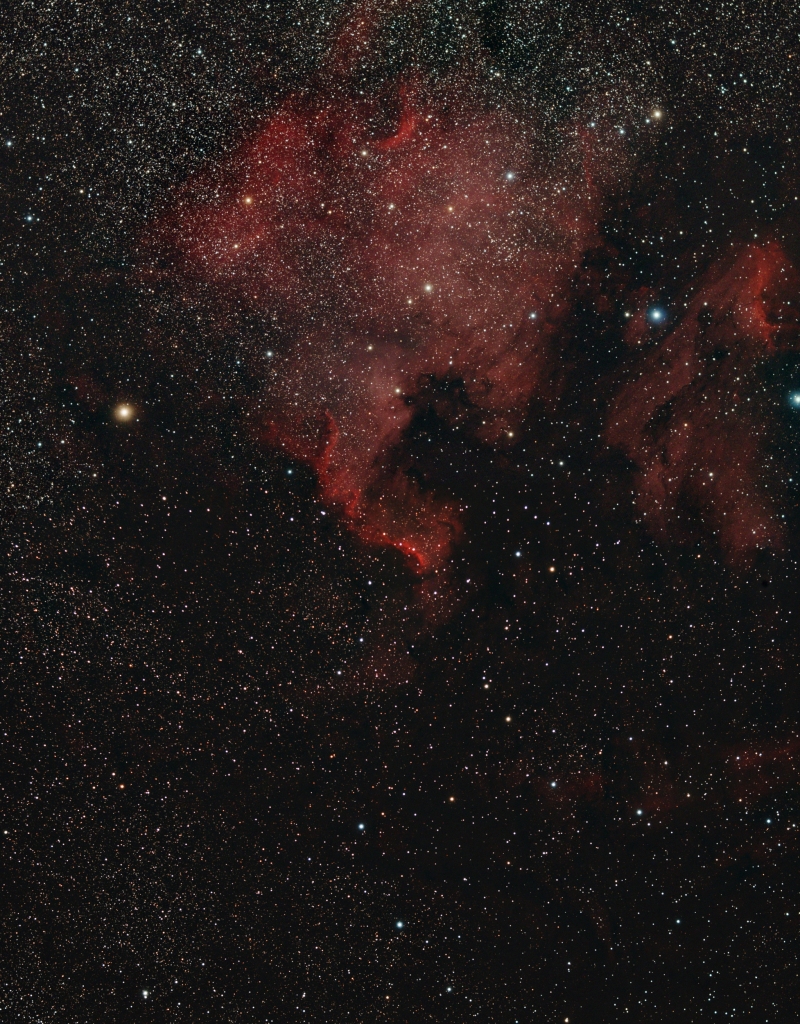
No added contrast or saturation

And here’s the “straight out of Photoshop” version with no added contrast enhancement or saturation courtesy of PaintShopPro.

Posted in mini-WASP Array | Leave a comment

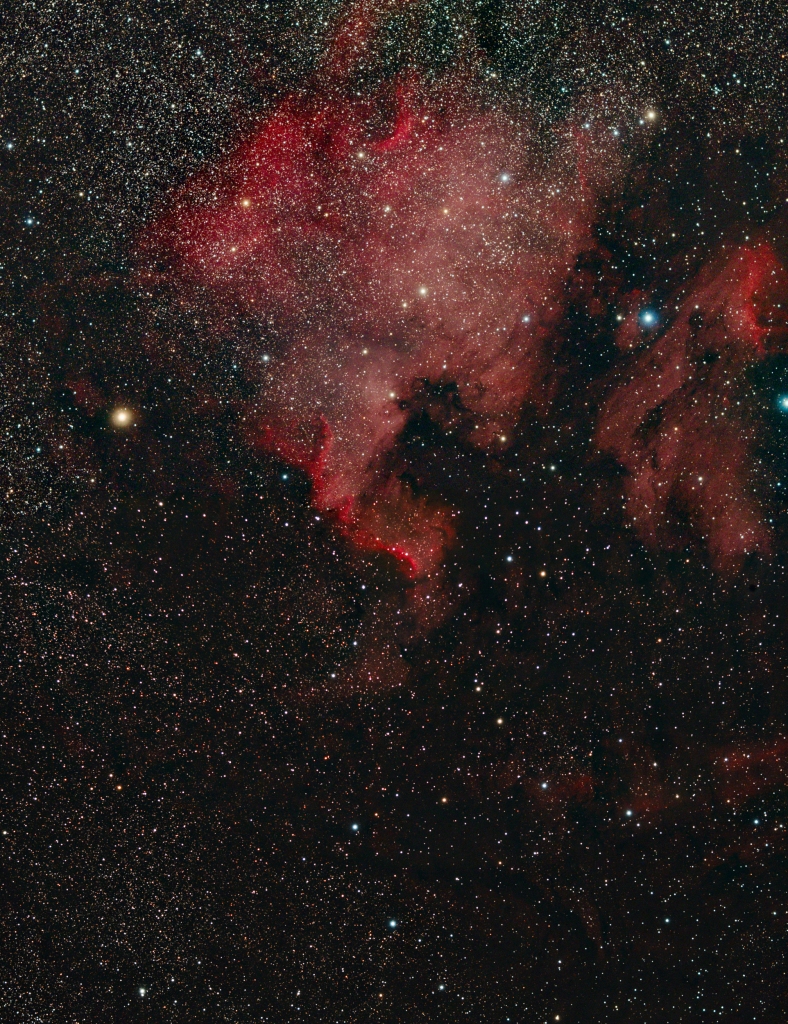
NGC7000 reprocessed

The very quick “process” I did on the NGC7000 image below was no more than a DPP pass and bolt the two frames together – would have taken less than 10-minutes as I just wanted to see what the image looked like.  I know there’s a bad magenta caste and the bottom half of the image looks like it’s been through a ringer – but I didn’t think that spending more time and doing it “properly” in Photoshop would make much difference – WRONG!!!  I spent around half an hour doing it “properly” using gradient exterminator and some curves and levels and it came out markedly different – much to my surprise.

Posted in mini-WASP Array | 3 Comments

Well even with one wonky scope the mini-WASP can sure deliver the goods :)

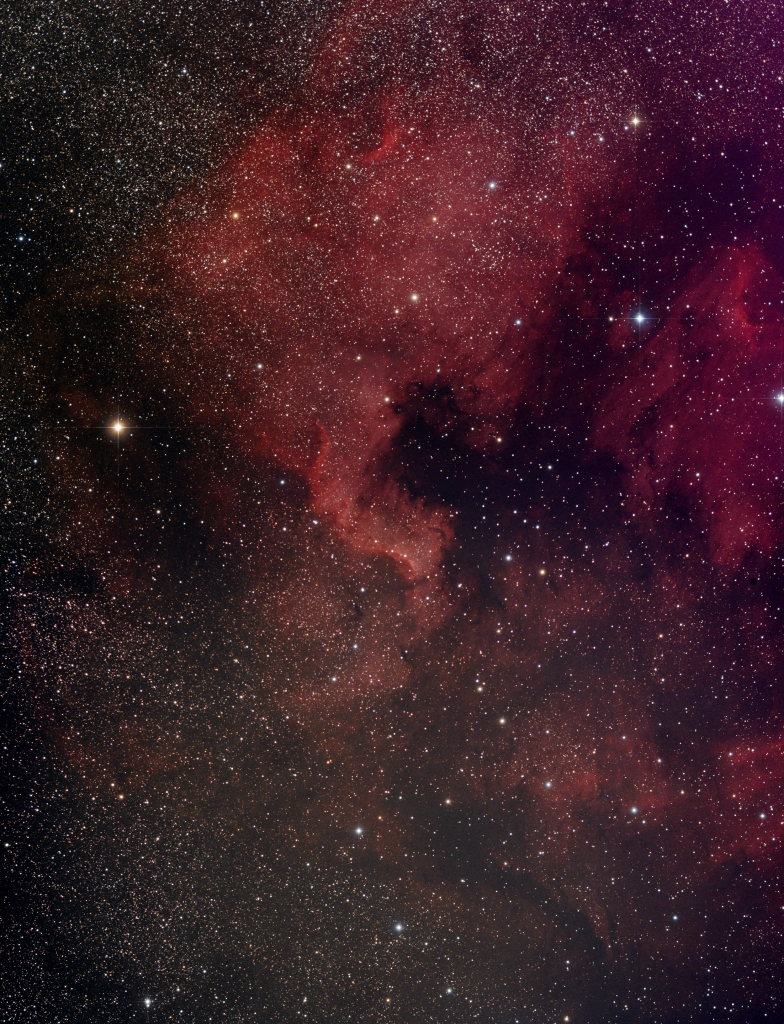
Another 1-hour image (only 6 x 10-minute subs) from the early hours of this morning.  This is the North America nebula NGC7000 with the Pelican making a cameo appearance on the right.  This time the mount was dithered so not hot pixels – YAY!!!

Posted in mini-WASP Array | Leave a comment

The mini-WASP array – one step forward and three steps back.

I’ve had my suspicions for quite a while now, but for some reason after just over 5 years  it has finally jelled in my last two remaining neurons what the problem has been.

From way back when I was imaging with the original Sky 90 (bought from True Technology) piggy-backed on the C11 – I had this bunch of trailing stars in the corner of the field of view.  It looked like polar rotation (or coma) but it wasn’t dependent on the sub-exposure time (even for very short subs) so polar rotation was written off.  I got a reasonable collimation (overall) according to CCDInspector, but there was always this bunch of annoying stars in the corner.  Then I saw Steve Cannistra had a similar problem which was due to flexure in the camera rotator – I did his fix and the problem stars were still there.

Recently I bought another Sky 90 from an Irish astronomer and this went on to the mini-WASP array as one of the two main imaging scopes.  I was able to collimate the M26C to this scope very quickly, and unlike the other scope I didn’t have to really bolt down the adjusters to the metalwork on the M26C to get good collimation.

So after just over 5 years I finally come to the conclusion that the collimation of the Sky 90 itself is way out!!  Luckily this is the model that has the three collimation adjuster screws on the lens cell.  So the offending Sky 90 has now been removed from the mini-WASP framework and is now sitting on its own tripod ready for yours truly to attempt collimating against a star.  Not done this before for a refractor, so I’ll let you know how I get on, and if the problem goes away.

Even though collimation on the second camera wasn’t too good (again) last night, I still took 6 x 10-minute subs of the North America nebula using both cameras and scopes.  I’ll be looking at the data very shortly.

Posted in mini-WASP Array | 6 Comments

Momentous day today – the first (almost proper) 2-framer to come out of the mini-WASP array :)

Well here it is – one hour’s worth of data taken with the two M26C cameras on the New Forest Observatory mini-WASP array.  Still lots to be done before it’s properly tuned in – but I’m pretty close now.  As I was finishing this off at 3:00 a.m. this morning I might well be writing a load of rubbish here – but I’ll carry on all the same.  Note this is just 6 x 10-minute subs from each camera – now try and imagine my usual 8-hours plus with the Sky 90.  I’ve left all the hot pixels in the background as I didn’t have the dither function running last night – but I’ll try to have that going on the second outing.  The collimation for camera 1 (the top half of the image) is spot on – the collimation for camera 2 (the bottom half of the image) is off a little and needs to be tweaked just a bit (lousy stars bottom right hand corner).  However – the field of view is as you can see MASSIVE (there’s M29 sitting at the bottom of the frame, check out the FOV on your favourite planetarium program) – and the M26C cameras really seem to be delivering the goods with only a single hour’s worth of data!!  Well done Terry Platt.

As it looks like it might be clear again tonight I’m off to bed for a couple of hours.

Posted in mini-WASP Array | 3 Comments

Deep-Sky Image of the Week

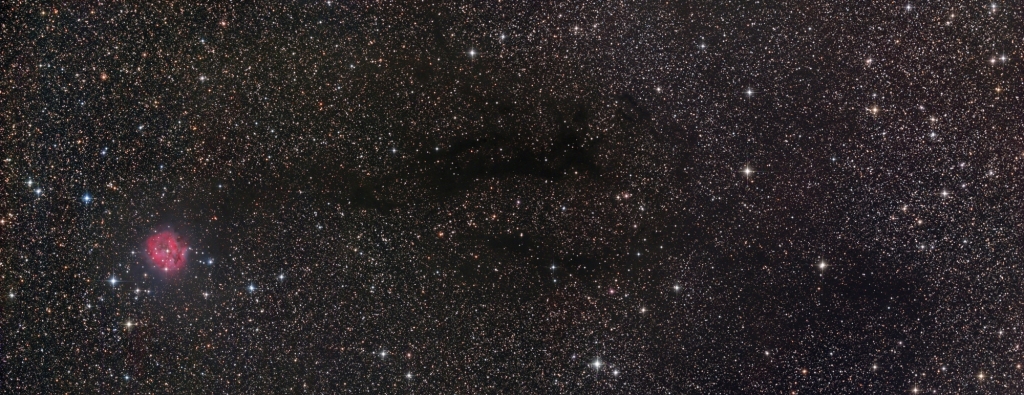
This is the new Deep-Sky Image of the Week page and your opportunity to show the best of your work to a large audience.  The New Forest Observatory site is rapidly approaching a quarter of a million visits and new posts typically appear on Google within a couple of minutes!!  Modestly I am kicking this page off with a Parker/Carboni rendition of the Cocoon nebula region.  This is a 3-frame Hyperstar III mosaic taken using the old rig in the South Dome – a Hyperstar III equipped Celestron Nexstar GPS C11 with an SXVF-M25C one shot colour camera.  Image acquired by Greg Parker and processed by Noel Carboni.  As I am kicking up a fuss about the (in my opinion) highly overprocessed version of this area shown on today’s APOD  (the APOD guys received the Parker/Carboni definitive version a few weeks back) – I thought it appropriate to post our image so that you can compare it with today’s APOD and come to your own conclusions.

Posted in News | 2 Comments

Deep-Sky Image of the Week – a new page for the New Forest Observatory – send me your best work

Sorry – but there’s a bit of a rant coming up – you have been warned.
The last straw for me was today’s (29/09/2011) APOD of the Cocoon – I felt quite ill seeing that one first thing in the morning.
I sent the big 3-framer Noel & I did of the same area into APOD just a few weeks ago – and they then publish today’s effort.
O.K. I know I am very slow – but I do eventually get the message – the APOD guys aren’t going to publish any more stuff from me (I’m not sure what I’m meant to have done – but I guess it must have been pretty terrible).
So here’s what I am going to do about it.
I am going to put a “Deep-Sky Image of the Week” section on my New Forest Observatory web site with a link to a higher resolution version of the image (if available) on my Flickr site.
I am inviting submissions from amateur imagers located anywhere on the planet to send me their images and the one that impresses me the most will get the air time for that week.
I will be putting a copy of this message on an American Astronomy Forum and an Australian Astronomy Forum so that there is some pretty wide coverage.
I know there are plenty of gifted amateur imagers out there that have been equally unimpressed with the APOD guys (I know because some of you have written to me asking what exactly the hell you have to do to get published on APOD  🙂  I guess I can’t answer that question anymore).
Anyway – I’m coming to the end of the rambling (oh by the way I got the first 4 x 3.33 high resolution image out of the mini-WASP array last night – guess who won’t be seeing anything coming out of that system?  🙂 ) – if you fancy being part of a counter-movement to the APOD monopoly, send your images (JPEG, not too big) to greg@newforestobservatory.com with brief image details and I will get this show on the road as quickly as I can.
Greg

Posted in News | Leave a comment

It’s 1:30 a.m. and I’ve finally set up the mini-WASP array :)

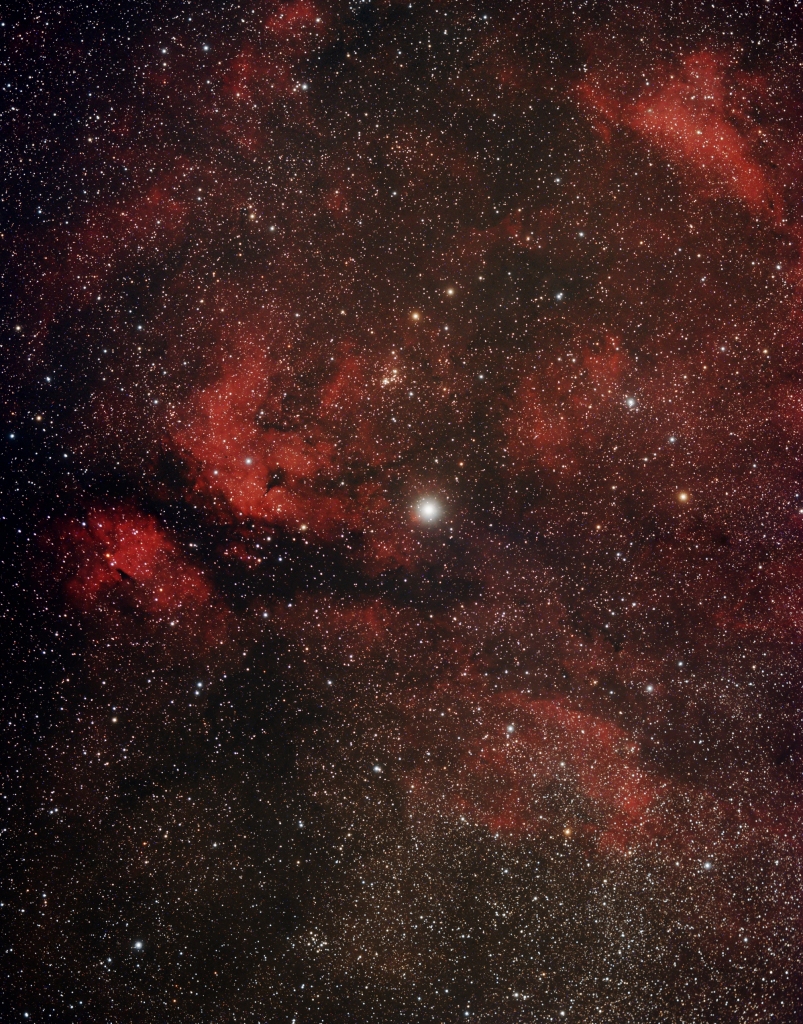
It has been a glorious day all day with clear blue skies – and this time it didn’t fog over as soon as the Sun went down.  So I started the final hard bash at getting the mini-WASP array commissioned at 8:30 p.m. and got it to the state where I can start imaging with both cameras and an overlapping field of view at 1:30 a.m.  I am now doing a 2-framer (in one go) around the Sadr region.  The only thing I haven’t got running is the dither which is a bit annoying, but I can probably work around that with a bit of luck.  So – after 4 years of planning and execution the mini-WASP array is finally all systems go.  Must admit I didn’t think that simply doubling up to two cameras and scopes would be so much trouble.  There’s a very good chance that I won’t go the whole hog and build the 4-camera 4-scope array unless I get VERY used to running these 2 cameras – and somehow I don’t think I am going to get THAT proficient.  Still – mustn’t be greedy, a 4 x 3.33 degree field of view at 3 arcseconds per pixel should be good enough to last me for quite a long time 🙂

Posted in mini-WASP Array | Leave a comment