From completely clear to completely fogged out in an hour!

It’s been completely clear here for most of today so I was looking forward to another night of superb deep-sky imaging on the mini-WASP array.  Still clear at 7:30 p.m. but too light to start work.  Look outside at 8:20 p.m. and what do I see?  Well nothing basically – we’re completely fogged out!!  So what’s that all about then?  Oh well – nothing else for it – stick on some Simple Minds at full volume.

Posted in News | Leave a comment

Nice clear Moonless evening on 26/09/2011

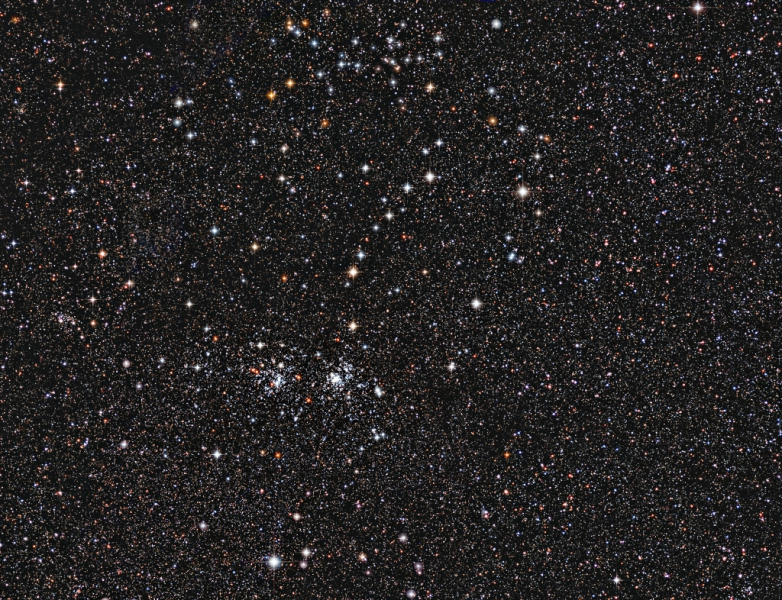
Until the fog rolled in at 1:30 a.m.  But gave me enough time with the Hyperstar III to get a better image of the supernova in M101 and also a quick look at the Double Cluster in Perseus.  Also managed to get some work done on the mini-WASP, but I really need to get the second camera properly set up and imaging now.  Problem is I hate wasting good imaging time in setting up, so as one camera is all aligned and collimated properly I am tempted to just use the one camera and image all evening.  Must have more self-control!

Posted in Hyperstar and SXVF-M25C | Leave a comment

O.K. so faster than light claim not quite as trivial as simply measuring a distance.

Having now read around this one a little I am very pleased to report that this isn’t as trivial a problem as getting the correct distance between source and detector.  It’s actually far worse than that 🙂  This is a VERY old chestnut to anybody that has worked to any extent in experimental optics.  The CERN experimental result requires the correlation of fast rising-edge pulses.  Now those of us with an optical background will know of those countless instances where superluminal velocities were “measured” due to improper treatment of the light-pulse SHAPE.  So in my opinion this CERN result, like all the (invalid) superluminal results in experimental optics will soon fall to Einstein’s Razor.

And as I am obviously a “dinosaur” according to those reporting that this faster than light result is expected and is all bound up with multiverses and dark energy and dark matter and all the rest of it I will admit, yes I am a dinosaur.  I only accept a theory if it provides me with predictions of (new) things I can measure to check the validity of the theory (that have not been adequately explained before).  All good theories do this, Special Relativity, General Relativity and Quantum Theory all provide predictions of what will be measured under certain conditions and they give concrete answers to the results of experiments that have never been previously carried out.  The “New Age” theories don’t seem to come along with predictions that allow them to be checked by experiment and are therefore worthless intellectual pursuits in my opinion – and I guess that must make me a dinosaur 🙂

Postscript:

And yes I am very familiar with Popperian philosophy and that it is falsifiability not verifiability that is the issue – but that has nothing to do with requiring a good theory to be predictive.


Posted in News | 3 Comments

I don’t believe it – now the speed of light might have been exceeded!

Having had the little rant below I can hardly believe I read in yesterday’s Daily Mail (only just picked it up today) that CERN Physicists think they might have seen neutrinos clocking up velocities greater than light.  And once again it is only “O”- level (or if you insist GCSE) maths that is needed to check whether the claim is reasonable.  Now unfortunately I have to rely on the second hand numbers provided by the Mail so I may be doing the CERN guys a great disservice here, but I’ll take a quick look in a moment and see if I can get any hard numbers directly from CERN.  For what it’s worth the Mail numbers are as follows.

Distance between the neutrino emitter and the detector 454 miles.  How much “quicker” than light?  60 nanoseconds or 60 billionths of a second.  Now that ain’t much you know.  Light only travels 186,000 miles in a second in a vacuum, so in 60 billionths of a second it only covers 59 feet (and we’re talking about something going faster than light) so we’re talking about a distance discrepancy of something less than 59 feet in 454 miles.  This is looking more than slightly dodgy now isn’t it.  If you took the distance between the two labs over the surface of the Earth (i.e. taking the curvature into account) as 454 miles, then the shortest distance between the labs (taking the straight line path through the Earth, not following the surface curvature) is something like 453.75 miles, a difference of a quarter of a mile or 1,320 feet – quite a bit more than the (less than) 59 feet discrepancy we are looking for.

Now I’m aware that the (military grade) GPS is quite capable of giving your position on the Earth’s surface to within a few feet – but if the “early” neutrinos had taken the short route underground can we really be certain that the straight line distance between the emission point of the neutrinos and the detection point can be measured to better than 59 feet?  It doesn’t seem likely to me, so now I should go away and see if I can find what the CERN guys REALLY said as I’m sure it’s quite different (in detail) to the Mail’s version.

However – before I do go off and check this out – I’d like to make a comment.  Anyone who has done Special Relativity as a course at University or College will know where the whole idea of a speed-of-light limit comes from.  It is so fundamental and so obvious that anyone with even a small understanding of Special Relativity wouldn’t look at “faster than light” claims such as this for more than a moment.  What’s much more interesting is WHY there is this fundamental velocity limit, and why it has this particular value.  Knowing the answer to this question actually tells you something fundamental about how this Universe is put together.  In fact you will find that nothing travels faster than light in a vacuum because that is the velocity limit of the data pathways in the Quantum Computer that is generating our “Reality”.  But that is a story for another time 🙂
Posted in News | Leave a comment

Please engage your brain and actually think for yourself – I know it hurts – but it’s far better than letting someone else do the thinking for you!

From the rather short title you may guess this is going to get to be a bit of a rant – at least it’s based on things astronomical.  I am getting asked stupid questions by a number of people (who should frankly know a lot better) about comet Elenin and the havoc it is about to cause on Earth.  This is about all the earthquakes and tidal waves the gravitational attraction from the comet is going to create.  If you have “O”-level maths (probably called GCSE nowadays) you can actually work it out for yourself – you don’t even need a calculator.  You know the equation for the gravitational force exerted between two bodies of mass M1 and mass M2 separated by a distance r (if you don’t look it up, preferably in an elementary Physics textbook in case some genius blogger has put their own interpretation on the equation) and then stick the numbers into the equation.  What numbers?  Well Elenin’s closest approach will be around 34.9 million km, that’s the r bit in the equation, and Elenin’s mass is roughly 20 billion metric tonnes so make that M1, you can leave the mass of the Earth as just M2.  Why?  Because now you can work out the gravitational attraction between you and the Earth as you walk across the surface of the planet and compare this to Elenin’s efforts – the radius of the Earth is 6378km, you need that for the r in second bit (you standing on the Earth’s surface).

And please don’t even think about asking “Will Mars really appear as big as the Moon this year?” because even stone age man knew better than that.

Get a grip people and don’t believe what some idiot with no scientific education whatsoever has to say about things they don’t understand on the Internet.  In fact – do me a favour and don’t believe anything I have to say either – go off, look up the numbers in a textbook or in a refereed scientific paper and work it out for yourself.  Yes it does hurt, but at least you won’t be needlessly taking your hired camper van up the Highlands to keep clear of the Tsunamis.

Rant over.

Posted in News | Leave a comment

The Hyperstar III is go again :)

We had an extremely rare clear and Moonless night last night – the stars were superb.  Hard decision time – what do I do?  Do I spend a great viewing evening on getting the Hyperstar III back up and running, or do I continue working on the mini-WASP array?  Decided I would get the Hyperstar going again as that will allow me to get some imaging done with the Hyperstar while I continue commissioning the mini-WASP.  So – first start was to get the mount polar aligned after “tankifying” the Celestron “Heavy Duty” wedge.  This took the best part of 2 and a half hours – so we’re now at 11:30 p.m. with a reasonable polar alignment and virtually nothing else done.  Next on the list – fire up the Robofocus and train the focuser with a few V-curves.  Got good consistency in the curves after about an hour – so now we’re at 12:30 a.m.  Next, need to collimate the Hyperstar, this is always a pain.  You need to make the collimation adjustment, refocus, take an image, analyse the image in CCDInspector and then adjust again.  A tortuous time-consuming job – but actually got reasonable collimation in around an hour.  So now we’re at 1:30 a.m. what to do next?  As the sky is still great so I might as well image something – closest object to where I was working is the Heart nebula – that’ll do.  Got 4 x 15-minute subs (with dithering!) on the Heart and went to bed.  Just checked the data this morning – very nice.  Collimation can probably do with an extra little tweak but not bad overall – at least I have one system back up and running again ready for the winter  goodies 🙂

Posted in Hyperstar and SXVF-M25C, News | Leave a comment

The magic of the integers – a result found in “Ascent to Orbit”

As you know I like number theory and if I find something really interesting I’ll post it up here on the NFO site.

I was flicking through Arthur C Clarke’s “Ascent to Orbit” yesterday when I came across a mathematical result I don’t think I’ve seen before, and it’s a pretty remarkable result too.  Anyone who has done “A” level maths will know that the sum of the first n integers is given by 0.5 x n x (n+1).  If you square the result to get the square of the sum of the first n integers you get 0.25 x n2 x (n+1)2 and the amazing thing is that this is exactly the same as the sum of the cubes of the first n integers or 13 + 23 + 33 + … +n3 .  In other words (1 + 2 + 3 + … + n)2 = 13 + 23 + 33 + … + n3 .  Now isn’t that amazing?

Posted in News | Leave a comment

Registar says 68,200

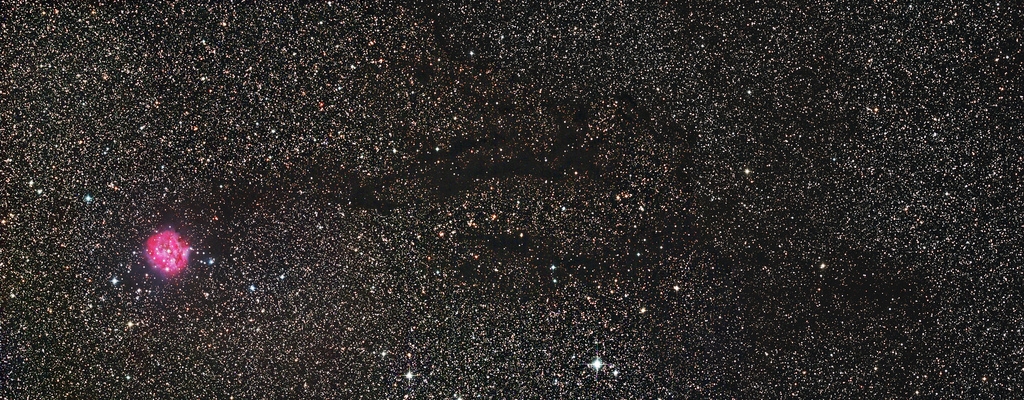
A number of people have asked me how many stars appear in the Cocoon nebula 3-frame mosaic.  I use a program called Registar to link separate frames together so I can see how they all fit – and Registar will also do a “star count” for the stars in the image (I don’t think it is accurate to the level of a star 🙂 )  Anyway – Registar says there are 68,200 in this image – always turns out to be a LOT less than you would guess.

Posted in Deep Space Objects, News | Leave a comment

Starmus memories II

As it continues to pour with rain here in the New Forest – thoughts go back to the hot, dry days at the Starmus Festival in Tenerife June this year 🙂

Posted in News, People and Places | Leave a comment

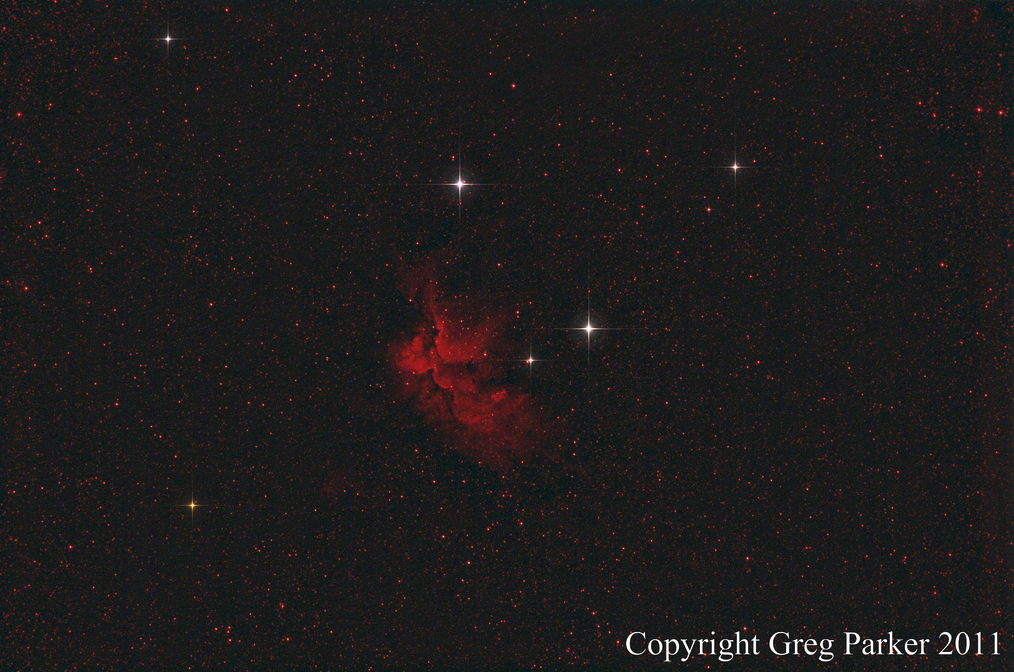
NGC7380

A darker background and the edge has been cropped 🙂

Posted in Sky 90 and SXVF-M25C | Leave a comment