Total lunar eclipse

Well, we have just had the longest unbroken run of clear night skies that I can remember.  Tonight is the full Moon and every imager knows that a full Moon always means clear skies – but not tonight!  Why not?  Because in the early hours of Thursday morning we have a full lunar eclipse taking place (these occur during full-Moon phases) – so, the Patron Saint of astro-imagers has cloud cover on the cards.  Still, it will be worth checking outside every so often to see if anything is visible to you, and if it is, take a snap with the digital camera to record the event.
Posted in Articles | Leave a comment

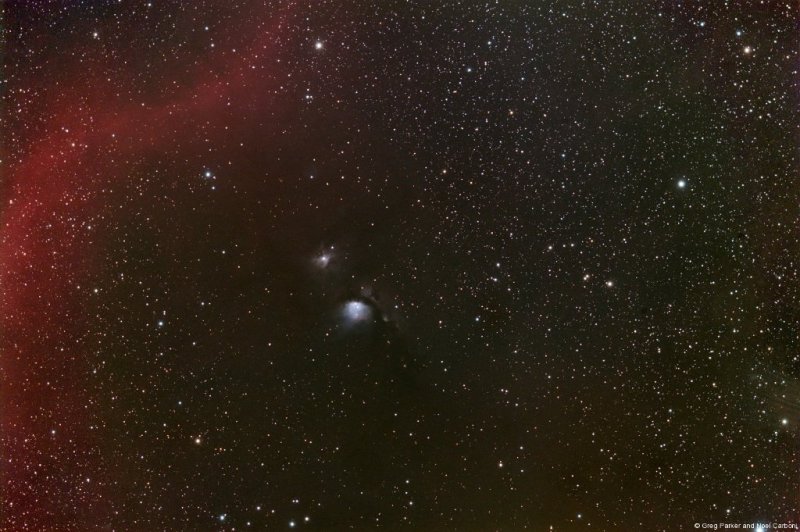
M78 and Barnard’s Loop

The fourth image in the 6-night marathon is M78 and part of Barnard’s Loop in Orion.  This is a work in progress as so far this is only 4 hours of RGB data using 15-minute subs – and with an intrusive Moon.  Noel’s expert processing has already created quite a nice image, but we need more data, and I need to move the whole frame to the right to get more of Barnard’s Loop in the FOV.

Posted in Sky 90 and SXVF-M25C | Tagged , | Leave a comment

Procyon

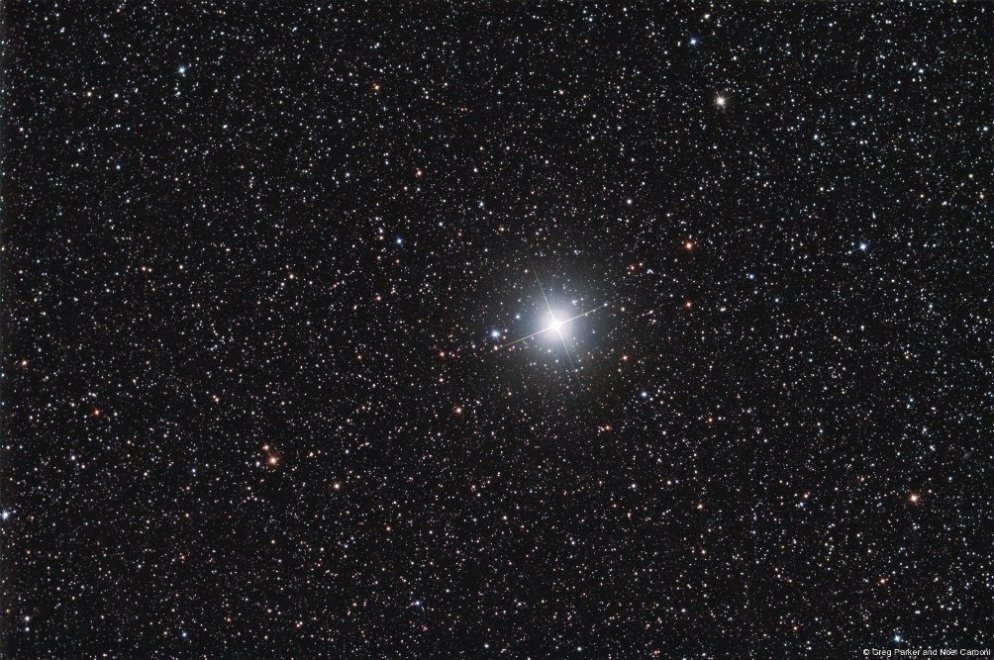
The third image from the 6-night session is the first single-star image I have taken with the Sky 90/SXVF-M25C combination.  This is Procyon – and the image comprises 48 sub-exposures at 5-minutes per sub or exactly 4 hours total exposure time.

Posted in Sky 90 and SXVF-M25C | Tagged , | Leave a comment

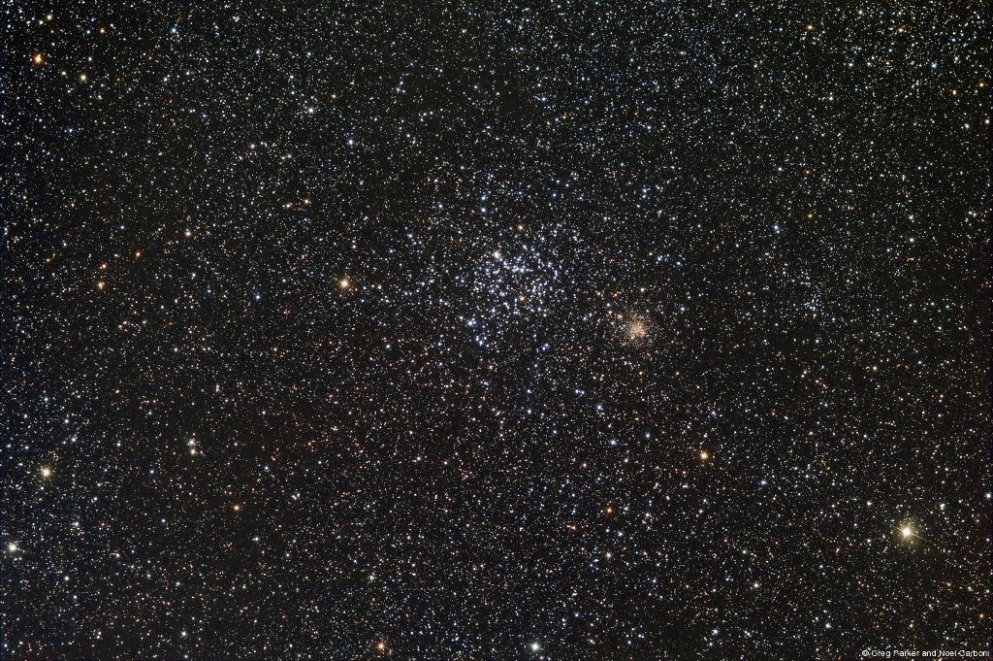
M35 and NGC2158 a pair of open clusters in Gemini

The second image from the 6-night marathon session this month is a nice pair of open clusters in Gemini – M35 and NGC2158.  This image comprises 39 sub-exposures at 6-minutes per sub or just 6-minutes short of 4-hours in total.

Posted in Sky 90 and SXVF-M25C | Tagged , | Leave a comment

The Owl nebula and M108 in Ursa Major

We have just had six clear nights in a row – which for me personally is an all-time record!  Got a few reasonable images during this period, unfortunately last couple of days had the Moon intruding, but we can’t have everything 🙂

This first image is the Owl nebula [M97] a planetary nebula, and nearby galaxy M108, both in Ursa Major.  This is an RGB image comprising 11 subs at 15 minutes per sub giving a total of 2 hours and forty five minutes.

Posted in Sky 90 and SXVF-M25C | Tagged , | Leave a comment

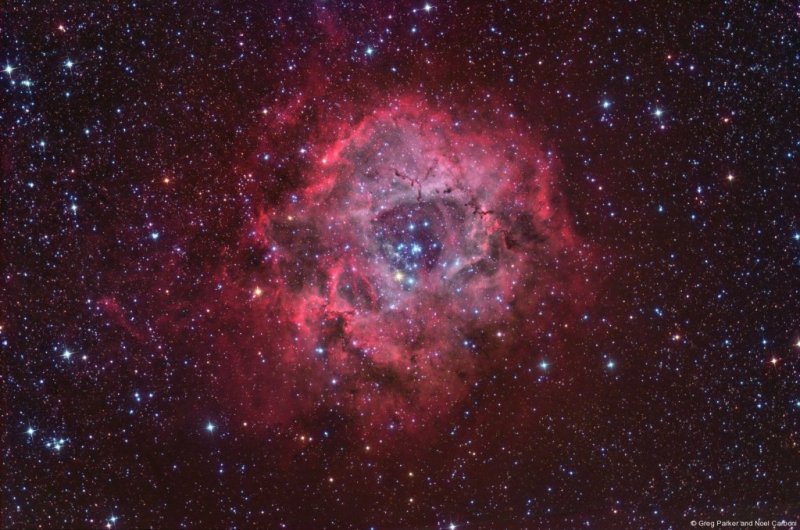
The Rosette nebula definitive image

Just when you thought it couldn’t get any better, Noel Carboni revisited the original data and reprocessed the Rosette from scratch.  You can see from the attached image that he has squeezed the last ounce out of this one.  I think we can safely tick this one off the list now 🙂

Posted in Sky 90 and SXVF-M25C | Tagged , | Leave a comment

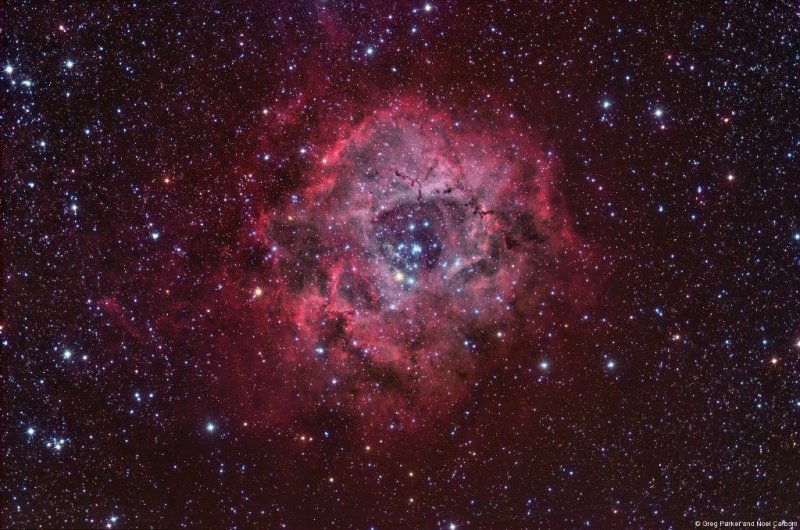
The Rosette nebula – reloaded

Managed to get three hours worth of OIII data for the Rosette on Saturday 9th February – and Noel has just expertly added this into the earlier image.  The OIII has brought out some more fine detail in the core region.  This image has over 12 hours worth of RGB, H-alpha and now OIII data included.  Enjoy!

Posted in Sky 90 and SXVF-M25C | Tagged , | Leave a comment

Astrofest 2008

Had a very quick trip up to High Street Kensington today to check out Astrofest 2008.  Met a few UKAI forumites, and had a chance to speak to some of the guys who have thinned my wallet over the years.  My first time at Astrofest and it should certainly be on the top 10 list of places to visit for U.K. imagers.

Posted in News | Leave a comment

NFO in the local Daily Echo

Faith Eckersall conducted an interview at the New Forest Observatory and this appeared in print in the Daily Echo on Monday February 4th 2008.  Brian May also saw the article and has it on his site under “new deep-sky photography book”.  The doctors’ say that after a course of treatment involving strong anti-emetics Brian should be o.k. to resume normal duties 🙂

Posted in News | Leave a comment

IOM February 2008: Alnitak, Alnilam & Mintaka

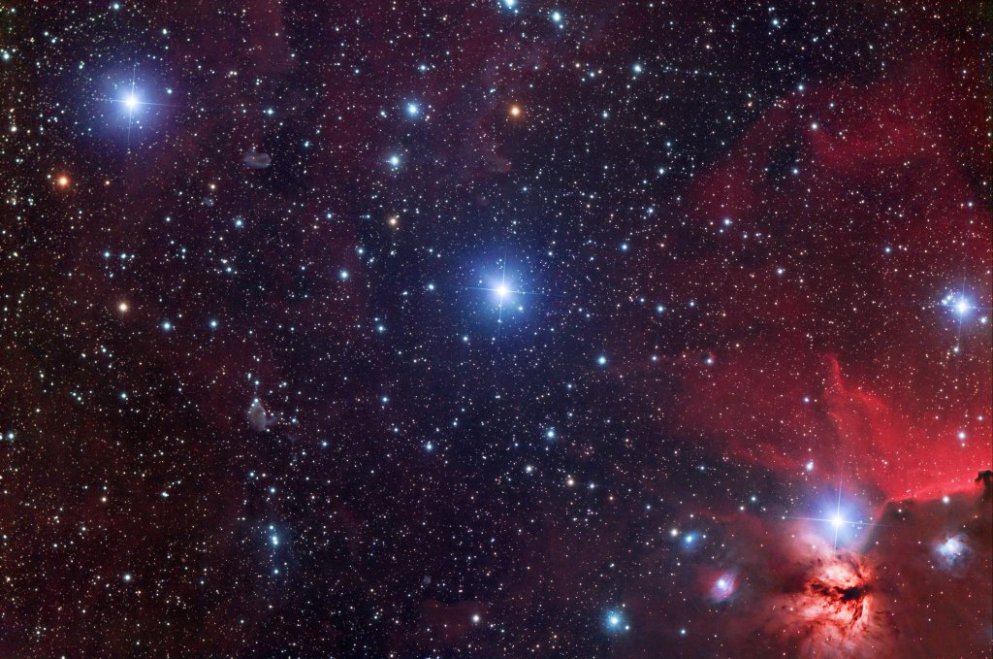
We are still blessed with the magnificent sight of Orion moving across the Southern horizon during February.  Orion’s Belt consists of three very bright stars, Alnitak, Alnilam and Mintaka, with Alnitak being the east most (left) star of the three.

Although most astronomers are aware of the proximity of the Horsehead and Flame nebulae to Alnitak (Alnitak is always a difficult star to deal with in processing Horsehead wide-fields) – what is not generally appreciated is the large amount of faint emission and reflection nebulosity in the region as a whole.

The accompanying image (which made the both the cover, and centre two-page spread of the October 2007 issue of Practical Astronomer) comprises 4 hours and 45 minutes worth of RGB data in 900 and 1,000 second subs.  No H-alpha data was taken due to bad weather conditions.

It is clear from the image that a lot more data needs to be taken to bring out all that faint nebulosity lying in Orion’s Belt.  This needs at least 4-hours worth of H-alpha using 20-minute subs, and the same using both H-beta and OIII filters as well.  I hope to be able to get the narrowband data together this year – weather of course permitting .

Give this region a try – you need a big (3-degree) field of view to get all the Belt stars in the frame, and you can see you will need a LOT of total exposure time.  Very best of luck to you in your attempts at imaging this fascinating (and difficult) region.

Posted in IOM, Sky 90 and SXVF-M25C | Leave a comment