IC443 and IC444 work in progress

The accompanying image is the Jellyfish nebula [IC443] and associated emission nebulosity [IC444] on the Gemini/Orion border.  Continue reading
Posted in Sky 90 and SXVF-M25C | Tagged , | Leave a comment

High speed flash update

First Light Systems Ltd. [FLS] are right on target to have the initial 200 Joule, 40 microsecond flash duration [Pro] systems on the market by the end of February 2008.  Continue reading

Posted in News | Leave a comment

The Great Nebula in Orion region definitive image

Just when you thought it couldn’t possibly get any better, Noel Carboni has now added the recently taken R72 data for M42 to our earlier H-alpha/RGB image.  Continue reading

Posted in Sky 90 and SXVF-M25C | Tagged , | 3 Comments

M42 imaged in the infrared

As you know I have recently started terrestrial imaging [photography] with a Canon 40D.  Whilst looking at all the accessories for the new camera I came across some interesting filters called R72 filters.  These filters only allow light of wavelength longer than 720 nm through, that is they are infrared filters and they block out all the shorter [visible] wavelengths. Continue reading

Posted in Sky 90 and SXVF-M25C | Tagged , | Leave a comment

All that glitters

It is currently believed that the primary source of the element Gold is supernova explosions.  It also seems that the Gold on planet Earth is around the same age as the Earth itself at some 4.6 billion years.  Therefore one concludes that the Earth formed very shortly after its seeding star completely sterilised the entire local area in a supernova explosion.  Couple this with the recent findings that the earliest life on Earth may date back some 3.5 billion years and it seems that in terms of cosmological timescales, life found its foothold on this rocky planet almost instantaneously after the whole region had just been sterilised of all potential life.

This must be extremely good news for SETI workers, and perhaps provides us with a useful new factor in the Drake equation?

Posted in Articles | 2 Comments

Some terrestrial mosaics

I mentioned a little while back how I was using the Canon 40D to take mosaics of the local New Forest area.  The reasons for creating mosaics with a 10 megapixel camera include: Continue reading

Posted in Articles | Leave a comment

Latest deep-sky image – IC1396

It’s been a while since our last image as we’re both busy trying to get Star Vistas camera-ready for our publishers by 1st April 2008.  However, Noel & I managed to free up some time to get this latest image to you, the massive emission nebula IC1396, containing the famous “elephant’s trunk” – in the constellation Cepheus: Continue reading

Posted in Sky 90 and SXVF-M25C | Tagged , | Leave a comment

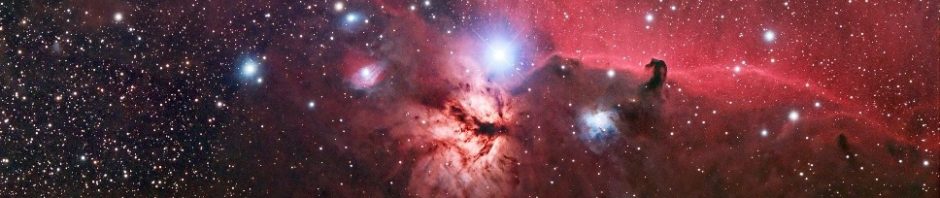
IOM January 2008: The Horsehead Nebula

Well, we are still in the depths of winter in January, so all the winter constellations are still very well-placed for imaging. 

The Horsehead nebula (Barnard 33) in Orion is very well placed this month for imaging.  The dark horse’s head is illuminated in front by several deep-sky objects:

  • The massive emission nebula IC434
  • The amazing flame nebula (NGC2024) to the horse’s left (North of the horse)
  • A bright reflection nebula NGC2023 slightly South East of Alnitak
  • And of course, Alnitak itself (the most eastern star in Orion’s belt) blazing away next to the flame nebula

With so much going on in this 2 degree by 1 degree region of space – no wonder this is probably the most highly photographed area of the night sky.

Continue reading

Posted in IOM | Leave a comment

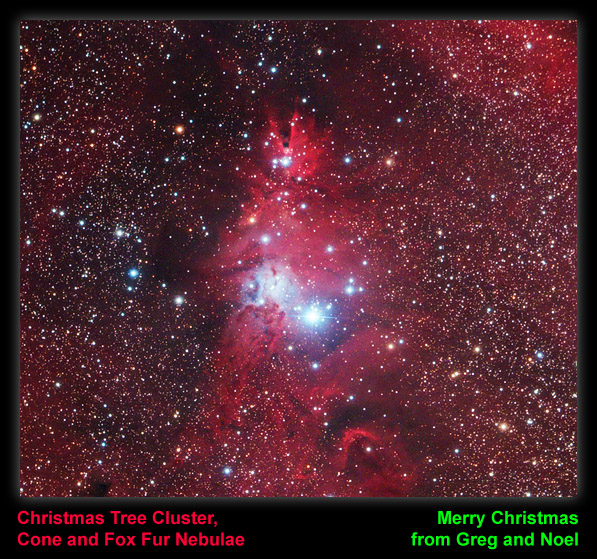
Merry Christmas and Happy New Year

We would like to wish everyone a Merry Christmas, a Happy New Year and a great 2008. 

Noel & Greg.

Posted in News | Leave a comment

Review of Making Beautiful Deep-Sky Images

I found this review of the Making Beautiful Deep-Sky Images book by Michael Bakich titled Easy Pretty Pictures.

It is a great review – thanks Michael! 🙂

Posted in Other Magazines | Leave a comment