Here’s a simple little maths problem for you to look at, if you like that sort of thing.
For what value of x does the following equation hold true?
x^n + 2.x^n+1 = x^n+3
Where x^3 is x cubed.
Here’s a simple little maths problem for you to look at, if you like that sort of thing.
For what value of x does the following equation hold true?
x^n + 2.x^n+1 = x^n+3
Where x^3 is x cubed.
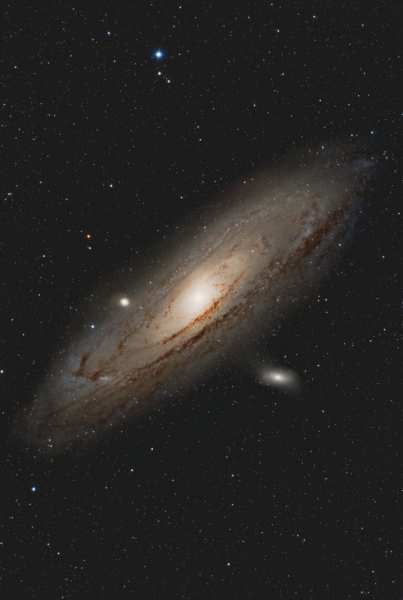
I sent a friend a low-res version of M31 and they asked if they could have the hi-res version to print out and put on their wall. Now it gets embarrassing – can’t find the hi-res version anywhere. So I have to go back to the original datasets (Sky90 and Hyperstar 4 data) composite them, completely reprocess them, and have another go. The result is above. Close to the original low-res version but not exactly the same.
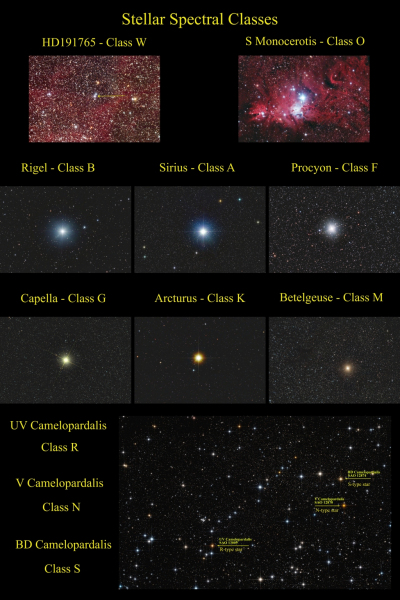

I just put this montage together of stellar spectral classes with some real examples.
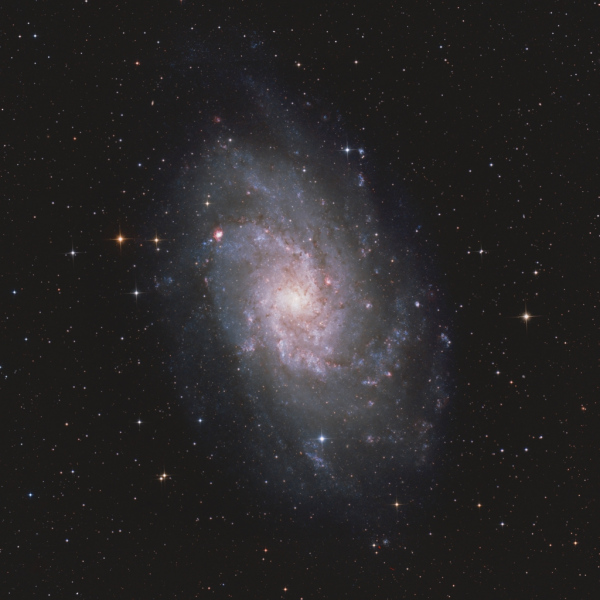
Absolutely all the data I have on the Triangulum Galaxy.

Now there’s a LOT going on in this one! Central object is the Jellyfish nebula with bright star Propus. Top right we have TWO open clusters, the larger one is M35, and the smaller golden one to its right is NGC2158. Finally in the bottom right hand corner there is the Monkey Head nebula. Image captured using the Canon 200mm prime lenses with the M26C OSC CCDs. A total of 18 subs at 20-minutes per sub.

The whole of Canis Minor. Canis Minor only comprises 2 stars – Procyon (bright white star bottom left) and Gomeisa (blue star towards top right). This is a 2-frame mosaic using the Canon 200mm prime lenses and the M26C OSC CCDs. The image comprises 37 subs at 9-minutes per sub.

A 2-frame mosaic of the Arcturus region using the Canon 200mm prime lenses and the M26C OSC CCDs. This image comprises 40 subs at 5-minutes per sub. Note the Napoleon’s Hat asterism at the 5 o’clock position.

Lots of Taurus Molecular Cloud dust in this one taken using the 200mm lenses and the ASI 2600MC Pro CMOS cameras on the MiniWASP array. This image comprises 26 x 15-minute subs and could do with at least the same amount of data again.

Here is a larger field of view of the Flaming Star nebula region taken on the 200mm lenses, without stars.
