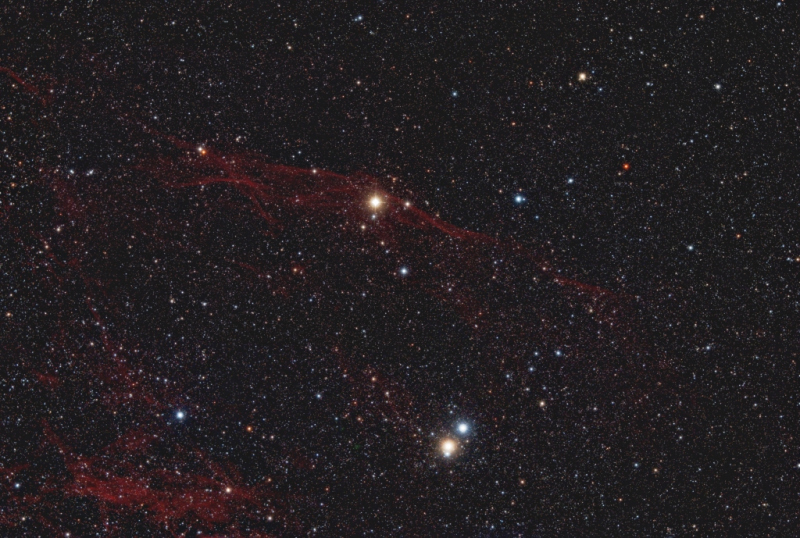
Delta Persei a Very Blue Star

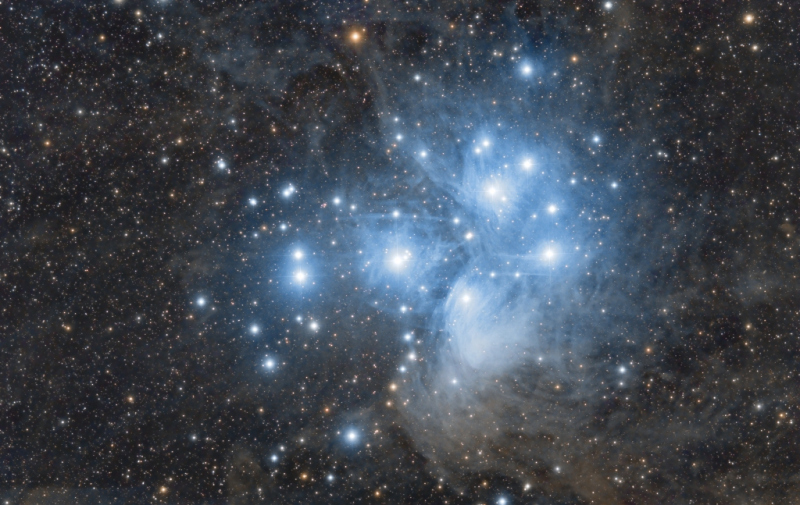
39-Delta Persei (SAO39053) is a VERY blue star as you can see. Spectral type B5III SB. This is 72 x 450-second subs (9 hours) on the Sky90 array using the M26C OSC CCDs.

Posted in mini-WASP Array, Sky 90 and SXVF-M26C | Leave a comment

All My Data on M100

This is all the data I have from the HSIII and 814C plus the Sky90s and M26Cs. This will be in excess of 8-hours of data.

Posted in Hyperstar and 814C, Sky 90 and SXVF-M26C | Leave a comment

Filters on the Hyperstar 4 – L-Extreme

As mentioned earlier, I did try the Optolong L-Extreme filter out on the Hyperstar 4 (on the Gamma Cass nebula) and the result was – no improvement as far as I could see. So as expected, these filters are not suitable at f#2 (no real surprise there) and for an OSC camera you really need to stick with just a UV/IR cut filter for the best results.

Posted in Hyperstar 4 and ASI2600MC-Pro | Leave a comment

A Halloween Witch’s Broom

All the data I have all put together to give this image of the Witch’s Broom nebula.

Posted in Hyperstar and SXV-H9C, Hyperstar and SXVF-M25C, mini-WASP Array, Sky 90 and SXVF-M26C, Veil Nebula | Leave a comment

Veil Nebula – All the Data I Have

This image of the Veil nebula in Cygnus incorporates all the data I have on the object. So this image includes Hyperstar III on the C11 data, Sky90 (2-frame mosaic including narrowband) data, and the Canon 200mm lenses with the Optolong-Pro filter data. In total this will be in excess of 40-hours exposure time. If I can get it, I will add more Canon 200mm lens data as and when.

Posted in 200mm lens and ASI 2600MC-Pro camera, Canon 200mm prime lens, Deep Space Objects, Hyperstar and SXVF-M25C, Hyperstar III and SXVF-M26C, mini-WASP Array, Sky 90 and SXVF-M25C, Sky 90 and SXVF-M26C, Veil Nebula | Leave a comment

Today’s EPOD

Got today’s EPOD – https://epod.usra.edu/ – with the recent Sadr and the Butterfly Nebula – taken with the Canon 200mm prime lenses and the ZWO ASI 2600 MC-Pro CMOS cameras. Thank you Jim for continuing to publish my work.

Posted in EPOD | Leave a comment

Filters on the Hyperstar 4

My usual filter on the Hyperstar 4, on a C11, with an ASI 2600MC Pro CMOS camera, is a simple UV/IR cut filter. And this does the job admirably. But in my Bortle 4.5 zone I would like to filter out some of the background rubbish and get even more performance out of the Hyperstar.

To this end, I have tried an Optolong L-Enhance filter which filters in the H-alpha and OIII and filters out the rest. Doesn’t seem to help the Hyperstar much as far as I can see, which just means the filter is not good at f#2. Not too surprising really, and pretty much as expected. However, I switched it over to the Canon 200mm prime lenses where it would provide an f#4.2 aperture – and the results are superb. Win some lose some.

Just seen that Starizona also sent me an Optolong L-Extreme filter as well. As I haven’t tried this out on the Hyperstar yet, I just fitted it this morning. I will do a test run on an object where I already have plenty of UV/IR cut filter data to compare it with (probably the Pelican nebula) and I will get back to you with the results. I am expecting that, once again, the results are inferior to a plain UV/IR cut filter, but you never know.

I used the Optolong L-Extreme filter to image the Gamma Cassiopei nebulosity with 15-minute subs! Now 15-minute subs with the Hyperstar are as you know, nothing to be sniffed at. And the result? Very disappointing unfortunately (for 15-minute subs).

So it is as expected, I don’t have any narrowband filters to hand that will help me reduce my local light pollution that work well at f#2. Any filtering will therefore be carried out on the 200mm lenses or the Sky90 array only.

Posted in Hyperstar 4 and ASI2600MC-Pro | Leave a comment

Carbon Star – T Cancri

A reprocess.

Posted in mini-WASP Array, Sky 90 and SXVF-M26C | Leave a comment

M31 – The Andromeda galaxy

A reprocess.

Posted in mini-WASP Array, Sky 90 and SXVF-M26C | Leave a comment

The Veil nebula in Cygnus

This is a composite image comprising 8-hours of 20-minute subs taken last night on the Canon 200mm prime lenses, together with a 32-hour 2-framer taken on a single Sky90 including Ha and OIII narrowband data. It still needs a LOT more 200mm lens data.

Posted in 200mm lens and ASI 2600MC-Pro camera, mini-WASP Array, Sky 90 and SXVF-M26C, Uncategorized, Veil Nebula | Leave a comment