More M31 Andromeda Galaxy Pictures

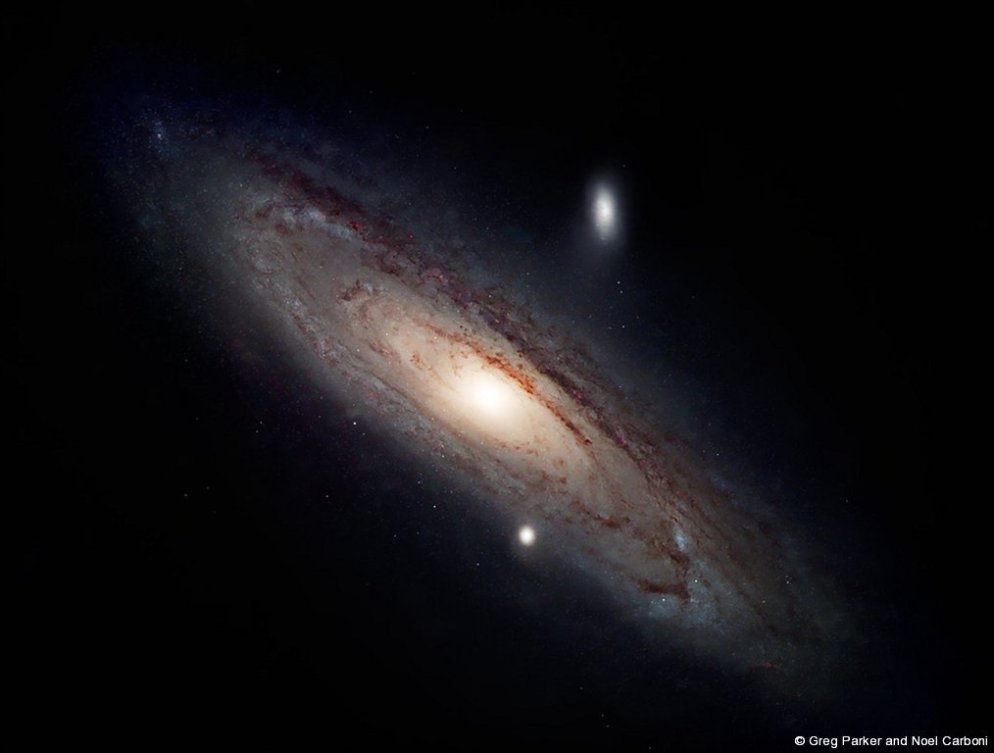
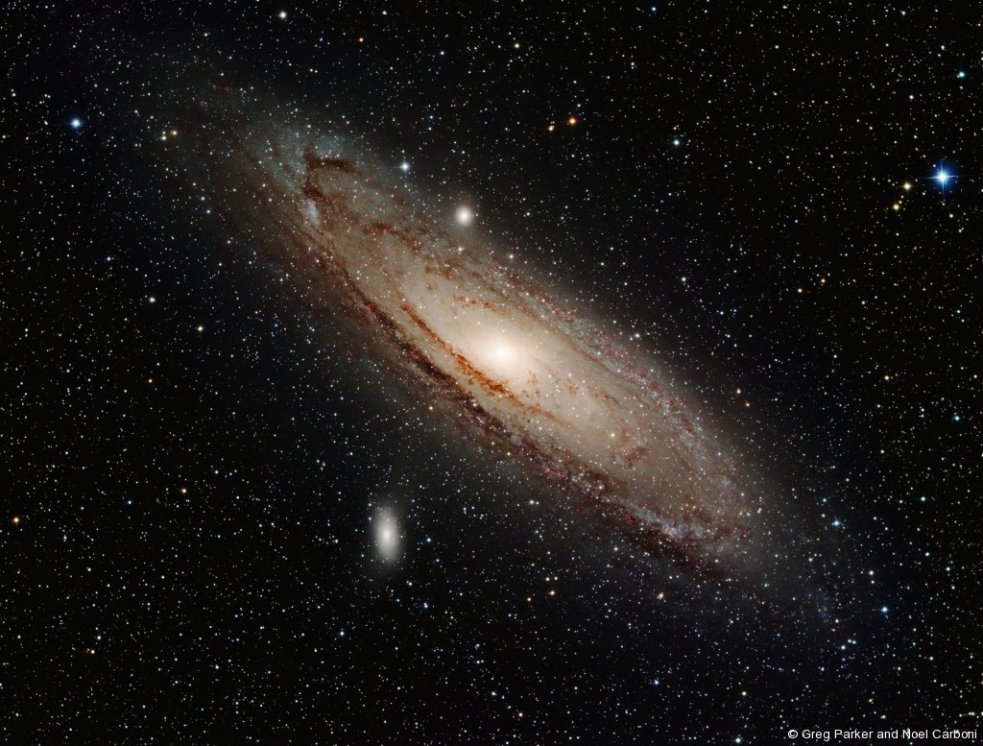
These are not new pictures, but the first two somehow escaped being added to the gallery! 🙂

The first of the escaped images is a side-by-side comparison of the Andromeda Galaxy with and without the Milky Way stars.  The second is a single image of the Andromeda Galaxy without the Milky Way stars. And the final image is the Andromeda Galaxy with the Stars – I think it is personal choice as to which way you like it.

All images are yet more testament to Noel’s skill at manipulating the raw data.

Posted in Sky 90 and SXVF-M25C | Tagged , | Comments Off on More M31 Andromeda Galaxy Pictures

How does a mirror work?

Attempting to explain the operation of the simplest optical device known to man, was the practical demonstration in my Inaugural Lecture at the University of Southampton, which took place on May 18th 2005. 

The “Eureka” moment as the mirror’s ability to laterally invert text was seen to be illusory caused quite a stir in the audience and was a talking point for colleagues for weeks afterwards. 

I chose this particular experiment as amongst other things, batteries and power were not necessary.  I had seen from my colleagues’ previous Inaugural Lectures that anything that can go wrong will go wrong, especially if electrical power is involved.

Continue reading

Posted in Articles | 7 Comments

Observing Handbook and Catalogue of Deep-Sky Objects (Luginbuhl & Skiff)

Observing Handbook and Catalogue of Deep-Sky Objects This was one of the very first “serious” astronomy books I bought when I first got the Celestron Nexstar 11 GPS.  Initially, as I only used the Nexstar  for observing, the title of this book seemed relevant to my needs – yes I bought the book solely on the title!

When I received the book, I’ll be honest, I was very disappointed.  No colour pictures and the few black and white diagrams did not impress me, the book sat unused on my shelf for many months.

Fast-forward to when I started imaging seriously! Continue reading

Posted in Recommended Reading | Leave a comment

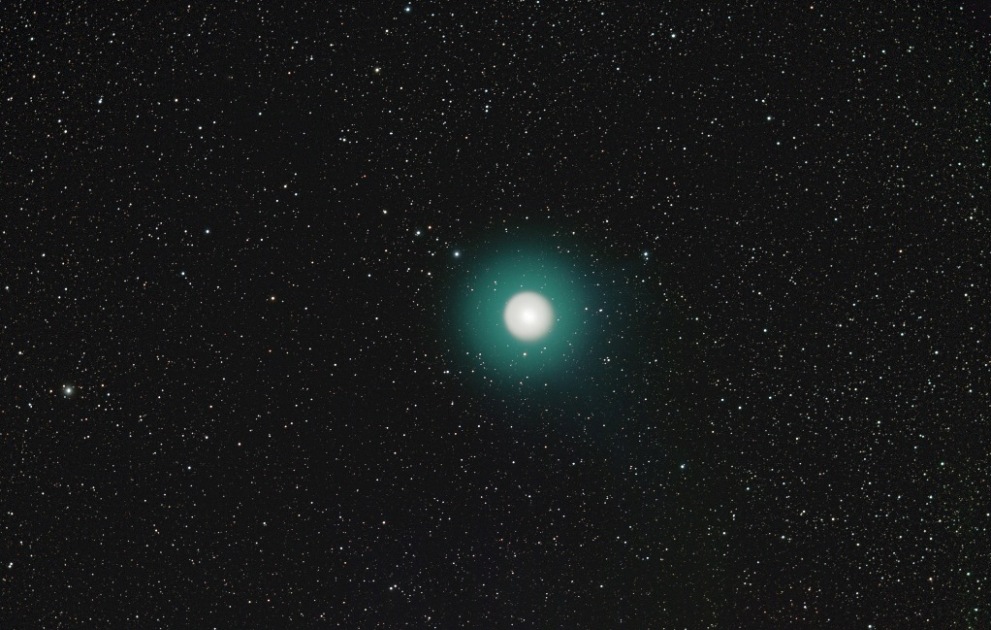
Comet Holmes Image

So hot off the press this one’s burning 🙂

The data was captured on the 30th October 2007 and Noel managed to squeeze in the processing between a pile of other work he has at the moment, and produced this image.  Awesome!

Comet Holmes is a regular visitor with periodicity 6.9 years, but on this return it underwent a massive increase in brightness that took it from a completely invisible (to the naked eye) magnitude 17, to something approaching magnitude 3 which is the brightness of the nearby stars in Perseus.

The Sky 90 at f#4.5 with the SXVF-M25C one-shot colour camera was used to capture 130 subs at 1-minute per sub.  But the data was stacked in two different ways! 

Because the comet moves at a slightly different rate to the stars, one data set was stacked with the comet as the reference point (giving a stationary comet and trailing stars) and the other data set was stacked with reference to the stars (giving stationary stars and a blurred comet). 

The two data sets were then combined to give the stationary comet sitting in a stationary star field.

Not much of a tail apparent, but a beautiful and rare object to capture all the same.
Posted in Sky 90 and SXVF-M25C | Tagged , | Comments Off on Comet Holmes Image

IOM November 2007: M45 The Pleiades

Once again, I am about a month early with this object according to Walter Scott Houston’s “Deep-Sky Wonders”, but this is to make sure we get a nice long imaging time on this cluster in an evening.

Everyone knows the question mark shaped open cluster in the sky that is the Pleiades in the constellation Taurus.  It is perhaps the constellation with the largest number of associated names as well including Subaru, Freyja’s hens, Matariki, the seven sisters, Tzab-ek, Krittika, At-thuraiya, kilimia, and probably many others.  This asterism is one of the closest open clusters to Earth lying at a distance of approximately 135 parsecs or 440 light years.  The closest open cluster to the Earth is the Hyades lying some 46.3 parsecs away.

Continue reading

Posted in IOM, Sky 90 and SXVF-M25C | Tagged , | 2 Comments

Book Signing in November

There will be a book signing for the Springer publication “Making Beautiful Deep-Sky Images” by Greg Parker in Waterstones bookshop on the University of Southampton campus [Highfield Road] in November 2007. 

Keep watching this page for the time and date 🙂

Posted in News | 2 Comments

Do we live in a Matrix Universe?

The film “The Matrix” strikes a deep resonance with many people, so deep in fact that even respected scientists’ have asked the question, “Do we live in a Matrix Universe?” 

For those of you that haven’t seen the film, the Matrix is a computer generated reality, and humans go about their everyday lives without realising they are actually living in a computer generated world.  So compelling is this idea to some that this concept of a computer generated world has been given serious consideration. Continue reading

Posted in Articles | Leave a comment

A Surprise Package

The time is 1.00 p.m. on Monday 15th October.  A small package arrives, too small to be the huge coffee-table book (Cosmos by Giles Sparrow) I am expecting. 

What can it be? 

Opening up the cardboard sleeve out slides a small paperback and a couple of extra covers – wooohooo – it’s my Springer “How to” book “Making Beautiful Deep-Sky Images”.  The first copy to arrive in the U.K. delivered straight from the Publishers in New York!

They’ve done a really nice job, the paper quality is excellent and the pictures have come out far better than I was expecting – thank you Springer! 

Should be available through all major booksellers in the next 3-4 weeks, keep an eye out for it, or pre-order on Amazon now.

Posted in News | Leave a comment

EPOD: Reflection Nebulosity within the Emission Nebula in Cygnus

We didn’t even know about this!  Earth Science Picture of the Day (EPOD) have chosen our image of the reflection nebulosity within the emission nebula in Cygnus.  Here is what EPOD have to say:

The constellation of Cygnus the Swan, also referred to as the Northern Cross, is now nearly overhead for viewers in the Northern Hemisphere around 8:00 p.m. The stars composing Cygnus reside along the spine of our galaxy — the Milky Way. Surrounding the central star in Cygnus, Sadr (upper left center), is the massive emission nebula IC1318 (in red), also called the Gamma Cygni nebulosity. A sea of just the color red can be boring to the eye, but here notable blue gems, including the reflection nebula NGC6914, add substantially to the beauty of this image

This is a Sky 90 image taken using the old SXV-H9C camera.  This image represents approximately 4 hours of RGB data using 3 minute subs and 4 hours of H-alpha using 6 minute subs.  Just one tiny mistake in the description – Sadr isn’t in the image 🙂

Posted in EPOD, Sky 90 and SXV-H9C | Tagged , , | Comments Off on EPOD: Reflection Nebulosity within the Emission Nebula in Cygnus

What exactly is a Light Year?

At the recent Starscape Exhibitions a common question was “how far away are these deep-sky objects?”.  I gave a rough answer in terms of Light Years, and the questioner would walk away satisfied, but it was clear that they really didn’t have a clue about the immensity of distance implied by the term Light Year – so here’s a very short piece just to try and put things into context.

Before going into the numbers, I would like to remind you of Arthur C Clarke’s “First Law” as I will be touching on this in what follows. Clarke says,

“When a distinguished but elderly scientist says that something is possible, (s)he is almost certainly right.  When (s)he says it is impossible, (s)he is very probably wrong.”

And with that, onto the explanation…
Continue reading

Posted in Articles, Starscape II | Tagged , | Leave a comment